The Air Force Wants a $500K Missile. None Exist Yet.
The Air Force wants 3,500 supersonic counter-air interceptors at $500K each. WeaponSpecs' own database shows no fielded system occupies that price and capability tier.
Picture the planner responsible for defending a forward air base. The threat board in front of them spans a $2,000 first-person-view drone to a cruise missile that costs more than a house. Their inventory spans a shoulder-fired missile one Airman can carry and a battery interceptor that costs as much as a fighter jet’s ejection seat. Between those two points sits nothing. That gap is not hypothetical anymore. It is the reason the U.S. Air Force just went to industry with a number that, according to WeaponSpecs’ own spec database, does not currently buy anything in this capability class.
On July 1, 2026, the Air Force Life Cycle Management Center’s Armament Directorate issued a solicitation under its Counter Air Missile Program (CAMP) for a Ground Launched Counter Air Enterprise Test Vehicle, GLCA ETV for short: a supersonic, ground-launched counter-air missile (Army Recognition). The ask is 1,000 to 3,500 units, an open and modular digital-engineering architecture so the design can be produced fast and upgraded through its service life, and a unit cost target of $500,000 or lower (Defense Daily).
That is the entire public spec sheet. No range figure, no altitude envelope, no speed beyond “supersonic.” For a program asking industry to hit a specific price point, that silence on performance is worth flagging, not glossing over. A buyer who states a hard cost ceiling before disclosing what the missile has to do is either extremely confident in its requirements or leaving room to move the goalposts later. The AIAA’s coverage frames this as a rapid-prototyping effort (AIAA), consistent with an Air Force that wants speed to a testable article more than a locked-down spec on day one.
A related but separate effort covers the drone end of the threat
A companion request for information, issued July 17, 2026 with industry responses due August 7, asked for a ground-based launcher able to defend Air Force bases against threats spanning Group 1 drones under 21 pounds up to Group 5 drones over 1,320 pounds, roughly the size of an MQ-9 Reaper, plus cruise missiles (Air & Space Forces Magazine). That RFI is organizationally distinct from CAMP-GLCA: it covers the cheap-drone end of the threat spectrum, where CAMP-GLCA is aimed at a supersonic counter-air interceptor. Worth knowing both exist, worth not treating them as one program.
Why base defense jumped the queue
The strategic case reporting attaches to this push is the Iran war, referred to as Operation Epic Fury in some outlets. Iranian strikes destroyed a U.S. E-3 Sentry AWACS and damaged multiple KC-135 tankers and air-defense radars at Saudi airbases (Military Times). Losing an AWACS on the ground is a different kind of loss than losing one in combat: a billion-dollar sensor platform destroyed while parked, because nothing between a rifle and a battery could stop what came for it.
The Intelligence Community’s 2026 Annual Threat Assessment adds a longer-horizon justification: it projects adversary missile inventories capable of threatening the U.S. will grow from more than 3,000 today to over 16,000 by 2035. That is an IC projection, not a delivered inventory count, and a decade-out projection carries real uncertainty, but it is the number Air Force planning is reportedly building against. Air Force Secretary Troy E. Meink said on May 20, 2026 that base defense had become “an increasingly high priority” for the service, a statement that lines up with two solicitations landing seven weeks apart aimed at exactly this gap.
The $500K target sits in a price tier that is currently empty
Here is where WeaponSpecs’ own database earns its keep. We pulled per-round unit cost and published engagement range for six ground- or ship-launched anti-air interceptors, including CAMP-GLCA’s stated target, across our catalog of 1,213 systems. The pattern is stark.
*CAMP-GLCA has no missile in production; $500K is the Air Force's stated cost ceiling for a program still at the request-for-proposal stage, not a delivered price. SM-3 Block IIA ($28M) is omitted from the chart for scale reasons: it's a different mission class (exo-atmospheric intercept) at roughly 56 times the CAMP-GLCA target and would compress every other bar to near-invisibility; it appears in the table above instead.
Below $500K, the only genuinely cheap options in our database are short-range point-defense weapons that cannot do what “counter-air base defense” implies. The Stinger is a man-portable, roughly 5-kilometer infrared missile, one Airman, one launch tube, not a ground battery interceptor covering an airfield perimeter. The RIM-116 RAM is a ship-mounted, 9-kilometer last-ditch point-defense missile that has never been adapted for a land base. Neither is a counter-air system in the sense the solicitation describes.
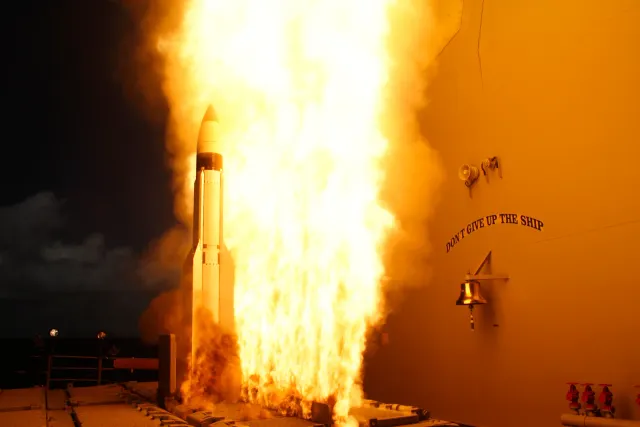
Above $500K, everything with real range and altitude costs multiples more. PAC-3 MSE runs roughly $3.87 million per round, a figure we detailed in our own Patriot stockpile rebuild analysis. SM-6 is $4.3 million. SM-3 Block IIA, a different mission class entirely, exo-atmospheric intercept rather than atmospheric counter-air, runs $28 million. There is no fielded, ground-launched, genuinely base-defense-capable interceptor anywhere near $500,000 in our database.
“We don’t have enough precision-guided weapons, and we certainly don’t have enough low-cost munitions, so we’re on the wrong side of the cost-exchange ratio,” said Mark Gunzinger, a retired Air Force colonel and Director of Future Concepts and Capability Assessments at AFA’s Mitchell Institute for Aerospace Studies (Air & Space Forces Magazine, Nov. 17, 2025).
That is the actual shape of the problem. The Air Force is not shopping for a discount on something that already exists. It is asking industry to build a price and capability tier that does not exist at all yet. It is the kind of gap WeaponSpecs usually flags when a Russian or Chinese state figure claims a capability with no fielded system behind it. Here the same skepticism lands on a U.S. Air Force ask, and it holds up the same way: a stated number with nothing built to it yet is a target, not a fact.
| System | Role | Per-round cost | Published range | Status |
|---|---|---|---|---|
| FIM-92 Stinger | Man-portable point defense (MANPADS) | $400K | 4.8 km | Fielded |
| CAMP-GLCA (target) | Ground-launched supersonic counter-air | $500K (Air Force’s stated ceiling, no missile built yet) | Not publicly disclosed | RFP stage, no award yet |
| RIM-116 RAM | Ship-mounted point defense | $900K | 9 km | Fielded |
| PAC-3 MSE | Ground-based area/ballistic defense | $3.87M (FY2026 flyaway unit cost, see WeaponSpecs’ own Patriot stockpile rebuild analysis) | ~60 km (battery engagement range) | Fielded |
| SM-6 | Ship-based extended-range air/missile defense | $4.3M | 240 km | Fielded |
| SM-3 Block IIA | Ship-based exo-atmospheric intercept | $28M | 2,500 km | Fielded |
The order size is its own open question
The 1,000-to-3,500-unit range in the solicitation is a 3.5x spread with no stated reasoning disclosed anywhere in reporting reviewed for this piece. That is a wide enough band to cover very different programs, a limited base-defense buy versus something closer to a standing magazine depth across multiple installations, and nothing public says which one the Air Force is actually planning toward. An industry day has already happened, and an ETV award is expected, but as of this writing no contract has been placed. This is a solicitation-stage story. There is no missile yet, no locked price, no confirmed unit count.
What to watch next
Three things will tell you whether CAMP-GLCA is a real program or a stated ambition still looking for a contractor who can hit it. First, the ETV award itself: who wins, and whether the contract value implies anything close to $500,000 per round at the low or high end of that 1,000-to-3,500 range. Second, whether the Air Force ever publishes a range or altitude figure for GLCA, because a supersonic missile with an undisclosed engagement envelope is not yet comparable to anything in this table, including the systems it’s meant to sit between. Third, whether $500,000 survives contact with a real design review. Every other system in this database that does real counter-air work costs at minimum 7.7 times that target. A buyer, a taxpayer, or a bidding contractor should treat that gap as the actual risk in this program, not a rounding error the winning design will quietly absorb.
Sources
- U.S. Air Force Seeks New Ground-Launched Supersonic Missile as China and Russia Expand Air Threats
- Air Force Wants New Ground-Based Launcher for Air Base Defense
- Air Force to Evaluate New Industry Offerings for Low-Cost Missiles
- US Air Force seeking air defense missile system to protect air bases
- U.S. Air Force Seeks Rapid Prototype for Supersonic Counter-Air Missile
- USAF Solicits Rapid Prototyping Of Supersonic, Ground Launched Counter Air Missile
Systems in this comparison
Every system covered above, with its photo and, where available, a video. Tap a card to open the full spec sheet.
Compare these side by side →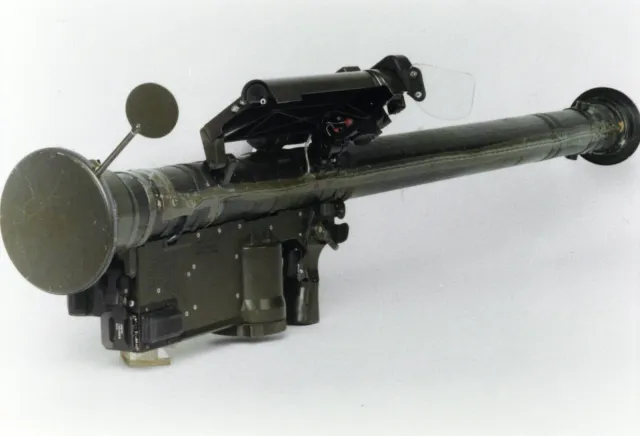
Missile
FIM-92 Stinger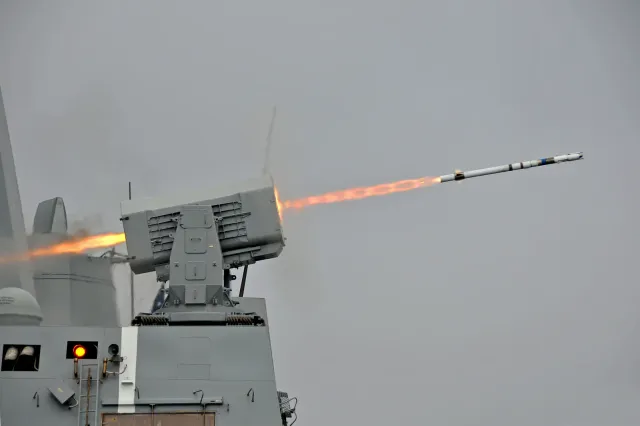
Missile
RIM-116 RAM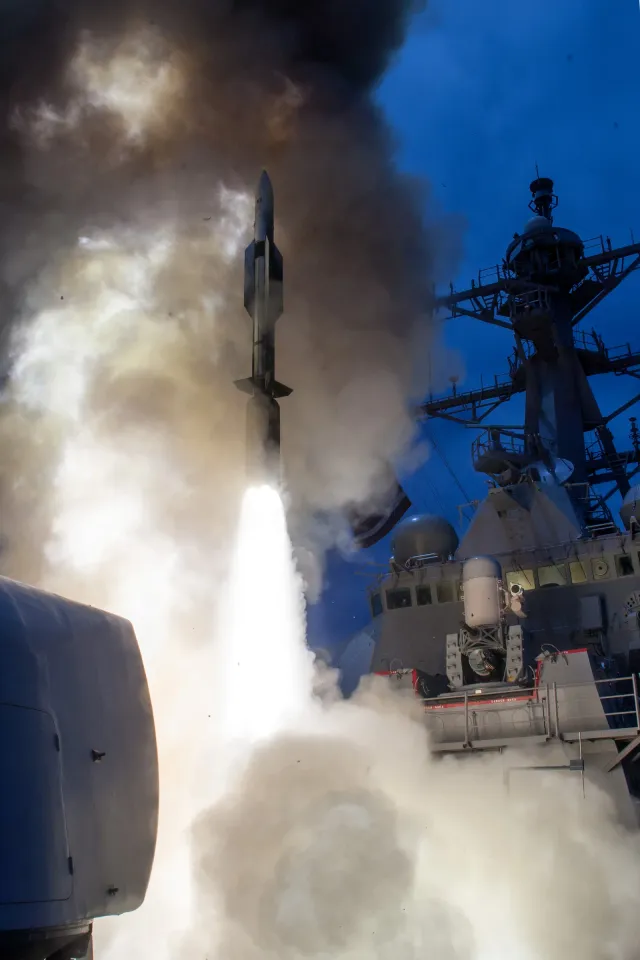
Missile
SM-3 Block IIA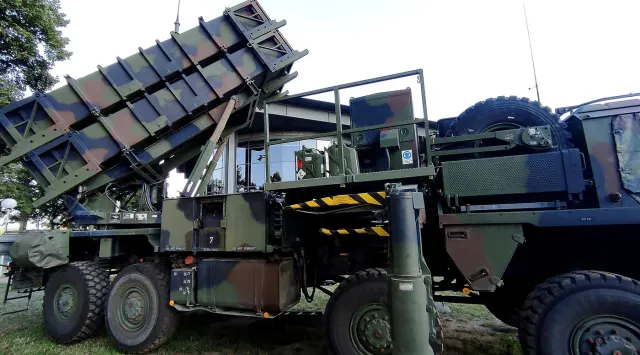
Air defense system
Patriot PAC-3Related reading


