South Korea Clears $125M Buy of 103 AIM-9X Sidewinders
The State Department cleared 103 AIM-9X Block II missiles for Seoul on Aug. 21, a batch sized almost exactly to one mass drone-and-cruise-missile raid.

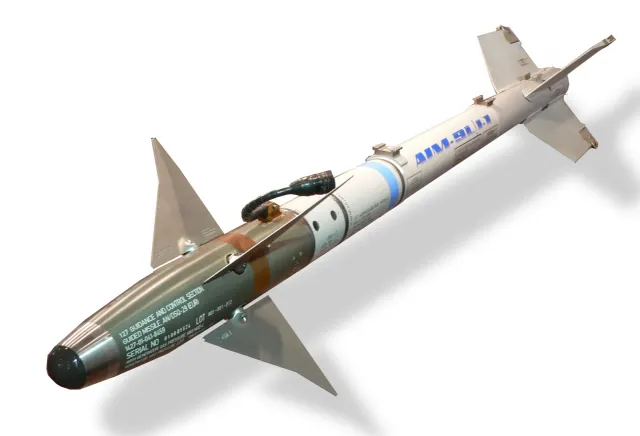
U.S. military photo, DVIDS, public domain
The U.S. State Department has cleared a possible Foreign Military Sale to South Korea of 103 AIM-9X Sidewinder Block II missiles and 10 companion guidance units, a $125 million package the Defense Security Cooperation Agency notified to Congress on August 21, 2026, as Transmittal 26-78. The number is not incidental: South Korean trade press has previously described a mass aerial attack as capable of burning through 100 AIM-9X Block II rounds within hours, which makes this batch read less like routine restocking and more like Seoul quietly sizing its dogfight-missile reserve to survive one large-scale raid.
The notification covers 103 AIM-9X Block II tactical missiles plus 10 AIM-9X Block II Tactical Guidance Units, along with non-lethal items including an active optical target detector, training, weapon system support, spares, and U.S. government and contractor logistics support. The principal contractor is RTX Corporation, based in Arlington, Virginia, and no offset agreement has been arranged at this time. South Korea already operates AIM-9X on three of its frontline fighter types: the F-15K Slam Eagle, the KF-16 Fighting Falcon, and the F-35A Lightning II.
In its official justification, the State Department described the sale as “improving the security of a major ally that is an important force for political stability and economic progress in the Indo-Pacific region,” language meant to support Seoul in “expanding its air defense capability, deterring aggression in the region, and ensuring interoperability with U.S. Forces.” The notification carries the standard boilerplate that the sale “will not alter the basic military balance in the region,” a clause attached to nearly every DSCA release regardless of the buyer or system involved.
This is South Korea’s second RTX air-to-air missile notification in about ten weeks. On June 11, 2026, the State Department cleared a separate $292 million sale of 70 AIM-120C-8 AMRAAM missiles and two guidance sections, also built by RTX. Read together, the two notifications show Seoul restocking both ends of its air-to-air inventory within the same quarter: AMRAAM for beyond-visual-range engagements, and now AIM-9X for the close-in, infrared-guided shots that come into play once an intercept turns into a dogfight or a saturation attack presses inside visual range.

The timing lines up with a run of North Korean moves that South Korean and U.S. planners have been tracking closely. North Korea has said it ordered ballistic and cruise missile production expanded to 2.5 times current levels within five years, an order Kim Jong Un reportedly issued in June 2026. Pyongyang also unveiled an AI-guided tactical cruise missile in May 2026 and announced its deployment to frontline units, following a November 2024 order for full-scale mass production of suicide and loitering drones. None of those figures are independently verified outside North Korea’s own statements, but they describe a real shift toward cheaper, mass-produced strike weapons rather than a handful of exquisite systems, the kind of threat that shows up as a saturation raid rather than a single missile. U.S. and South Korean forces have responded in kind on the defensive side, holding their first joint counter-drone exercise this year aimed specifically at medium-sized unmanned aircraft.
That is the backdrop against which the 103-missile figure matters. Against a mass drone-and-cruise-missile attack, within-visual-range interceptors like AIM-9X are a finite, fast-draining resource, the same interceptor-depletion dynamic WeaponSpecs has tracked in Ukrainian and Gulf air-defense contexts now showing up in Korea’s own air-to-air math. A batch sized to roughly one raid’s worth of stock is best read as insurance against exactly that scenario, not as an incremental capability upgrade.
AIM-9X Sidewinder is a short-range, infrared-homing dogfight missile with a published range near 35 kilometers, a top speed around Mach 2.5, and thrust-vector control that lets it turn tighter than a purely aerodynamic missile, background detailed on WeaponSpecs’ AIM-9X system page. U.S. procurement data puts a bare unit cost near $600,000 per missile. This FMS package works out to roughly $1.21 million per missile once the total $125 million is divided across all 103 rounds, but that blended figure folds in guidance units, training, spares, and logistics support alongside the missiles themselves, not a clean per-round price, so the two numbers describe different things rather than contradicting each other.
What is confirmed here is the DSCA notification itself: a formal step under the Arms Export Control Act that starts a congressional review period before any government-to-government agreement can be finalized. What is not yet confirmed is a signed contract. DSCA notifications routinely proceed to a Letter of Offer and Acceptance without incident, but the $125 million figure, like the delivery schedule, remains an estimate until Seoul and Washington actually sign.
If this sale proceeds on the usual timeline, the more informative signal from Seoul will not be this notification but whatever comes next: whether South Korea keeps pace with a third RTX air-to-air order before the year is out, and whether its published rationale keeps leaning on North Korea’s drone and cruise-missile buildup as the reason. Two RTX missile notifications in ten weeks is already a faster cadence than South Korea’s air-to-air restocking has run in recent years, and that pace, more than any single dollar figure, is the clearest evidence of how seriously Seoul is treating the mass-attack scenario its own trade press has been describing.
Sources
- Korea – AIM-9X Sidewinder Block II Missiles — U.S. Department of State, Aug 21, 2026
- South Moves to Bolster Air-to-Air Missile Stockpile as North Threats Grow — Korea JoongAng Daily, Aug 22, 2026
- U.S. approves potential sale to S. Korea of AIM-9X air-to-air missiles — The Korea Herald, Aug 22, 2026
- U.S. Approves Sale of Advanced Air-to-Air Missiles to Korea — Seoul Economic Daily, Aug 22, 2026
- Republic of Korea – AIM-120C-8 Advanced Medium Range Air-to-Air Missiles — U.S. Department of State, Jun 11, 2026
Systems mentioned
Every system named in this story, with its photo and, where available, a video. Tap a card to open the full spec sheet.
Missile
AIM-9X SidewinderMore news


