Army Selects Hanwha K9 Wheeled Howitzer for M777 Replacement
Hanwha Defense USA wins a $100.3M Army contract, worth up to $262.9M, to build wheeled K9 howitzer prototypes to replace towed M777s by fall 2026.

Spc. Elijah Magana, 5th Mobile Public Affairs Detachment, U.S. Army, DVIDS, public domain. A Finnish Army K9 Moukari self-propelled howitzer, a variant of the K9 Thunder, fires during Dynamic Front 25 near Rovaniemi, Finland, Nov. 18, 2024.
The U.S. Army has selected Hanwha Defense USA to build wheeled K9 Mobile Howitzer prototypes under its new Mobile Tactical Cannon program, a first step toward replacing towed M777 155mm artillery in select formations. The initial award is $100.3 million for six prototypes, growing to as much as $262.9 million if the Army exercises an option for six more.
What the Army actually bought
The Mobile Tactical Cannon program is built around speed. Rather than run a lengthy requirements-and-development competition for an entirely new howitzer, the Army structured MTC as an Other Transaction Agreement, a procurement vehicle designed to move faster than a traditional contract by letting the service work with a manufacturer that already has a design in production. Hanwha’s answer is the K9 Mobile Howitzer, a wheeled adaptation of the tracked K9 Thunder, the South Korean-built 155mm/52-caliber self-propelled gun that has become the best-selling artillery system of its kind worldwide, in service with 11 export operators from Poland to Australia. Putting that gun on a wheeled chassis trades some of the tracked K9’s cross-country mobility for road speed, lower maintenance overhead, and a smaller logistics footprint, the same tradeoff that has driven several NATO armies toward wheeled self-propelled artillery over the past decade.
Six prototypes are funded now. The first is scheduled to ship from Hanwha’s integration facility in Opelika, Alabama in early fall 2026, with the remaining five following within a year, according to DefenseScoop’s reporting. Building the prototypes on U.S. soil matters for a foreign-designed system entering American service: it lets the Army point to domestic assembly and jobs even though the core gun design and much of the underlying engineering trace back to South Korea’s Hanwha Aerospace. If the Army likes what it sees, exercising the 12-unit option brings the contract to $262.9 million, and TWZ reports that a full program of record could eventually reach roughly 500 systems, a scale that would make MTC a meaningful slice of the Army’s future artillery fleet rather than a niche add-on.
Why the M777 needs replacing
The M777 has been the Army’s and Marine Corps’ standard towed 155mm howitzer since the mid-2000s, prized for being light enough to sling under a helicopter and move into positions a tracked gun cannot reach. That same lightness is also its limitation: a towed gun has to be hitched to a truck, unhooked, leveled, and readied to fire, a sequence that takes minutes a crew does not always have when facing modern counter-battery radar that can locate and target a firing position within seconds of the first round leaving the barrel. Self-propelled artillery like the K9MH answers that problem by carrying the gun on its own drivetrain, so a crew can fire and immediately displace to a new position without waiting for a tow vehicle, a “shoot and scoot” capability that has become increasingly important as both Russia and Ukraine have demonstrated how quickly artillery that stays put gets destroyed.
The Army’s other self-propelled option, the tracked M109A7 Paladin, already does this, but it is heavier, more expensive to maintain, and slower to deploy by road than a wheeled system. MTC is not framed as an outright M109A7 replacement, but Army officials have left open the possibility that a mature wheeled howitzer could eventually supplement or partially displace the tracked fleet as well, particularly for units that value strategic mobility over the added protection a tracked chassis offers. For now, the near-term target is narrower and more concrete: get a self-propelled option into the hands of units that currently only have the towed M777, at roughly the same $3 million-class unit cost as the tracked K9 Thunder it is derived from, well under the $6 million BAE’s tracked M109A7 costs per unit.

A foreign design beating the American primes at home
The competitive backdrop is what makes this contract notable beyond its dollar value. BAE Systems builds both the M777 that MTC is meant to eventually displace and the tracked M109A7 that anchors the Army’s current self-propelled fleet, giving BAE an incumbent’s advantage in almost any future artillery competition. Hanwha winning MTC instead marks the company’s first major U.S. Army contract and one of the more visible instances of a foreign-designed weapon system beating an entrenched American prime on its own turf. It follows a broader pattern of South Korean defense exporters, Hanwha chief among them, winning contracts across NATO and partner militaries by offering combat-tested hardware that is already rolling off a production line rather than a design that still needs years of development funding before the first unit is built.
“Battles are won through platforms and combat capability, but wars are won by industrial capacity,” said Mike Smith, chief operating officer of Hanwha Defense USA (DefenseScoop, Aug. 19, 2026).
That framing lines up with how the Army has described its own thinking on MTC: the service wanted a system it could field quickly against formations that need self-propelled artillery now, not a design that would take a decade to reach the same point Hanwha’s production line already occupies. Whether MTC eventually scales to the roughly 500-system program some reporting anticipates will depend on how the six initial prototypes perform once they reach U.S. Army test ranges, and on whether the domestic assembly arrangement in Alabama proves durable as political scrutiny of foreign-sourced defense hardware continues.
Sources
- Army chooses Korean-designed howitzer to be prototype for new mobile cannon — Stars and Stripes, Aug 19, 2026
- Hanwha captures Army contract for mobile tactical cannons — DefenseScoop, Aug 19, 2026
- Army picks Hanwha's wheeled K9 for self-propelled howitzer prototypes — Breaking Defense, Aug 19, 2026
- South Korea's Highly Mobile 155mm Artillery System Wins U.S. Army Howitzer Contract — TWZ, Aug 19, 2026
- Hanwha Secures First Major U.S. Army Contract — Army Technology, Aug 19, 2026
- Army Selects Hanwha for Mobile Cannons — National Defense Magazine, Aug 19, 2026
Systems mentioned
Every system named in this story, with its photo and, where available, a video. Tap a card to open the full spec sheet.
Compare these side by side →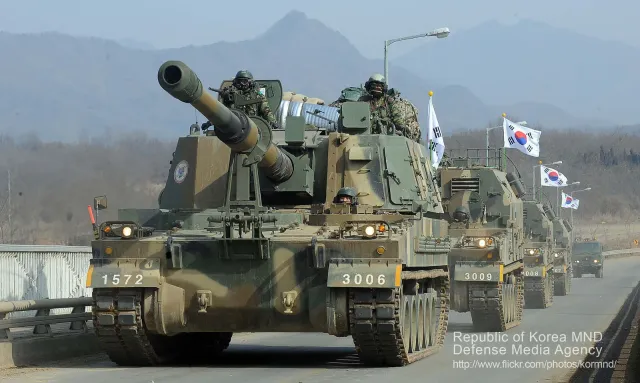
Artillery & MLRS
K9 Thunder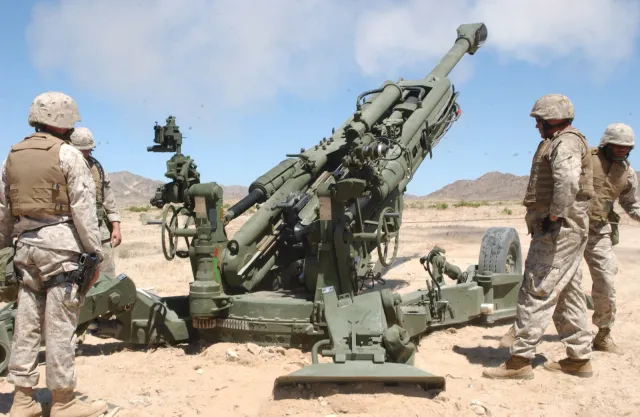
Artillery & MLRS
M777 Howitzer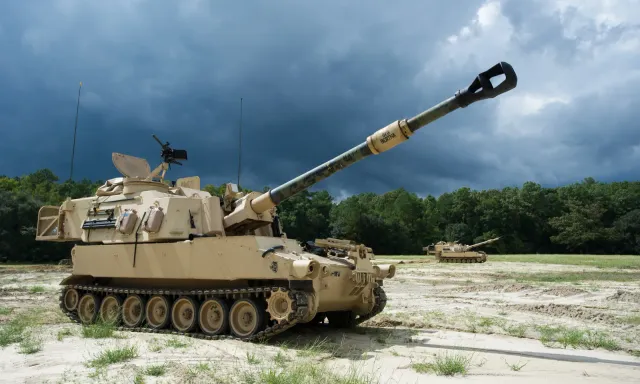
Artillery & MLRS
M109A7 PaladinFrequently asked questions
What is the Mobile Tactical Cannon program? +
MTC is a new U.S. Army effort to field a wheeled, self-propelled 155mm howitzer that replaces towed M777s in select formations, prioritizing fast fielding of an already-producing design over a ground-up development competition.
Why did the Army pick a South Korean design? +
The K9 Thunder family is combat-proven and already in production for 11 export customers, letting the Army adapt an in-production wheeled variant rather than fund a new howitzer from scratch.
How much is the contract actually worth? +
The initial award is $100.3 million for six prototypes under an Other Transaction Agreement. It can grow to $262.9 million if the Army exercises an option for six additional units. A full program of record could eventually reach roughly 500 systems.
When will soldiers actually see the new howitzer? +
Hanwha expects to ship the first prototype from its Opelika, Alabama integration facility in early fall 2026, with the remaining five following within a year of the award.
More news


