Navy Awards Raytheon $22.9B Deal to Triple Tomahawk Output
RTX's Raytheon will scale Tomahawk cruise missile production from roughly 60 to 1,000 rounds a year under a seven-year, $22.9 billion Navy contract.

U.S. Navy photo, DVIDS, public domain. USS Delbert D. Black (DDG-119) fires a Tomahawk Land Attack Missile during Operation Epic Fury, Feb. 28, 2026.
The U.S. Navy has awarded Raytheon a seven-year, $22.9 billion contract to scale Tomahawk cruise missile production from an estimated 60 missiles a year to a target of more than 1,000 a year, one of the largest single production ramp-ups in the missile’s four-decade history.
What the contract actually funds
The award, first reported by Breaking Defense, covers Tomahawk Block V and the anti-ship Maritime Strike Tomahawk variant. It is not a standalone deal negotiated from scratch; it funds production under a framework agreement Raytheon and the Pentagon signed in February 2026 that also covers AMRAAM air-to-air missiles, whose target rate is rising to 1,900 a year, and Standard Missile variants used in ship-based air and missile defense. That framework set the ceiling on what the government could eventually buy; this $22.9 billion award is the specific money that turns the Tomahawk portion of it into real production orders.
Raytheon says it already tripled its first-half 2026 Tomahawk deliveries compared with the same period in 2025, evidence the ramp was underway before this contract formally locked in the funding. The company is putting the money into expanded lines at its Tucson, Arizona missile plant and a recently enlarged Alabama missile-integration facility, the site of a separate $115 million expansion project. Both investments point to the same underlying constraint driving this entire announcement: building 1,000 cruise missiles a year is not primarily a design problem, it is a manufacturing-capacity and skilled-workforce problem, and closing that gap takes years of tooling and hiring even once the money is approved.
Going from roughly 60 missiles a year to a contracted 1,000 is more than a sixteenfold increase, a scale of ramp-up rarely attempted on a weapon this complex outside of wartime production surges.
Why the stockpile ran low in the first place
The Tomahawk Block V carries a roughly 450-kilogram warhead out to about 1,600 kilometers, guided by a combination of GPS, inertial navigation, and terrain-matching that lets it fly a pre-planned route at low altitude to strike a fixed target with minimal warning. That precision has made it the U.S. military’s default option for striking targets from ships and submarines without putting an aircraft or its crew over contested airspace, which is exactly why the stockpile depletes quickly whenever the U.S. conducts an extended strike campaign. Roughly 4,500 Tomahawks have been built across the missile’s history and it remains in service with three operators, but the per-unit cost, around $2 million, and the multi-year lead time to build a replacement mean the inventory does not refill itself the way a less complex munition might.
Pentagon officials have been explicit that recent strike operations are part of what emptied the shelves faster than the existing production line could replace. Michael Duffey, the Under Secretary of Defense for Acquisition and Sustainment, described the goal in terms that go beyond simple restocking.
“This Tomahawk award increases our ability to equip the Joint Force, ensuring our Warfighters never face a fair fight,” said Michael Duffey, Under Secretary of Defense for Acquisition and Sustainment (Washington Examiner, Aug. 2026).
Raytheon’s own president, Phil Jasper, framed the contract the same way from the industry side, tying it to a broader capacity buildout rather than a one-time order.
“We are making significant investments in our workforce, technology, supply chain and facilities to dramatically boost production capacity and meet surging demand,” said Phil Jasper, president of Raytheon (Breaking Defense, Aug. 17, 2026).
The bigger industrial-base story
This contract does not stand alone. It is one piece of a wider Pentagon push, sometimes described internally as building an “arsenal of freedom,” to rebuild munitions production capacity across the board after years in which peacetime-scale manufacturing left the U.S. unable to quickly replace what a sustained high-end fight would consume. The same February 2026 framework that funds this Tomahawk ramp also covers AMRAAM’s jump to 1,900 missiles a year and Standard Missile variants central to Navy ship defense, meaning Raytheon’s Tucson and Alabama expansions are being built to serve several missile lines at once rather than Tomahawk in isolation. Whether a sixteenfold production increase is achievable on the timeline the contract implies is an open industrial question. Missile manufacturing depends on specialized subcomponents, including solid rocket motors and precision guidance electronics, that multiple defense primes are competing for simultaneously, and a production target set on paper does not guarantee the supply chain underneath it can actually deliver at that rate by the contract’s seventh year.
Sources
- Raytheon gets massive $23B contract to boost Tomahawk production — Breaking Defense, Aug 17, 2026
- Pentagon announces $22.9 billion contract with Raytheon — Washington Examiner, Aug 17, 2026
- US awards Raytheon $22.9B Tomahawk deal — Fox News, Aug 17, 2026
Systems mentioned
Every system named in this story, with its photo and, where available, a video. Tap a card to open the full spec sheet.
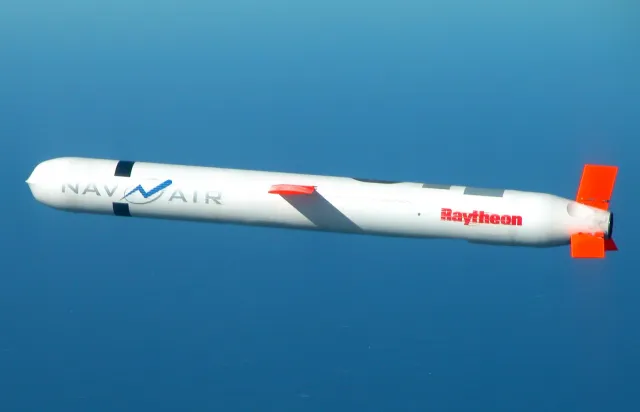
Missile
Tomahawk Block VFrequently asked questions
How big is the production increase, really? +
The contract targets output rising from an estimated 60 missiles a year today to a contracted 1,000 missiles a year, more than a sixteenfold increase over the life of the seven-year deal.
Why is the Navy scaling up Tomahawk production now? +
Pentagon officials cite stockpile depletion from recent strike operations and a broader industrial-base push, described by acquisition official Michael Duffey as building an 'arsenal of freedom,' to rebuild munitions capacity for a sustained high-end conflict.
Is this a brand-new contract or an extension of something else? +
It funds production under a framework agreement Raytheon and the Pentagon signed in February 2026 covering Tomahawk, AMRAAM, and Standard Missile variants. This $22.9 billion award is the money behind that framework, not a separate program.
Does this change the missile's design? +
No. This is a capacity investment in workforce, tooling, and supply chain for the existing Tomahawk Block V and Maritime Strike Tomahawk family, not a new missile variant.
More news


