Pentagon Locks In 7-Year Deals to Ramp Up SM-3 Interceptors
Boeing and RTX sign seven-year framework agreements to boost SM-3 Block IB/IIA hardware output as the Pentagon races to rebuild interceptor stocks.

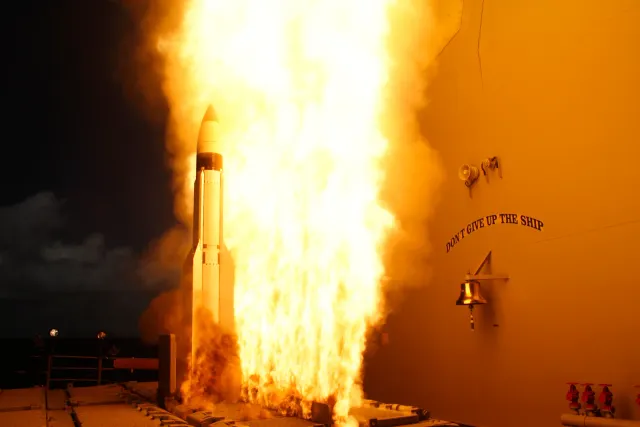
U.S. Navy photo (DVIDS), public domain
The Department of War signed two separate seven-year framework agreements on Aug. 14, one with Boeing and one with RTX’s Raytheon business, to expand production of hardware for the Standard Missile-3, the Navy’s ship-launched exo-atmospheric interceptor. Under its deal, Boeing will ramp up output of the avionics and ejector assemblies used in both the SM-3 Block IB and Block IIA variants, work that has never before carried a dedicated multiyear demand signal from the Pentagon.
A demand signal, not a check
Both agreements are framework agreements, a category distinct from a funded contract. Neither carries a disclosed dollar figure. Instead, they function as a formal, seven-year commitment of intent: Boeing and RTX can begin investing in tooling, staffing and long-lead materials against the promised volume before the government and Congress finish negotiating the multiyear procurement contract that would actually appropriate money against it. That distinction matters because the alternative, waiting for a signed and funded multiyear deal before any supplier makes a capital move, adds months or years to a production ramp that the Pentagon has decided it cannot afford to wait on. Under Secretary of War for Acquisition and Sustainment Michael Duffey framed the urgency directly:
“These agreements ensure our Warfighters get the munitions they need to win,” said Michael Duffey, Under Secretary of War for Acquisition and Sustainment (Navy Times, Aug. 14, 2026).
Boeing’s Bob Ciesla, vice president of the company’s Precision Engagement Systems unit, described the practical effect on the shop floor: the framework tells Boeing it is safe to start building before the paperwork catches up. “This gives us a clear demand signal to build and deliver SM-3 interceptors at the levels needed to counter threats,” Ciesla said.
The funded contract that came four days earlier
The Aug. 14 frameworks did not appear in isolation. Four days prior, on Aug. 10, RTX announced that the Missile Defense Agency had separately awarded it a $745 million contract, real, obligated money, for SM-3 Block IIA production and sustainment, split between facilities in Tucson, Arizona and Huntsville, Alabama. RTX is also self-funding a $115 million expansion of that Alabama integration site, which the company says will lift its integration and delivery capacity by more than 50%. WeaponSpecs covered that $745 million contract in detail when the Department of War’s daily contracts list first disclosed it. The Aug. 14 frameworks build directly on top of that funded baseline: where the Aug. 10 award pays for interceptors the government has already committed to buy, the new frameworks are the Pentagon telling both of SM-3’s key suppliers to plan for seven years of demand beyond that, funded contract or not.

Why the interceptor, not just the missile, is the bottleneck
SM-3 is the mid-course, exo-atmospheric layer of Aegis Ballistic Missile Defense, the system U.S. and Japanese warships use to shoot down medium- and intermediate-range ballistic missiles above the atmosphere before they reach terminal descent. It comes in two fielded variants with sharply different price tags: Block IB, the shorter-range, older round still in Navy service at roughly $10 to 15 million per missile, and Block IIA, the larger, faster, co-developed-with-Japan version that runs closer to $28 million per round according to 2025 Missile Defense Agency procurement data and is WeaponSpecs’ own tracked figure for the system. Boeing’s role in both variants is upstream of the missile most people picture: it does not build the rocket motor or the kill vehicle, it builds the avionics and ejector assemblies that other primes and the Navy depend on to get a finished round into a launch cell. A bottleneck at Boeing’s level constrains every downstream assembly line regardless of who is building the rest of the missile, which is exactly the kind of single point of failure a seven-year framework is designed to remove before it becomes a crisis rather than after.
Part of a broader industrial-base push
RTX signed an earlier, broader framework in February 2026 covering not just SM-3 but Tomahawk, AMRAAM and SM-6 production as well, and the department has publicly described the overall effort as putting “our entire defense industrial base on a wartime footing.” That framing is not rhetorical excess this year. Munitions strain from the ongoing Iran war has been a recurring theme across this desk’s coverage, from Patriot and THAAD component-supplier deals to PAC-3 seeker production ramp-ups, and the Aug. 14 SM-3 frameworks are the latest discrete, dated entry in that same pattern rather than a one-off. Raytheon’s Barbara Borgonovi, president of Naval Power, tied the specific interceptor to the broader alliance stakes: “SM-3 Block IIA is a cornerstone of regional defense, giving the U.S. and allied partners greater reach, accuracy and confidence against evolving threats,” Borgonovi said.
What happens next
The frameworks themselves do not obligate a dollar of new spending, and that is deliberate rather than a shortcoming. What they do is remove the lag between a future funded contract getting signed and a supplier actually being ready to deliver against it. Whether that gap closes as fast as the Pentagon wants depends on two things still outside its direct control: how quickly Congress grants the multiyear procurement authority both companies are counting on, and whether Boeing’s avionics and ejector-assembly ramp keeps pace with the RTX-side production increases already funded by the Aug. 10 contract and the Alabama facility expansion.
Sources
- RTX's Raytheon awarded $745 million contract for SM-3 IIA interceptors — RTX, Aug 10, 2026
- Pentagon inks SM-3 framework deals with RTX, Boeing on critical components — Breaking Defense, Aug 14, 2026
- Boeing to Increase SM-3 Hardware Production Under New Pentagon Agreements — Seapower Magazine, Aug 14, 2026
- Pentagon inks deals with Boeing, RTX to boost production of SM-3 components — Navy Times, Aug 14, 2026
Systems mentioned
Every system named in this story, with its photo and, where available, a video. Tap a card to open the full spec sheet.
Missile
SM-3 Block IIAFrequently asked questions
What is a framework agreement, and is this real money? +
It is a non-binding, multiyear demand-signal arrangement, not a funded contract. It lets Boeing invest in tooling and staff ahead of a formal deal while the Department of War and Congress finalize multiyear procurement authority. The follow-on multiyear contract is still being negotiated.
What is the difference between SM-3 Block IB and Block IIA? +
Block IIA is larger, faster (Mach 13.5 versus Block IB's lower top speed), and far more expensive at roughly $28 million a round versus $10 to 15 million for Block IB. It was co-developed with Japan, while Block IB is the earlier, shorter-range, cheaper variant still in Navy service.
Why is the Pentagon racing to expand missile-interceptor production right now? +
Ongoing combat operations against Iran and support to Ukraine's air defenses have drawn down U.S. interceptor stockpiles faster than peacetime production replaces them, prompting a string of 2026 framework deals across SM-3, Patriot/PAC-3, THAAD and Tomahawk lines.
Where is the SM-3 hardware built? +
RTX's SM-3 Block IIA integration work spans Tucson, Arizona and an expanded facility in Huntsville, Alabama. Boeing's new avionics and ejector-assembly work under the Aug. 14 framework is expected to draw on its existing Huntsville footprint as well.
More news


