Carrier Swap: George Washington Relieves Troubled Lincoln
USS George Washington is steaming to the Middle East to relieve USS Abraham Lincoln after a twice-extended, monthslong Iran-war deployment.

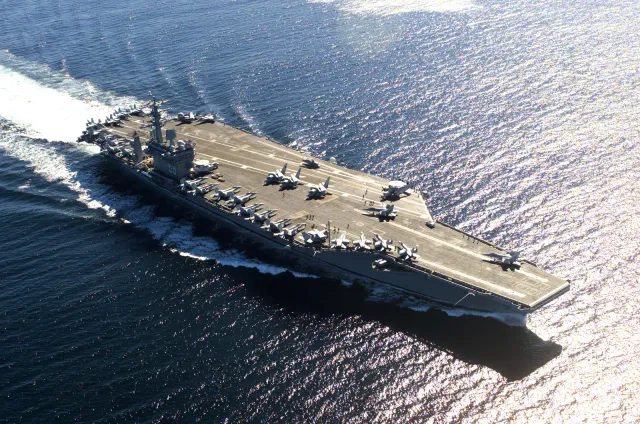
U.S. Navy photo (DVIDS), public domain
USS George Washington, the Navy’s only forward-deployed carrier, is steaming from the Pacific toward the Arabian Sea to relieve USS Abraham Lincoln, which has been deployed since November 2025, a nine-month, twice-extended stretch that has drawn public scrutiny over crew conditions aboard the ship.
A scheduled rotation, or a crew stretched to its limit
George Washington departed a scheduled port visit to Da Nang, Vietnam that concluded Aug. 5, and is now transiting toward the Arabian Sea. U.S. officials describe the move as a previously planned rotation, the kind of routine carrier handoff the Navy schedules well in advance regardless of any single deployment’s specifics. What makes this rotation different is the volume of public reporting that has built up around the ship it is relieving. Family members and lawmakers have described mold, plumbing failures, early-deployment supply and food shortages, and mental-health strain aboard Lincoln, including two documented overboard incidents, one aboard the escort destroyer USS Frank E. Petersen in April and one aboard Lincoln itself in August that remains under investigation.
Sen. Richard Blumenthal, D-Conn., has been the most direct public critic, calling the conditions “abhorrent” and pressing Navy leadership to change course: “Do everything possible to avoid additional hardship, not contribute to the hardship,” Blumenthal said (NPR, Aug. 14, 2026).
The Navy’s pushback
Defense Secretary Pete Hegseth disputed the framing directly, saying some of the reporting was “completely misrepresented” and that the department has kept every deployed crew supplied. Navy Secretary Hung Cao struck a similar note while also acknowledging real strain: “will return home soon as part of a planned rotation,” Cao said of Lincoln, adding that its crew “have been pushed to their limits, but they have never broken” (CBS News, Aug. 14, 2026). The Navy has denied any fleet-wide uptick in suicidal ideation or attempts, while acknowledging what it called a small number of mental health cases treated with no loss of life, and says it is sending additional counselors and social workers aboard. That leaves a genuine, unresolved gap between two accounts on the record at the same time: family members and a U.S. senator describing conditions serious enough to warrant a public rebuke, and the Navy’s own civilian and uniformed leadership insisting resources have been maintained even as it moves to relieve the ship. Nothing in the available reporting resolves that gap one way or the other, and this account does not attempt to either.

What nine months and two extensions actually costs
A carrier deployment is built around a roughly six-to-seven-month planning baseline; every extension past that stacks additional strain on a crew that has no more relief valve than the ship’s own scheduled maintenance and resupply windows allow. Lincoln’s deployment, extended twice against that baseline, means its roughly 5,000-person crew has spent the better part of a year at sea supporting sustained combat operations rather than a routine presence patrol, a workload that shows up less in any single dramatic incident than in the cumulative wear the Navy itself has now partly conceded, the counselor deployment and the acknowledged mental-health caseload being the clearest admissions on the record. That is the specific cost a nine-month, twice-extended deployment imposes, and it is also the specific reason the Navy has an incentive to move George Washington into place now rather than waiting for the next scheduled rotation window.
What Lincoln has been doing, and what changes
Lincoln’s deployment has supported the ongoing U.S.-Israeli military campaign against Iran, which President Trump announced as “major combat operations” on Feb. 28, 2026, and the U.S. naval blockade enforcement in the Strait of Hormuz that WeaponSpecs covered when it was reinstated in July after an earlier pause collapsed. George Washington will join USS George H.W. Bush, already operating in the Arabian Sea, giving the Navy two carriers in theater during the handoff window. The swap’s less obvious cost is on the other side of the globe: because George Washington is the Navy’s sole forward-deployed carrier, based in Yokosuka, Japan, its transit to the Middle East leaves the Pacific without a U.S. carrier presence for the duration, a trade the Navy is evidently judging worth making given the acute demands of the Iran campaign and Hormuz enforcement over any near-term Pacific contingency.
What to watch
Lincoln’s actual return date is still described only as “soon,” not fixed, and the ongoing investigation into the August overboard incident aboard the ship has not been resolved. Whether the Navy’s additional counselors and social workers meaningfully change conditions for whichever carrier crew is deployed next, and whether Congress or the Pentagon respond to Blumenthal’s public pressure with anything beyond statements, are both open questions this desk will continue tracking as part of its broader Iran-war coverage.
Sources
- New aircraft carrier heads toward Mideast after reports of issues on long-deployed USS Lincoln — NPR, Aug 14, 2026
- New aircraft carrier heads to Middle East amid concerns about USS Lincoln conditions — CBS News, Aug 14, 2026
- USS George Washington headed to Middle East to relieve USS Abraham Lincoln — Stars and Stripes, Aug 13, 2026
- USS Abraham Lincoln to Be Replaced Amid Growing Concerns for Troops — Newsweek, Aug 14, 2026
Systems mentioned
Every system named in this story, with its photo and, where available, a video. Tap a card to open the full spec sheet.
Warship
Nimitz-class Aircraft CarrierFrequently asked questions
How long has USS Abraham Lincoln been deployed? +
Since November 2025, reported as roughly nine months and twice extended by the time of the swap, one of the longest single carrier deployments of the current Iran conflict.
Is the crew-conditions story confirmed or disputed? +
Both. Families and Sen. Richard Blumenthal describe mold, plumbing failures and mental-health strain aboard Lincoln. The Navy and Defense Secretary Pete Hegseth say some reporting was misrepresented and that resources have been maintained, while acknowledging a small number of mental-health cases were treated.
Does this leave the U.S. without carrier coverage anywhere? +
Temporarily, in the Pacific. George Washington is the Navy's only forward-deployed carrier, based in Japan, so its transit to the Middle East leaves that theater without a U.S. carrier presence until it is relieved or another rotates in.
What is George Washington relieving Lincoln from doing? +
Supporting the ongoing U.S.-Israeli campaign against Iran and the reinstated U.S. naval blockade enforcement posture in the Strait of Hormuz. It will operate alongside USS George H.W. Bush, already in the Arabian Sea.
More news


