Qatari LNG Tanker Struck, Disabled in Strait of Hormuz
The GasLog Shanghai lost power after an unidentified projectile hit its engine room off Oman, UKMTO confirmed, as Brent crude jumped on the news.

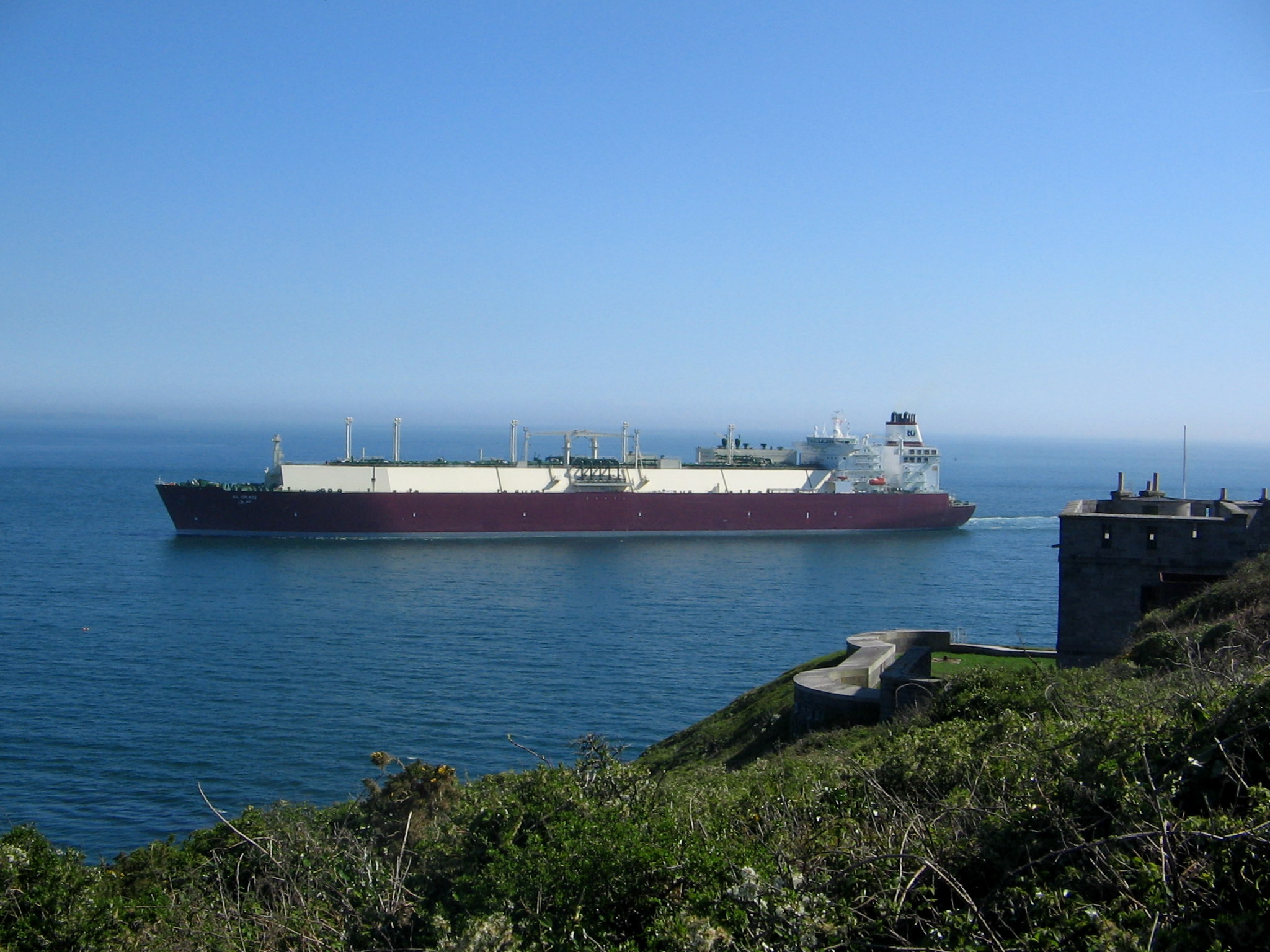
Photographer Zariquiegui, public domain, via Wikimedia Commons. Representative photo of the Q-Max-class LNG carrier Mozah, not the GasLog Shanghai.
The LNG carrier GasLog Shanghai, loaded with Qatari liquefied natural gas, was struck by an unidentified projectile while transiting the Strait of Hormuz off the Omani coast on August 1, disabling its engine room and leaving it unable to maneuver, UK Maritime Trade Operations and the ship’s operator confirmed. No crew injuries were reported, and a resulting fire was extinguished.
What happened to the ship
The GasLog Shanghai had loaded Qatari LNG around July 27 and stopped transmitting its AIS tracking signal on July 31, the day before UK Maritime Trade Operations confirmed the vessel had taken damage. UKMTO said the engine room was hit, leaving the ship without propulsion, and that a fire that broke out afterward was put out with no reported casualties or environmental impact. A GasLog company spokesperson confirmed the operator’s own account directly: the ship’s operator confirmed it was hit by an unknown projectile that caused a power outage, and that no crew members were injured and the resulting fire was extinguished. No individual name or title was attached to that statement in available reporting, so it is attributed here to a GasLog spokesperson rather than to a specific person.
What makes this incident worth tracking closely is its specificity. Much of the reporting on tensions in the Strait of Hormuz over the past year has dealt in generalities, warnings of disruption, elevated risk premiums, naval posturing. This is a named vessel, carrying a known cargo, confirmed damaged by an international maritime safety body and the ship’s own operator, which is a different and more concrete kind of evidence than a warning about future risk.
Why the strait, and why now
The Strait of Hormuz is the world’s most consequential energy chokepoint, and while its role in seaborne crude oil is the most cited statistic, roughly a fifth of global LNG shipments also pass through it, carrying Qatari gas in particular toward buyers in Asia and Europe. A strike disabling a single named LNG carrier there is a different order of event than a generic warning about the strait’s vulnerability, because it demonstrates the risk has already materialized against a real ship rather than remaining hypothetical.
The strike also did not happen in isolation. On July 31, the day before the GasLog Shanghai was confirmed hit, Iran claimed to have stopped or turned back several tankers transiting the strait, naming the VLCCs Spain B and Noble among them along with two unnamed vessels. Those Iranian claims are explicitly unconfirmed and are flagged as such by the outlet that reported them; they should be read as background on why tensions in the strait were already elevated in the days before this strike, not as an established fact connecting Iran to the GasLog Shanghai incident specifically. No party has claimed responsibility for the strike on the tanker itself in verified reporting, and this desk found no source directly attributing it to Iran.
This is also not the same event as an earlier, separate Qatari LNG tanker incident reported in the Strait of Hormuz on July 7, 2026. That was a distinct occurrence roughly a month earlier; treating the two as one continuous event would overstate how frequent this specific kind of strike has actually been, when the more accurate read is that it is a recurring target type rather than a single ongoing incident.
The market reaction
Oil markets moved within hours of the strike becoming public. Brent crude for October delivery rose 1.2% to $87.93 a barrel, and WTI rose 1.3% to $84.67 a barrel, the largest single-day gains for both benchmarks since March 2026. That kind of jump on a single tanker incident, rather than a broader supply disruption, reflects how much of the strait’s risk premium is about what could happen next rather than what has already happened: a single disabled ship does not meaningfully reduce global LNG or oil supply on its own, but it is read by traders as evidence that a wider disruption to shipping through the strait is more plausible than it was a week earlier.
Sources
- LNG tanker carrying Qatari cargo struck in Strait of Hormuz as Mideast conflict drives oil rally — Daily News Egypt, Aug 1, 2026
- Qatari LNG tanker struck by projectile in Strait of Hormuz, Bloomberg reports — Arab Times Online, Aug 1, 2026
- Hormuz tanker stops, Red Sea war cover, August 1, 2026 — The DeepDraft, Aug 1, 2026
- Update: LNG tanker incident in Strait of Hormuz — Insurance Journal, Jul 7, 2026
Frequently asked questions
What is the GasLog Shanghai and what happened to it? +
The GasLog Shanghai is an LNG tanker carrying Qatari gas that was struck by an unidentified projectile in the Strait of Hormuz on August 1, 2026, disabling its engine room. No injuries were reported, according to UK Maritime Trade Operations and the ship's operator.
Who is blamed for the strike? +
No party has claimed responsibility in verified reporting. Coverage places the incident in the context of wider Iran-linked disruption in the Strait of Hormuz, but does not attribute the strike directly to Iran, and that attribution should be treated as unconfirmed.
How much LNG moves through Hormuz? +
Roughly one-fifth of global LNG shipments transit the Strait of Hormuz, making it a chokepoint for gas markets in addition to its better-known role in oil flows.
Did markets react to the strike? +
Yes. Brent crude rose 1.2% to $87.93 a barrel and WTI rose 1.3% to $84.67 a barrel the same day, the largest one-day gains for both benchmarks since March 2026.
More news


