US, Iran escalate Strait of Hormuz standoff with 140+ strikes
US Central Command strikes over 140 Iranian military targets after a Gulf tanker attack; Iran's IRGC retaliates against five allied states overnight.
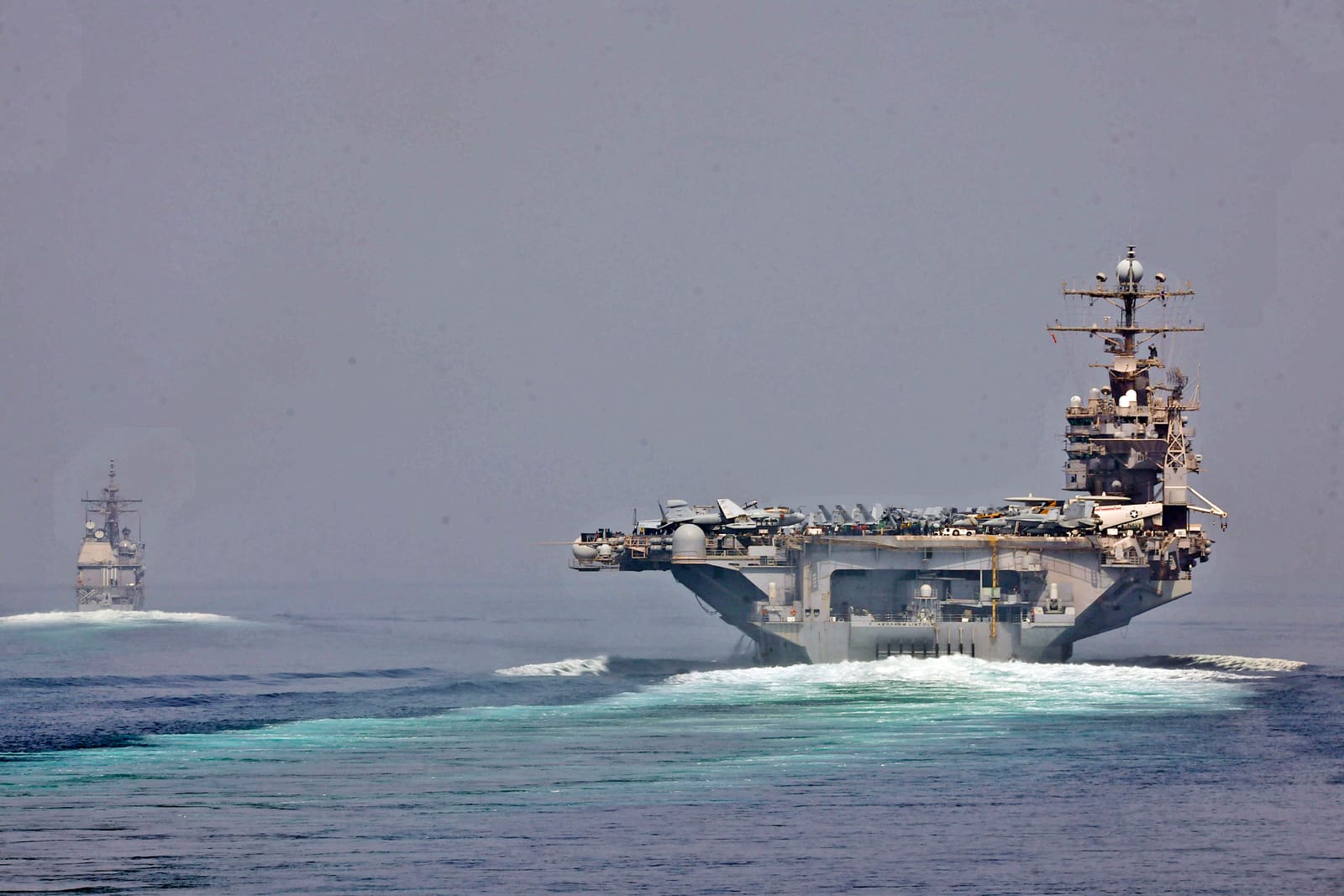
U.S. Navy photo by Mass Communication Specialist 3rd Class Alex R. Forster, public domain, via Wikimedia Commons
By the numbers
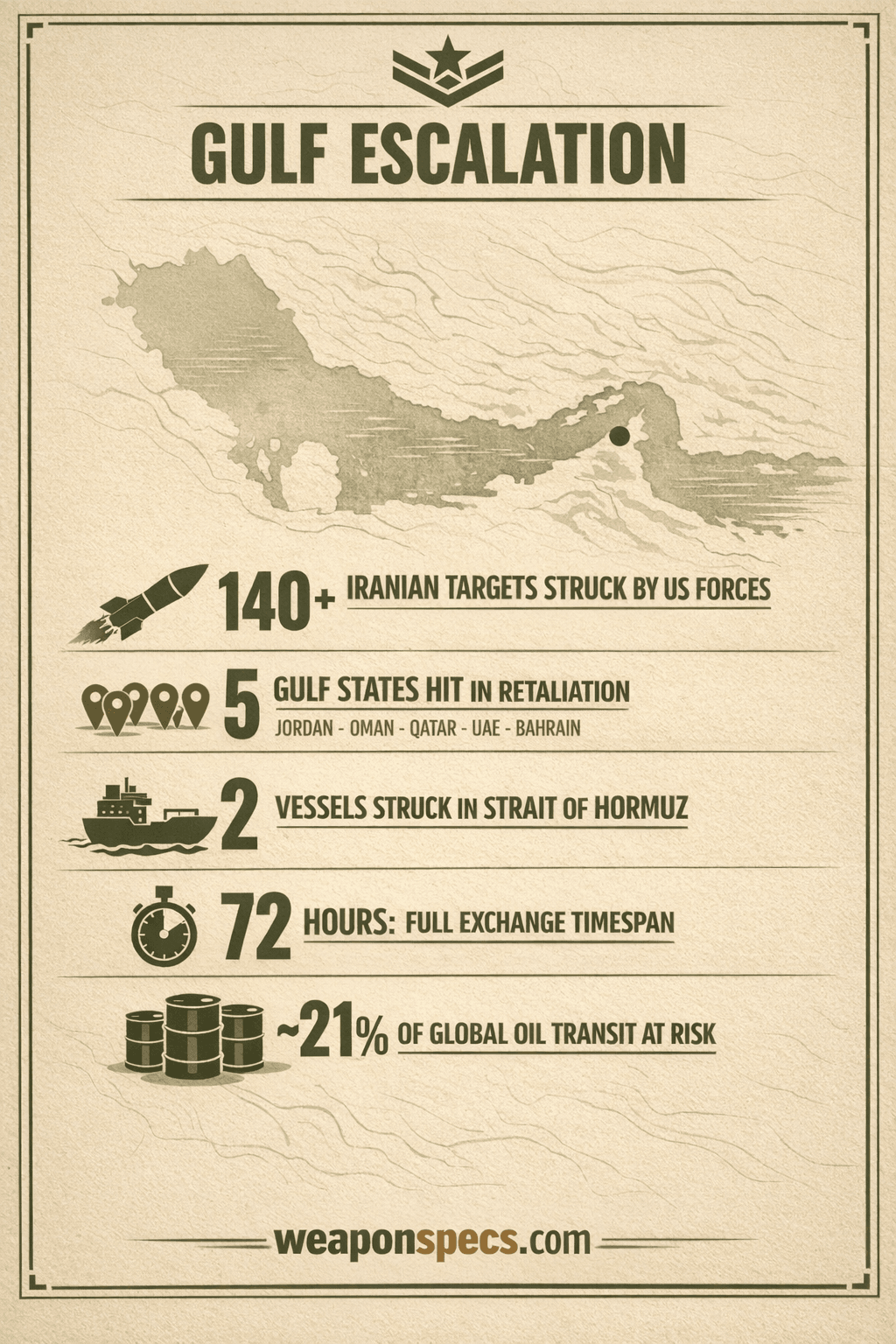
Infographic: WeaponSpecs News Desk
The ceasefire between the United States and Iran collapsed further over July 11 and 12, when US Central Command struck more than 140 Iranian military targets and Iran’s Islamic Revolutionary Guard Corps answered with coordinated missile and drone attacks on five Gulf states in a single overnight window, according to NPR’s reporting on the exchange. It is the third and by far the widest wave of US strikes in a single week, pushing the cumulative target count past 300 since the current round of fighting resumed on July 8, and it marks the first time in this conflict that Iran has struck five separate countries in one coordinated retaliatory action.
The immediate trigger was an attack on a Cyprus-flagged container ship, the M/V GFS Galaxy, in the Strait of Hormuz on the morning of July 11. The vessel caught fire and sustained damage, and one crew member is reported missing. Iran’s IRGC said it fired a warning shot at an unauthorized vessel and separately claimed the strait is now closed to shipping, a claim from Iran’s government and military, not an independently verified fact, and one that conflicts with the strait’s continued role as a functioning international waterway. US Central Command responded that afternoon with roughly 140 precision strikes across Iranian territory, hitting missile and drone launch sites, anti-ship missile batteries, naval command-and-control nodes, ammunition storage, coastal radar installations, and IRGC fast-attack small-boat groups, per wire reporting on the strike package reviewed for this story.
Iran’s retaliation reached further than any prior wave
Overnight into July 12, the IRGC Aerospace Force launched a coordinated series of ballistic-missile and drone attacks against six targets across five Gulf states plus a second reported vessel strike in the Strait of Hormuz, a broader simultaneous footprint than the three-country retaliation seen on July 8 and 9. In Jordan, the IRGC claimed to have struck Prince Hassan (Muwaffaq Salti) Air Base, asserting it destroyed a command center and MQ-9 drone hangars there, according to Middle East Eye’s live coverage. That claim of specific facility destruction comes from Iran’s own military and has not been independently confirmed.
Oman’s Duqm port, which supports US Navy logistics and refueling in the region, was also targeted, with the IRGC again claiming a direct hit on American naval support infrastructure there, a state claim requiring the same caveat. Qatar’s Al Udeid Air Base, a major US Central Command hub, came under attack as well; the IRGC claimed to have destroyed a fighter-maintenance and command facility, while Qatari authorities reported intercepting the incoming missile, according to Arab News. Those two accounts, an Iranian claim of a successful hit and a Qatari claim of interception, are directly at odds, and neither has been independently adjudicated.
The United Arab Emirates reported a missile and drone attack that triggered shelter-in-place warnings for residents near affected areas. Bahrain, which hosts the US Navy’s 5th Fleet headquarters, reported air-raid sirens and multiple interceptions overnight. Kuwait reported intercepting incoming threats as well, with no reported casualties or confirmed damage there. Iran also claimed to have struck a second vessel in the Strait of Hormuz during the same overnight window, a claim that, like the others, comes from Iran’s government and has not been independently verified as of publication.
A truce signed in June, broken twice in one week
The ceasefire now unraveling further was signed June 17, 2026, at the Palace of Versailles between President Trump and Iranian President Pezeshkian, an agreement intended to freeze the broader 2026 Iran war that began February 28, 2026, when US and Israeli strikes hit Iranian nuclear and military sites. The truce lasted barely three weeks before renewed US strikes on July 8 broke it the first time, triggering the three-state retaliation against Jordan, Kuwait and Qatar covered in WeaponSpecs’ prior report on that episode. This week’s exchange is a second, larger breakdown layered on top of that one. President Trump declared on July 12 that the ceasefire was “over” and “a waste of time,” language that removes any remaining ambiguity about Washington’s posture heading into the coming days.
The Strait of Hormuz sits at the center of why this particular flashpoint keeps recurring. The waterway carries an estimated 20 to 21 percent of global oil and LNG transit, and Iran has asserted a right to close it, or at least to threaten shipping there, intermittently since the war’s opening days in late February. Every prior escalation in this conflict has produced renewed threats against the strait; this is the first time in the current round that an actual attack on a commercial vessel, rather than a threat or a military exchange near the strait, has directly triggered the next phase of US strikes.
Why the target set matters
The US strike package’s emphasis on anti-ship capability, coastal radar, and small-boat swarms is a specific response to how Iran has chosen to threaten shipping in this conflict: not with a conventional naval blockade, which Iran’s surface fleet cannot sustain against US and allied forces in the Gulf, but with fast, dispersed small-boat groups, coastal anti-ship missile batteries, and radar-cued targeting that are hard to track and can strike opportunistically. Degrading that specific target set is aimed at reducing Iran’s ability to credibly threaten tanker traffic going forward, independent of whatever additional retaliation Tehran mounts on land against Gulf state bases.
Sources
- US attacks Iran over ship being hit in Strait of Hormuz; Tehran lashes out — NPR, Jul 11, 2026
- Iran attacks Qatar, Bahrain and UAE after fresh US strikes — Arab News, Jul 11, 2026
- IRGC hits Jordan's Prince Hassan Air Base, Qatar 'intercepts missile' — Middle East Eye, Jul 12, 2026
Frequently asked questions
Why is the Strait of Hormuz the flashpoint in this conflict? +
The strait carries roughly one-fifth of global oil and LNG trade. Iran has claimed the authority to close it and has attacked shipping there intermittently since the 2026 Iran war began on February 28, making it the chokepoint both sides keep returning to.
Is this a one-off flare-up or a repeating pattern? +
It is the third attempted ceasefire in the 2026 Iran war to break down. The most recent truce, signed June 17 at the Palace of Versailles, lasted under four weeks before US strikes resumed on July 8. Iran has described its strikes as proportionate, a characterization from Tehran, not an independently verified assessment.
What would a full closure of the strait mean for oil markets? +
A full closure would disrupt an estimated two million barrels of daily oil flow and force tankers onto far longer routes via the Suez Canal or around the Cape of Good Hope. Escalations at the strait have reliably moved oil prices even without a closure actually occurring.
Is NATO or Russia getting directly involved militarily? +
No direct Russian military intervention has been confirmed, and NATO members are engaged diplomatically rather than through strikes. The fighting remains bilateral between US and Iranian forces, with Iran's retaliation landing on Gulf states hosting US installations rather than drawing other militaries into direct combat.
More news