Russia's $100K 'Banderol' Missile Kills 10 in Kharkiv Village
Two S8000 Banderol cruise missiles hit a rural intersection in Pechenihy, killing 10 people, the latest strike from Russia's cheap, mass-producible jet-powered missile.

Photo by Wikimedia user Nickel nitride, CC0 1.0
Two Russian S8000 Banderol cruise missiles struck the center of Pechenihy, a rural settlement in Kharkiv Oblast’s Chuhuiv Raion, at 8:40am local time on August 18, hitting a post office and shops at a busy intersection surrounded by residential buildings. Ten people were killed and at least 18 wounded, according to Ukrainian officials and LIGA.net’s reporting from the scene. The weapon involved, a low-cost, mass-producible jet-powered missile Russia only began producing at scale in mid-2026, is itself part of the story: it is built specifically to overwhelm Ukrainian air defense through cheap volume rather than individual sophistication.
What happened at the intersection
The strike hit at 8:40am, a time and location, a post office and a cluster of shops at a busy crossroads, that put it squarely amid daily foot traffic rather than an isolated military target. Ukrainian officials and LIGA.net’s on-the-ground reporting put the toll at 10 dead and at least 18 wounded, with damage extending to 10 private homes, a cafe, the post office, five stores and 15 vehicles. The Pechenihy community declared August 18 and 19 days of mourning.
President Volodymyr Zelensky described the strike in direct terms:
“This morning, the Russians launched a brutal attack on a busy intersection in Pechenihy, Kharkiv region, a location with a post office and stores, surrounded only by residential buildings. We will definitely respond to this Russian strike,” said Volodymyr Zelensky, President of Ukraine (NBC News, August 19, 2026).
As of this writing, no specific retaliatory target tied to the Pechenihy strike had been reported.
The attack did not happen in isolation. The same overnight period saw Russia launch 147 drones at civilian infrastructure near Kyiv and a separate strike that killed two people in Zaporizhzhia. The following night, August 19, Ukraine’s own deep-strike drone campaign hit the Wildberries logistics warehouse at Koledino outside Moscow, a continuation of a campaign WeaponSpecs has covered previously and not a new development in its own right. Together, the two nights illustrate an exchange that has been intensifying through August, strikes on both sides landing within roughly 24 hours of each other.
The weapon: a cheap missile built to be fired in bulk
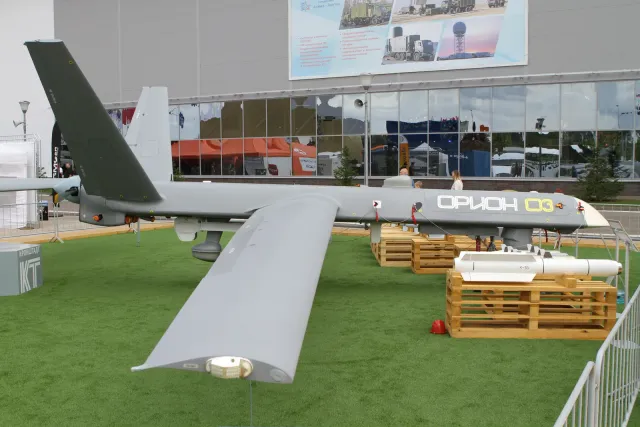
Ukrainian military intelligence first publicly revealed the S8000 Banderol in May 2025. Built by the Kronshtadt Group, the same manufacturer behind the Orion reconnaissance and strike drone, the Banderol is a jet-powered cruise missile Russia began mass-producing in mid-2026 specifically for what Ukrainska Pravda has termed “missile spam,” high-volume strikes designed to exhaust Ukrainian air defense interceptor stocks rather than rely on any single missile’s sophistication to get through.
Reported specifications place the Banderol at roughly 500 kilometers of range, a cruise speed near 560 kilometers per hour and a top speed around 650 kilometers per hour, though sourcing varies slightly on the exact figures. It measures about 5 meters long with a 2.2-meter wingspan and a 30-centimeter body diameter, and carries an OFBCH-150 warhead reported at 114.3 kilograms with 49.5 kilograms of explosive fill, though some reference sourcing cites a rounder 150-kilogram warhead figure; the more detailed defense-trade figure is used as the primary number here. The missile is powered by a Chinese-made Swiwin turbojet engine weighing roughly 8.5 kilograms and producing about 81.6 kilograms-force of thrust, a supply-chain detail worth noting on its own: a core propulsion component in a Russian weapon sourced from a Chinese manufacturer. The Banderol is primarily air-launched from Kronshtadt’s own Orion UAV, also compatible with the Mi-28 Havoc attack helicopter, and Russia has since fielded a ground-based launcher variant as well.

The reported unit cost, around $100,000, is the whole point of the design. Where a more sophisticated cruise missile can cost several times that amount, a $100,000 price tag lets Russia produce and expend Banderols at a rate that strains the economics of intercepting them, since a defender’s interceptor frequently costs far more than the incoming missile it destroys. That same cost asymmetry is the driving logic behind the U.S. Missile Defense Agency’s own Low-Cost Interceptor program, a parallel effort on the American side to bring interceptor costs down closer to the threats they are built to stop.
Why the platform, not just the strike, is worth tracking
A single strike, however deadly, is a data point. What makes the Banderol worth tracking as a system is the production shift behind it: Russia moving from a weapon revealed in intelligence reporting a year earlier to mass production aimed at sustained, high-frequency use against Ukrainian cities. No system record for the Banderol itself exists in WeaponSpecs’ database yet, but its carrier platform, the Kronshtadt Orion, is tracked and offers useful context on the manufacturer’s broader unmanned systems work. As Russia continues fielding both air-launched and ground-launched variants, the Banderol’s role in the wider missile-and-drone campaign against Ukrainian civilian infrastructure is likely to keep growing rather than remain a one-off weapon.
Sources
- Russia strikes Pechenihy with Banderol missiles: 10 killed and 18 wounded, photos — LIGA.net, Aug 18, 2026
- Russian missile hits apartment building in Ukraine's Kharkiv, killing at least 10 — ABC News Australia (AP), Aug 18, 2026
- Ukraine aims a drone blitz at Moscow while Russian missiles kill 10 in a Ukrainian village — NBC News (AP), Aug 19, 2026
- S8000 Banderol — Wikipedia, Aug 1, 2026
Systems mentioned
Every system named in this story, with its photo and, where available, a video. Tap a card to open the full spec sheet.
UAV / drone
Orion (Inokhodets)Frequently asked questions
What happened in Pechenihy? +
Two Russian missiles struck a village intersection with a post office and shops at 8:40am local time on August 18, killing 10 people and wounding at least 18. The Pechenihy community declared two days of mourning.
What is the Banderol missile and why does it matter? +
The S8000 Banderol is a low-cost, roughly $100,000, jet-powered Russian cruise missile built by the Kronshtadt Group and mass-produced since mid-2026 specifically to saturate Ukrainian air defenses with cheap volume rather than individual sophistication. It uses a Chinese-made turbojet engine and is normally launched from Kronshtadt's own Orion drone.
Is this part of a bigger pattern? +
Yes. It hit the same overnight window as a 147-drone barrage on Kyiv-area infrastructure, and came a day before Ukraine's own deep-strike drone campaign hit a major logistics hub outside Moscow, part of an exchange that has intensified through August.
Has Ukraine responded? +
President Zelensky said Ukraine would respond but had not named a specific target as of this writing. No confirmed retaliatory strike tied specifically to the Pechenihy attack had been reported.
More news


