Germany, Norway, Canada Begin Joint Planning for 212CD Submarines
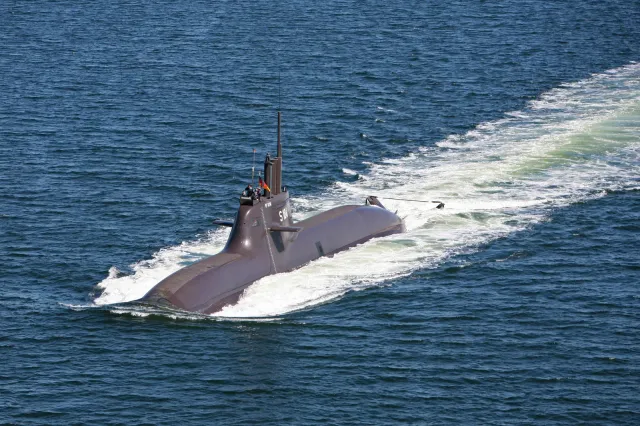
A four-day Kiel planning event started formal trilateral work on the Type 212CD submarine, the follow-through on Canada's July selection of TKMS.

Bundeswehr-Fotos (Flickr), Wikimedia Commons, CC BY 2.0
Canada’s Victoria-class submarines have been a maintenance headache for most of the three decades the Royal Canadian Navy has operated them. Britain built the four boats as the Upholder class in the late 1980s and early 1990s, laid them up when London cut its own conventional submarine force, and sold them to Canada secondhand in 1998. Canada has spent much of the time since keeping them running rather than using them; at various points every boat in the class has been sidelined for years at a stretch by fires, corrosion, or extended refits. There has been no realistic replacement program until now, and the boats Canada is buying are not a stopgap, they are its first new-build submarine acquisition in generations.
That contract went to Germany’s Thyssenkrupp Marine Systems (TKMS) on July 6, 2026, when Canadian Prime Minister Mark Carney, announcing the decision en route to the NATO summit in Ankara, named TKMS the preferred bidder for the Canadian Patrol Submarine Project. TKMS beat South Korea’s Hanwha, which had offered a design based on its KSS-III submarine, for a contract covering up to 12 boats. The design at the center of it, the Type 212CD, is not the submarine currently in German and Italian service. That in-service boat is the Type 212A, a smaller design dating to 2005. The 212CD (“Common Design”) is a distinct, larger successor already ordered by Germany and Norway: roughly 2,500 tonnes surfaced versus the 212A’s smaller displacement, 73 meters long, with a hybrid diesel-electric propulsion plant, fourth-generation fuel-cell air-independent propulsion, and lithium batteries giving it roughly 41 days of submerged endurance. Treating the two as interchangeable is a common sourcing error worth avoiding: the 212A is the boat currently patrolling, the 212CD is the one Canada, Germany and Norway are all now building toward.
The planning event that followed the contract decision
What actually happened this week is the operational follow-through on Carney’s July decision. Representatives of Germany, Norway and Canada, alongside TKMS, sensor and combat-systems maker Kongsberg, and engineering firm Multiconsult, held a four-day planning event in Kiel in late July 2026. Naval Today reported it first on August 11 as the launch of trilateral cooperation; Global Defense Corp’s August 23 report described the same event as the “operational start” of the three-nation program, establishing the multilateral working structures that will carry the project into formal contract negotiations, which sources describe as happening “in the coming weeks” rather than being underway yet.
“The selection of TKMS as Preferred Supplier for the Canadian Patrol Submarine Project is a significant milestone. With the first trilateral planning event, we are jointly laying the foundation for a trusting and cooperative partnership with Germany, Norway and Canada,” said Thomas Keupp, Chief Sales Officer at TKMS (Global Defense Corp, Aug. 23, 2026).

Why the fleet size numbers don’t agree, and what’s real
This is where honest reporting has to sit with an uncomfortable gap rather than paper over it. Naval Today’s August 11 report and Global Defense Corp’s August 23 report both put Canada’s order at up to 12 submarines, with the first four targeted for delivery by 2034. Norway’s order in that same coverage is 4 submarines and Germany’s is 2, for a combined trilateral total the two outlets describe as reaching up to 18 boats.
Naval News, reporting in June 2026 before the Kiel event, described a different arrangement: Germany and Norway jointly committed to a 12-submarine order for themselves, then agreed to redirect one boat each from that order to Canada rather than adding entirely new hulls, with Canada’s total put at 4 submarines delivered by 2036, two years later than the August reporting’s 2034 figure. Wikipedia’s account, sourced to a separate contract description, cites Norway at 6 submarines and Germany at 6, with Germany’s total potentially rising to 9 under a “2035 naval vision.” None of these three pictures cleanly reconciles with the others. The most likely explanation is that different reports are describing different order tranches, an initial firm batch versus follow-on options, or a running total versus a net figure after boats were reallocated to Canada, but that is an inference, not something any single source states outright. Rather than pick one version and present it as settled, the honest position is that Canada’s near-term order (its first four boats) and the eventual size of Germany and Norway’s combined fleet are the two figures agreement exists on in broad terms, while the precise national breakdown past that point remains reported inconsistently across otherwise reliable outlets.
What the boats are actually built to do
Whatever the final national split turns out to be, the 212CD itself is a specific answer to a specific NATO gap: a non-nuclear, high-endurance attack submarine built for the shallow, acoustically difficult waters of the Baltic and North Atlantic littoral, where a nuclear boat’s size is a liability rather than an advantage. Each boat carries six 533mm torpedo tubes and up to 14 torpedoes, missiles or drones, drawing on DM2A5 and CHWT heavyweight torpedoes, the IDAS missile, a possible Naval Strike Missile variant, an anti-torpedo Seaspider defense system, and uncrewed underwater vehicle capability. A crew of 27 to 30 runs the boat, small by the standards of a nuclear-powered attack submarine, reflecting a design built around automation rather than nuclear power’s near-unlimited endurance.
What to watch next
The Kiel event moved this program from a single national procurement decision into a genuine three-country undertaking, complete with the working-group structures a common-design build across three navies actually requires. What it did not do is produce a contract. Naval Today and Global Defense Corp’s own reporting places formal negotiations in the near future, not the past, and the unresolved fleet-size discrepancy above means the eventual dollar value and delivery timeline both remain moving targets. The next real marker will be whether Canada, Germany and Norway can turn a planning event into a signed agreement before year’s end, and whether the numbers converge once that happens.
Sources
- Germany, Norway and Canada start preparations for the Type 212CD subcontract (Global Defense Corp, Aug 23, 2026)
- Germany, Norway and Canada start preparations for Type 212CD sub contract (Naval Today, Aug 11, 2026)
- Type 212CD: Germany and Norway ready to transfer submarines to Canada (Naval News, Jun 1, 2026)
- Type 212CD submarine (Wikipedia)
Systems mentioned
Every system named in this story, with its photo and, where available, a video. Tap a card to open the full spec sheet.
Frequently asked questions
Is this a signed contract yet? +
No. This is a trilateral planning phase following Canada's July 6, 2026 selection of TKMS as preferred bidder for its Canadian Patrol Submarine Project. Formal contract negotiations are still pending as of this report.
What existing submarine fleets does this replace? +
Canada's aging Victoria-class boats, originally built in Britain and bought secondhand in the 1990s, are the main driver behind Canada's involvement. Norway's order replaces its Ula-class fleet. Germany is adding 212CD boats alongside its existing Type 212A fleet rather than replacing it outright.
Isn't this mainly a European program? Why does Canada matter here? +
Canada's involvement turns what began as a bilateral German-Norwegian submarine program into a three-nation, NATO-spanning standardization effort. Depending on which outlet's figures are used, it could produce somewhere between 18 and 24 largely identical conventional submarines across three navies, one of the largest common submarine fleets in the alliance.
More news


