Australia Bets A$33B on Henderson as Its AUKUS Submarine Hub
Canberra and Perth picked the Henderson Defence Precinct site, backed by roughly A$33 billion, to host rotating US and UK submarines from 2027.

Mass Communication Specialist 1st Class Victoria Mejicanos, U.S. Navy, DVIDS, public domain
Australia and Western Australia’s state government named the site of the Henderson Defence Precinct on August 24, 2026, the physical location where the country will build its future general-purpose frigates and Army landing craft, and where rotating US and UK nuclear-powered attack submarines will begin arriving in 2027. The commitment behind it runs to roughly A$33 billion once every linked investment is counted, Canberra’s clearest industrial down payment yet on its AUKUS Pillar 1 obligations.
The site sits in Perth’s southern suburbs, about five kilometers from HMAS Stirling, the existing naval base that already receives periodic US submarine visits and will host the actual rotational force under Submarine Rotational Force-West. Henderson and Stirling are separate facilities with separate money behind them, and keeping that distinction straight matters for reading the numbers below.
The A$12 billion and A$13 billion figures both attach to the new Henderson site itself, the first a direct development commitment, the second a 10-year forecast for the continuous shipbuilding work the precinct is meant to sustain. The A$8 billion is a separate, earlier-announced expansion of HMAS Stirling, the base that actually hosts the submarines. Combined, the three add up to the roughly A$33 billion figure state and federal officials have been citing as WA's total AUKUS-linked build-out.
What Henderson actually does, and what it doesn’t
Henderson will not build American or British submarines. Those remain the province of General Dynamics Electric Boat and HII in Connecticut and Virginia, and BAE Systems in the UK. What Henderson gets is a floating-dock facility for in-water maintenance of visiting nuclear boats, plus a build line for the Navy’s future general-purpose frigates and the Army’s landing craft, and eventually infrastructure to support Australia’s own SSN-AUKUS submarines once those arrive on a later timeline. WA Premier Roger Cook framed the ambition plainly: “We are firing the starters gun on the largest naval shipbuilding maintenance hub in the Southern Hemisphere.” Defence Minister Richard Marles has stressed that the precinct is meant to sit alongside, not replace, the state’s existing resources-sector economy, with Cook projecting defence work could become WA’s second-largest industry within years.
The rotations themselves rest on infrastructure at HMAS Stirling that is already partly in place. Australia’s Chief of Defence Force, Admiral Mark Hammond, confirmed on August 4, 2026, that US and UK submarine access to Stirling would be “enduring,” not limited to an initial five-year window as some earlier reporting had suggested, which is the kind of open-ended commitment that makes an A$8 billion base expansion worth funding in the first place.

Australia is also becoming a supplier, not just a host
Henderson is the basing half of Australia’s AUKUS bet. The other half is showing up quietly in the industrial supply chain. On August 2, 2026, Australian steelmakers Bisalloy Steels and BlueScope shipped the first Australian-made HY80 high-yield submarine steel into the Virginia-class supply chain, via a roughly US$2 million purchase order from General Dynamics Electric Boat, the first time Australian industry has qualified into the US submarine industrial base’s vendor program. It is a small dollar figure next to A$33 billion in basing infrastructure, but it answers a fair question about a country building a giant hub for other nations’ submarines: is Australia contributing capability, or just real estate? The steel order says both, at least in miniature.
Australia’s own path to owning submarines outright changed shape earlier in 2026. Rather than the mix of new-build and secondhand Virginia-class boats envisioned under the original 2021 AUKUS deal, Canberra and Washington agreed in May 2026 to a revised pathway: Australia will receive three used US Navy Virginia-class submarines, all Block IV-standard boats, with the sole newly built Virginia-class boat previously planned for the Royal Australian Navy dropped from the arrangement.
The bottleneck Henderson doesn’t fix
None of Henderson’s A$33 billion touches the actual constraint on AUKUS Pillar 1: how fast the US builds Virginia-class submarines in the first place. Production has run at roughly 1.2 boats a year against a Navy target of two, and Chief of Naval Operations Adm. Daryl Caudle told appropriators in May 2026 that reaching that two-a-year rate would take a “transformational,” not incremental, improvement in the shipyards, with the milestone now expected around 2032, four years later than the Navy projected as recently as 2023. Henderson is a sustainment and rotational-basing hub, not a build yard for US boats, so it cannot add a single submarine to that production line. What it can do is make sure Australia is ready to receive and maintain boats the moment the US industrial base is able to spare them, and make sure the political commitment behind AUKUS has a physical site attached to it rather than remaining a set of press-release promises.
Henderson answers the question of where Australia’s side of AUKUS Pillar 1 physically lives. It does not answer whether the US industrial base can build submarines fast enough to make the political timeline real. Those are two different problems, and only one of them, the Australian one, got roughly A$33 billion and a groundbreaking site this week. The other is still sitting with US shipyards that, on their own government’s timeline, will not hit a sustainable production rate until 2032, five years after the first rotational submarines are due to arrive at a base Australia has now committed to be ready for.
Sources
- Albanese and Cook Governments select site of the Henderson Defence Precinct (Prime Minister of Australia, Aug 24, 2026)
- 'Significant' AUKUS submarines milestone revealed (Canberra Times, Aug 24, 2026)
- Australia identifies future defense precinct site for AUKUS sub sustainment (Breaking Defense, Aug 24, 2026)
- Australian steel to support Virginia-class submarine construction (Naval News, Aug 2, 2026)
- Australia scraps new Virginia-class submarines in AUKUS shake-up (ABC News, May 31, 2026)
- Australia confirms enduring access for US Virginia-class submarines at HMAS Stirling naval base under AUKUS (Army Recognition, Aug 9, 2026)
- Two Virginia-Class Submarines A Year: The Industrial Problem The U.S. Navy Cannot Buy Its Way Out Of (19FortyFive, Jun 15, 2026)
Systems mentioned
Every system named in this story, with its photo and, where available, a video. Tap a card to open the full spec sheet.
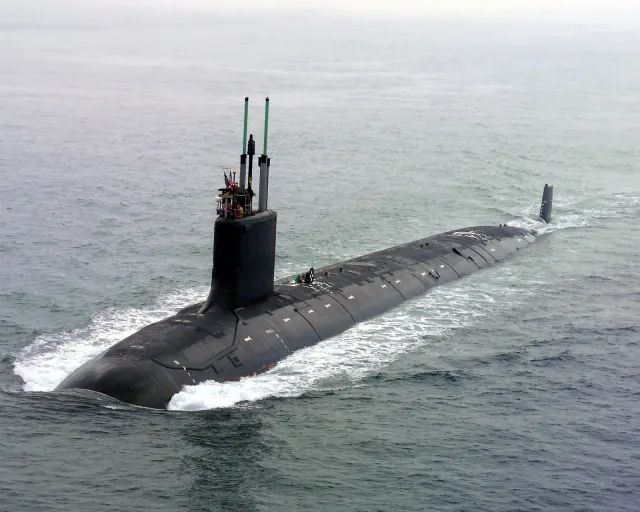
Submarine
Virginia-class SubmarineFrequently asked questions
Will US submarines actually be built at Henderson? +
No. Henderson is a sustainment and rotational-basing hub, not a construction yard. Virginia-class boats are built by General Dynamics Electric Boat and HII in Connecticut and Virginia. Henderson will build Australian frigates and landing craft and maintain visiting nuclear submarines.
When do submarine rotations to Western Australia actually start? +
2027, under Submarine Rotational Force-West, per the August 24, 2026 site announcement. HMAS Stirling, a separate existing base about five kilometers from the new precinct, already hosts periodic US Virginia-class port visits today.
Is this the same as Australia's own future submarine fleet? +
Related but distinct. Henderson supports rotating US and UK boats and builds Australian surface vessels now. Australia's own nuclear-powered attack submarines, three used US Navy Virginia-class boats under the revised 2026 AUKUS pathway, arrive later, on a separate timeline.
More news


