Harpoon Coastal Defense System Scores First Hit, Nears Taiwan
A truck-mounted Harpoon missile struck a target ship in its first live test, clearing a key hurdle before Taiwan fields its $2.3 billion order.

U.S. Navy photo, DVIDS, public domain (VIRIN 260116-N-N2005-2774)
A land-launched Harpoon missile struck a target vessel in near-shore waters off Point Mugu, California, in late July, the first successful live-fire test of the Harpoon Coastal Defense System (HCDS) and a critical gate ahead of fielding the truck-mounted battery to Taiwan under a $2.3 billion order. The U.S. Navy announced the result of Developmental Test-1, or DT-1, on August 28, more than a month after the missile actually flew.
A HEMTT truck learns to sink ships
The Harpoon Coastal Defense System takes a missile the U.S. Navy has flown since the 1970s and gives it a new launch platform: a Heavy Expanded Mobility Tactical Truck, or HEMTT, fitted with a command cab and four launch canisters. During DT-1, conducted at the Point Mugu Sea Range after two days of intensive testing, the missile launched from the truck-mounted battery and engaged a designated target vessel operating in littoral waters, the shallow, cluttered near-shore environment where a coastline’s own geography helps hide an attacker. Teams from the Navy’s Precision Strike Weapons Program Office (PMX-201), the Naval Air Weapons Station Technical Project Office, Point Mugu Sea Range and Boeing, which builds the missile, ran the test together.
The missile itself is not new. Harpoon Block II is a subsonic, sea-skimming, over-the-horizon strike weapon that pairs GPS-aided inertial navigation with an active radar seeker in its terminal phase, carrying a roughly 220-kilogram blast-fragmentation warhead at a top speed near Mach 0.85. More than 30 navies fly some version of it. What changed with HCDS is the launch point: instead of a ship’s deck or an aircraft’s wing, the missile now flies from a mobile ground battery that a defender can hide, move and reposition along a coastline, turning a well-understood missile into a weapon that a much smaller navy can use to threaten a much larger one’s ships from shore.

Why Taiwan is racing this timeline
Taiwan is HCDS’s only committed customer today, and the reason is straightforward: it faces a People’s Liberation Army Navy with far more hulls than its own fleet, and a mobile, concealable, land-based anti-ship battery lets Taipei threaten an invasion force from positions a much larger navy cannot easily find or strike first. Taiwan signed a Foreign Military Sale in 2023 worth up to $2.3 billion for 100 launchers and 400 RGM-84L-4 Harpoon Block II missiles, and Naval News reports at least five launchers and one radar vehicle have already reached the island. Splitting the missile portion alone against WeaponSpecs’ own database estimate of roughly $1.2 million per Harpoon Block II round puts the 400 missiles at around $480 million, leaving well over half the $2.3 billion contract covering the launchers, radar trucks and training that make the missiles usable rather than the missiles themselves, a reminder that a headline contract figure for a coastal-defense system buys an entire battery, not just its rounds.
Capt. Sarah Abbott, the PMX-201 program manager, credited the test’s success to the team that ran it.
“The flawless execution of this test is a direct testament to the unparalleled expertise and relentless dedication demonstrated by the entire team. This represents a significant milestone in our mission to deliver a vital, high-priority defense capability to the field,” said Capt. Sarah Abbott, Precision Strike Weapons Program Office manager (Defence Industry Europe, Aug. 29, 2026).
That framing matters because HCDS is not being developed as a generic Navy program with Taiwan as one customer among several. It is, for now, being built specifically to fill a Taiwanese requirement, which means every test milestone maps fairly directly onto how soon Taipei’s Littoral Combat Command gets a working system rather than onto a broader U.S. Navy fielding schedule.
What still has to happen
DT-1 is only the first of two planned developmental test phases. The Department of the Navy has said the second phase will include additional at-sea, live-fire and tracking events meant to assess the system’s combat readiness before it is cleared for service, but it has not disclosed a timeline for when that second round begins or concludes. Until that second phase wraps, HCDS remains a system with one successful test behind it rather than a fielded capability, and the pace of Taiwan’s deliveries depends on how quickly the Navy can move through that remaining testing.
The gap between “tested” and “fielded” is not a formality here. Coastal-defense missiles are only useful if they work reliably under the exact conditions a real engagement would present, cluttered near-shore geography, a moving target, a truck-mounted launcher rather than a stabilized ship deck, and a single successful engagement establishes that the concept works without yet proving it works consistently enough for combat. That is precisely what the second test phase is designed to close out.
Sources
- Taiwan-Bound Harpoon Coastal Defense System Scores Direct Hit in US Navy Test (Naval News, Aug 28, 2026)
- U.S. Navy says Harpoon Coastal Defense System hits target vessel in key test, advancing land-based anti-ship capability (Defence Industry Europe, Aug 29, 2026)
- Harpoon Coastal Defense System successfully intercepts target vessel in crucial testing (NavyCRF, Aug 28, 2026)
- U.S. Navy Completes Final Harpoon Block II Missile Update Test for Littoral and Land-Strike Operations (Army Recognition, Feb 6, 2026)
Systems mentioned
Every system named in this story, with its photo and, where available, a video. Tap a card to open the full spec sheet.
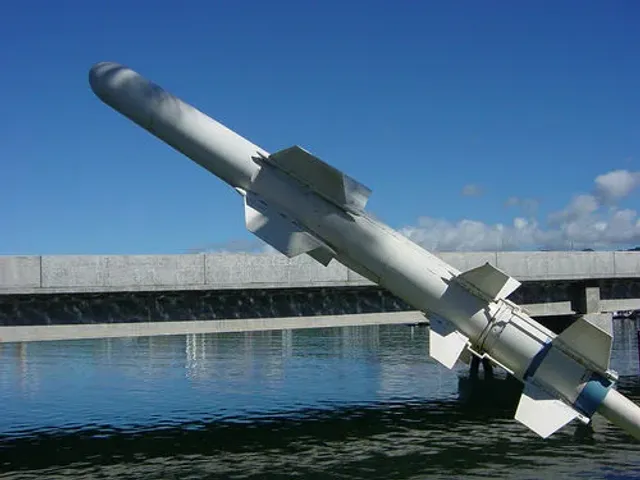
Missile
Harpoon Block IIFrequently asked questions
What is the Harpoon Coastal Defense System? +
It is a mobile, truck-mounted anti-ship battery: a HEMTT chassis carrying a command cab and four launch canisters, firing the RGM-84L-4 Harpoon Block II missile from shore against ships in near-coastal waters. It turns a missile long flown from ships and aircraft into a land-based weapon.
Who is buying it? +
Taiwan is currently the system's only committed customer, under a 2023 Foreign Military Sale worth up to $2.3 billion for 100 launchers and 400 RGM-84L-4 missiles. At least five launchers and one radar vehicle have already been delivered.
What did the test actually prove? +
That a Harpoon fired from a land-based battery at Point Mugu Sea Range, California, could hit a target vessel operating in near-shore, littoral waters. It was the system's first live-fire validation, known as Developmental Test-1, or DT-1.
What still has to happen before Taiwan gets its launchers? +
A second phase of developmental testing, covering additional at-sea, live-fire and tracking events, still has to run before the system is cleared for Taiwan's Littoral Combat Command. The Navy has not disclosed a timeline for that second phase.
More news


