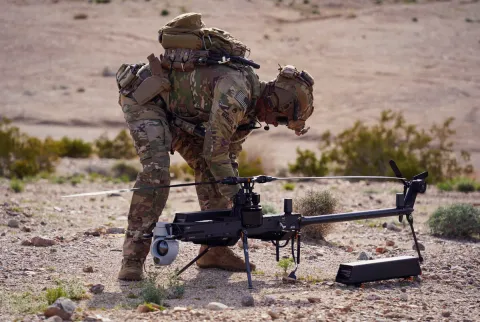
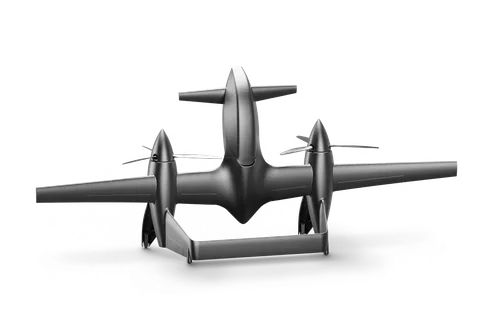
Product photos coming soon
Documents
 United States
 AeroVironment
JUMP 20
A runway-independent Group 3 fixed-wing VTOL UAV acquired with Arcturus UAV, offering 13-plus hours of endurance and a 185 km range for persistent ISR launched from land or sea.
In service since 2021 · 5 operator countries
Compiled from public sources ·primary reference ↗ ·last verified 2026-07-17
185
km range
5,182
m ceiling
Pricing: No single public per-unit price. Denmark's DALO programme-of-record contract carries a ceiling value of $181 million at fleet level, and Italy's 2025 contract was valued at $46.6 million; neither is a per-unit figure.
Procurement snapshot
Availability & export
US ITAR-controlled
Export needs U.S. State Dept (DDTC) approval; end-use & re-transfer restrictions apply.
Channel: Foreign Military Sales (FMS) or Direct Commercial Sale
Fielded & proven
Established · 5 operators
In service since 2021. Status: active.
Lifecycle cost (est.)
No public unit price to model from. Why so few systems publish one →
Interoperability
No standardised NATO calibre / datalink detected in public specs.
Derived guidance from public data, export regime by country of origin, lifecycle from the GAO ~30% acquisition rule. Verify eligibility, pricing and offsets with the manufacturer and your acquisition authority.
Overview
JUMP 20 is a Group 3 vertical take-off and landing fixed-wing UAS that came to AeroVironment through its 2021 acquisition of Arcturus UAV. It combines runway-independent VTOL launch and recovery with fixed-wing cruise efficiency and can be deployed in under 30 minutes on land or at sea. AeroVironment publishes 13-plus hours of endurance, a 185 km range and an operational altitude of 17,000 feet, which keeps its visual and acoustic signature low, along with a 13.6 kg modular payload bay. It has been fielded by the US Army under FTUAS Increment 1, delivered to Ukraine under USAI security assistance in 2023, delivered to Taiwan's Coast Guard Administration, selected by Denmark's Defence Acquisition and Logistics Organisation as a ten-year programme of record, and operated by the Mexican Navy; in July 2026 it received the MQ-31A military type designation from the Italian Ministry of Defence. It was eliminated from the FTUAS Increment 2 competition in 2023. Speed figures are deliberately absent: AeroVironment does not publish them for the JUMP 20, and the obvious substitute is a trap worth recording. The Wikipedia URL for 'JUMP 20' silently redirects to the article for the AeroVironment T-20, a different, older, catapult-launched non-VTOL Group 2 aircraft with a 24-hour endurance and its own speed figures. Those numbers describe a different airframe and have not been carried over here. A newer sibling, the JUMP 20-X, adds a heavy-fuel engine, beyond-line-of-sight connectivity, a STANAG-compliant modular open systems architecture and marinised shipboard autonomous launch and recovery; the base JUMP 20 documented here uses a standard gasoline engine and does not include those maritime upgrades. JUMP 20 is an ISR platform rather than a strike munition and carries no weapons.
Full specifications
Performance
Speed, range, altitude and engagement capability.
- Range
Maximum distance: ferry range for aircraft, operational range for vehicles, maximum engagement distance for missiles. Higher means more standoff or persistence.
- 185 km Stronger than 37% of UAVs
- Service ceiling
Maximum operating altitude. Higher gives energy advantage and sensor horizon.
- 5,182 m Stronger than 35% of UAVs
- Endurance
Time on station. Critical for UAVs and patrol platforms, higher means longer persistent coverage.
- 13 h Stronger than 53% of UAVs
Physical
Dimensions, weight and crew.
- Length
Overall length including gun/probe where applicable.
- 2.9 m
- Wingspan
Wingtip-to-wingtip span.
- 5.7 m
- Combat weight
Fully loaded weight. Lighter eases transport and bridging limits; heavier often means more armor.
- 98 kg
Propulsion
Engine, power and fuel.
- Engine
Powerplant model and type.
- Single gasoline four-stroke internal combustion engine
- Propulsion type
Turbofan, turboshaft, diesel, gas turbine, solid-fuel rocket, ramjet…
- VTOL fixed-wing with gasoline piston engine
Sensors & avionics
Radar, sensor suite and datalinks.
- Sensors
IRST, EO/IR turrets, laser designators, sniper pods, thermal sights.
- Modular payload bay, 13.6 kg capacity, for long-range EO/MWIR turrets with onboard tracking, stabilisation and video processing
Program
Cost, production scale and operators.
- Operator countries
Number of countries operating the system. More operators means broader support ecosystem.
- 5 Stronger than 67% of UAVs
Specifications compiled from public AeroVironment and reference sources ↗. Published defense figures are approximations, treat comparisons as directional. Last verified 2026-07-17.
Compare with rivals
See how it stacks up
 Baykar Bayraktar Akinci
 Frequently asked questions
What is the range of the AeroVironment JUMP 20? +
The AeroVironment JUMP 20 has a maximum range of 185 km.
How much does the AeroVironment JUMP 20 weigh? +
The AeroVironment JUMP 20 has a combat weight of 98 kg.
What engine does the AeroVironment JUMP 20 use? +
The AeroVironment JUMP 20 is powered by the Single gasoline four-stroke internal combustion engine.
What is the AeroVironment JUMP 20 used for? +
The AeroVironment JUMP 20 is a uav / drone typically used for isr, maritime domain awareness, border security, reconnaissance.
How many countries operate the AeroVironment JUMP 20? +
The AeroVironment JUMP 20 is operated by 5 countries.
How much does the AeroVironment JUMP 20 cost? +
AeroVironment JUMP 20: No single public per-unit price. Denmark's DALO programme-of-record contract carries a ceiling value of $181 million at fleet level, and Italy's 2025 contract was valued at $46.6 million; neither is a per-unit figure.. Defense program costs are rarely fully public and vary by contract and configuration.