Army Deploys Dark Eagle Hypersonic Missile to Guam
The Army's Dark Eagle missile trained on Guam, putting a 3,500 km hypersonic strike system within reach of China's coast for the first time from here.

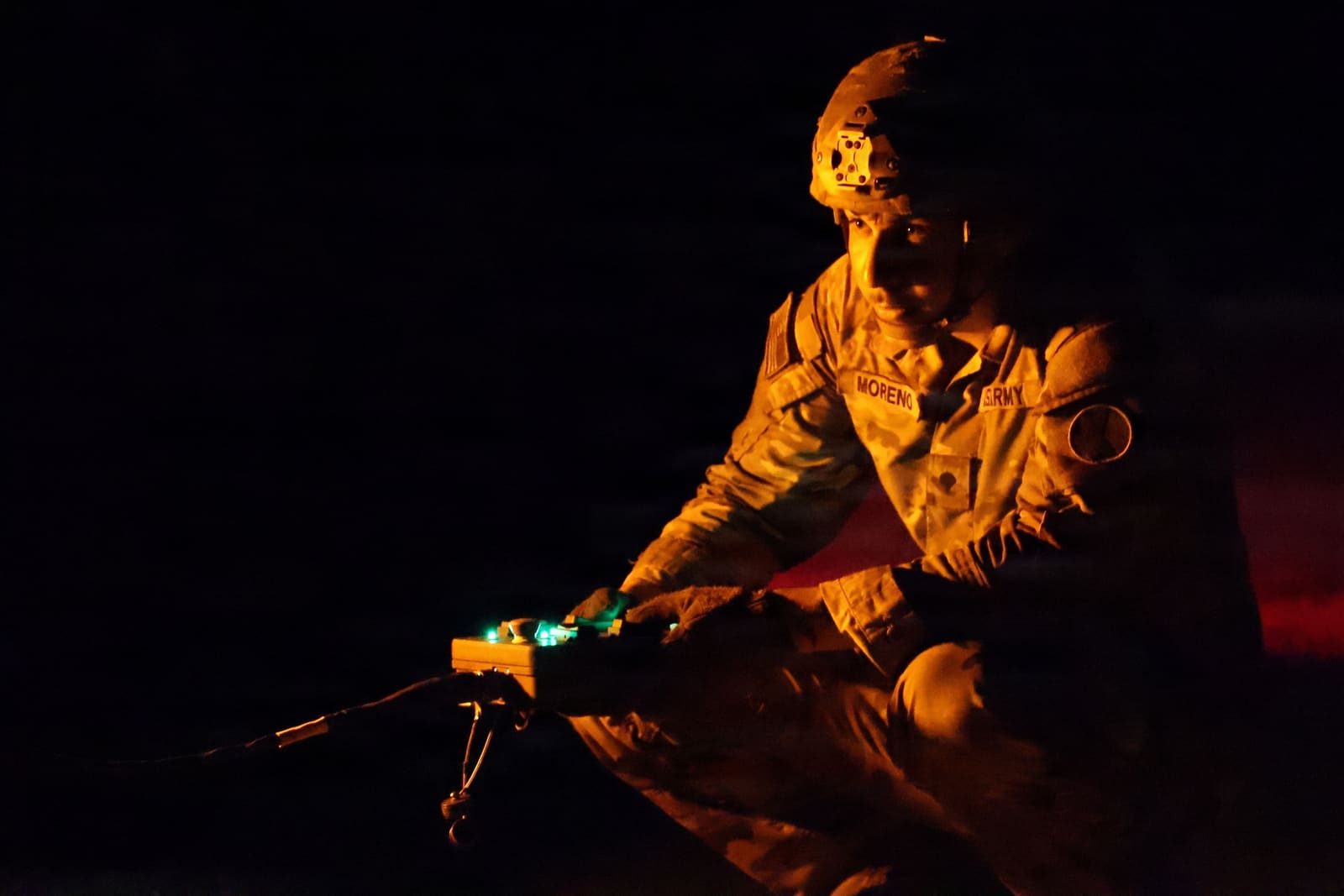
U.S. Army photo by Staff Sgt. Brandon Rickert, DVIDS, public domain
U.S. Army soldiers trained with the Dark Eagle Long-Range Hypersonic Weapon on Guam around Exercise Valiant Shield 2026, according to imagery the Defense Department’s own visual-information service released July 19 to 20 and reporting from Stars and Stripes and Army Recognition. Dark Eagle, also known as the Long-Range Hypersonic Weapon or LRHW, is a ground-launched, road-mobile missile that flies a conventionally armed hypersonic glide vehicle to roughly 3,500 kilometers at speeds above Mach 5. It is reportedly only the second time the system has deployed west of the International Date Line, after a first overseas appearance in Australia’s Northern Territory during Talisman Sabre 2025 a year earlier.
Adm. Samuel J. Paparo, commander of U.S. Indo-Pacific Command, is shown in the released DVIDS imagery observing soldiers training on the system, alongside Capt. Alexander Vahadji and Lt. Col. Alexander Mullin. The photos themselves are dated June 6, in the weeks bracketing the formal Valiant Shield 2026 exercise window of June 22 to July 1, and were captioned by DVIDS as showing personnel assigned to the 7th Infantry Division’s Multi-Domain Command-Pacific element, the Army’s newly consolidated two-star Pacific multi-domain headquarters, stood up at Joint Base Lewis-McChord in June 2026 from a merger of the 7th Infantry Division and the 1st Multi-Domain Task Force. A U.S. Indo-Pacific Command spokesman confirmed the location directly:
“The photos were taken on Guam,” said Army Maj. Jimmy Sheehan, a spokesman for U.S. Indo-Pacific Command, quoted by Stars and Stripes (July 21, 2026).

Why a 3,500 km missile on Guam changes the map
Guam sits roughly 2,700 kilometers from the nearest point on the Chinese mainland. That gap matters because Dark Eagle’s reported 3,500 kilometer range does not just barely reach the coast, it clears it by roughly 800 kilometers, which is enough additional reach to put a genuinely wide arc of China’s southeastern and eastern seaboard within range of a system based on the island, rather than a narrow coastal strip. Army Recognition’s review of the released imagery places Hainan, Guangdong, Fujian, Zhejiang and the approaches to Shanghai within that envelope at maximum range, a stretch of coastline that includes major Chinese naval and air bases, not just population centers. For a system that had previously only appeared overseas in Australia, thousands of kilometers further from mainland China, basing it on U.S. territory this close to the Chinese coast is a different kind of signal than a training deployment to a partner nation’s own territory.
That range also has to be read against a real constraint: Guam is a small, geographically fixed island whose infrastructure, ports and airfields are already well known and, in a conflict, would themselves be a target rather than a sanctuary. A four-launcher Dark Eagle battery carries eight missiles total, a genuinely limited strike capacity on its own. The value of basing it on Guam is less about a single battery’s firepower and more about demonstrating that the Army can now hold targets across a meaningful slice of the Chinese coast at hypersonic speed from a location inside the so-called second island chain, a capability the United States did not have from any fixed western Pacific base as recently as 2024.
Dark Eagle is the only system here whose range clears the Guam-to-China distance, and does so with room to spare. Ranges are each system's own published figures from the WeaponSpecs database; the Guam-China distance is a straight-line reference, not a weapon.
Where the system came from
Dark Eagle exists in its current ground-launched form largely because of a treaty that no longer binds the United States. The 1987 Intermediate-Range Nuclear Forces Treaty banned American and Soviet ground-launched missiles with ranges between 500 and 5,500 kilometers for more than three decades; the United States withdrew in 2019 citing Russian violations, clearing the legal path for the Army to develop a ground-mobile missile in exactly that banned range band. Dark Eagle’s system specifications list Lockheed Martin as the prime contractor responsible for the launcher, fire control and weapon integration, with Dynetics producing the Common Hypersonic Glide Body that both the Army’s Dark Eagle and the Navy’s ship- and submarine-launched Conventional Prompt Strike weapon share as a common round. The Army first activated an operational Dark Eagle unit, Bravo Battery of the 1st Battalion, 17th Field Artillery Regiment, in December 2025, only months before this Guam appearance.
Sources
- Dark Eagle deploys to Guam as Army eyes range on China — Stars and Stripes, Jul 21, 2026
- U.S. Army May Have Deployed Dark Eagle Hypersonic Missile to Guam Before Valiant Shield 2026 — Army Recognition, Jul 22, 2026
- Dark Eagle at Valiant Shield 2026 — DVIDS / U.S. Army, Jul 19, 2026
Systems mentioned
Every system named in this story, with its photo and, where available, a video. Tap a card to open the full spec sheet.
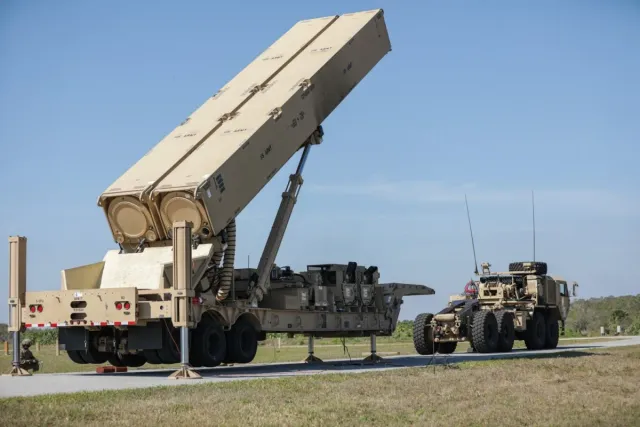
Strategic missiles
Dark Eagle (LRHW)Frequently asked questions
What is the Dark Eagle Long-Range Hypersonic Weapon? +
Dark Eagle, officially the Long-Range Hypersonic Weapon (LRHW), is a ground-mobile U.S. Army missile system that fires a conventionally armed, boost-glide hypersonic missile at speeds above Mach 5 to a range of about 3,500 kilometers. Lockheed Martin is the prime contractor, with Dynetics producing the glide body; a battery fields four launchers carrying eight missiles total.
Has Dark Eagle deployed overseas before? +
Yes. The Guam training is reported as the system's second deployment west of the International Date Line, after Dark Eagle's first overseas appearance in Australia's Northern Territory during Exercise Talisman Sabre 2025 in July 2025.
How far is Guam from China, and does that matter for this missile's range? +
Guam sits roughly 2,700 kilometers from the nearest Chinese coastline. Dark Eagle's reported 3,500 kilometer range leaves an 800 kilometer margin beyond that coastline, meaning a missile battery based on Guam could in principle reach targets across a wide arc of southeastern and eastern China, including Hainan, Guangdong, Fujian, Zhejiang and the approaches to Shanghai, not just the coast itself.
Is this the same story as WeaponSpecs' earlier report on Marine Corps air defense at Guam? +
No. WeaponSpecs previously covered the Marine Corps' Medium-Range Intercept Capability (MRIC), a short-to-medium-range air-defense interceptor system, being live-fire tested at the same Valiant Shield 2026 exercise on Guam. This story covers a different service (Army, not Marine Corps), a different mission (long-range offensive strike, not air defense), and a different system entirely.
More news


