Kizilelma Fires Roketsan's JET-230 Supersonic Missile in First Test
Turkey's jet-powered UCAV hit a naval target at 120+ km with a new supersonic missile, validating a stand-off strike role Baykar has been building toward since 2022.

Wikimedia Commons, CC BY 4.0, photo by Erişim
Turkey’s Bayraktar Kızılelma jet-powered unmanned combat air vehicle fired a Roketsan JET-230 supersonic missile for the first time and struck a naval target at a confirmed range of more than 120 kilometers, Baykar announced July 15. The test, conducted between July 8 and 13 out of the Turkish Air Force’s 5th Main Jet Base Command at Merzifon, is the first live demonstration of a stand-off, deep-strike weapon on the aircraft, a step beyond the close-air-support munitions and air-to-air missiles Kızılelma has fired in prior trials.
The test airframe, a serial production-standard aircraft carrying the tail designation S2, departed Baykar’s Akıncı Flight Training and Test Center in Çorlu, Tekirdağ, on July 8 carrying two JET-230 missiles. It flew the strike mission July 11 against a target over the sea, and Baykar’s chairman and chief technology officer Selçuk Bayraktar personally oversaw the test, calling it “yet another milestone” for the program in the company’s official release. One of the two carried missiles was fired; it hit the target directly.
What the JET-230 test actually validates
A 120-plus-kilometer strike range is not primarily about reach for its own sake. It is about where the launching aircraft has to be when it fires. Modern integrated air-defense systems, including the layered Russian- and Chinese-built networks Kızılelma’s export customers are most likely to face, build engagement rings around key assets that can extend well beyond visual range. A weapon that lets the launch platform release from 120 km or more out keeps that platform outside the densest part of those rings while still being able to hold a target at risk. That is the functional difference between Kızılelma as a reconnaissance-and-close-support drone and Kızılelma as a genuine stand-off strike asset, and it is the reason Baykar is promoting this specific test rather than treating it as a routine weapons trial.
Roketsan, the missile’s Turkish manufacturer, has described JET-230 as capable of reaching beyond 200 kilometers at full performance, a figure repeated in Baykar’s own messaging around the test. That number is a manufacturer claim, not an independently verified result. The July test confirmed a hit at 120-plus kilometers; it did not confirm the missile at its advertised maximum range, and multiple outlets covering the test noted the gap between the claimed ceiling and the demonstrated distance without further explanation from either company. Readers should treat 120-plus km as the number this test actually supports, and 200-plus km as Roketsan’s stated design target.
Program background: from reconnaissance drone to stand-off strike platform
Kızılelma first flew on December 14, 2022, becoming Turkey’s first indigenously developed jet-powered unmanned fighter-type aircraft. Baykar, the company behind the widely exported Bayraktar TB2 propeller-driven drone, designed Kızılelma as a faster, harder-to-detect follow-on: a low-observable-influenced airframe with an internal weapons bay, built from the outset for both conventional land bases and carrier operations from TCG Anadolu, Turkey’s light aircraft carrier and amphibious assault ship, which lacks the catapults or arrestor gear of a US-style carrier and instead relies on aircraft, manned or unmanned, capable of short takeoff.
The aircraft’s weapons testing has built up in stages. In November 2025 Kızılelma fired the Gökdoğan air-to-air missile against a target aircraft, an early proof of an autonomous air-to-air kill chain. In June 2026, the same S2 airframe used in the JET-230 test dropped TEBER-82 and LGK-82 guided glide bombs, munitions in the 250 kg class, guided by Turkey’s indigenous TOYGUN electro-optical targeting pod rather than any foreign targeting system, a milestone Baykar described as the aircraft’s first fully domestically guided strike. The JET-230 test extends that progression from close-in guided munitions to a genuine stand-off weapon.
Underpinning the added weapons capacity is an engine change. The first Kızılelma prototypes flew on the Ivchenko-Progress AI-25TLT, a non-afterburning turbofan producing roughly 16.9 kN of thrust. Serial-production aircraft, including the S2 used in this test, have moved to the AI-322F, an afterburning derivative of the same Ukrainian engine family rated around 24.5 kN dry and close to 44 kN with the afterburner lit, work that began integrating in 2025 with flight tests of the new powerplant running through late 2025. The extra thrust supports both a heavier weapons load and the higher-speed flight profile that a supersonic missile shot benefits from, and it is one of the clearer signs that Kızılelma’s Ukrainian supply relationship, forged in part through wartime cooperation, is now embedded in the production aircraft rather than limited to prototypes.
The strategic read is straightforward. A jet-powered UCAV that can fire a supersonic stand-off missile at 120-plus kilometers, carry precision-guided bombs with an indigenous targeting pod, and operate from both land bases and a light carrier gives Turkey a credible entry in a UCAV export market that has so far been dominated by Israeli systems like IAI’s Harop-family loitering munitions and, on the higher end, larger American platforms. Baykar has already built an export base with the propeller-driven TB2 and the larger Akıncı; a combat-tested, jet-powered, carrier-capable UCAV with its own stand-off missile is a different tier of product, and this test is the company’s public marker that the missile side of that package now works.
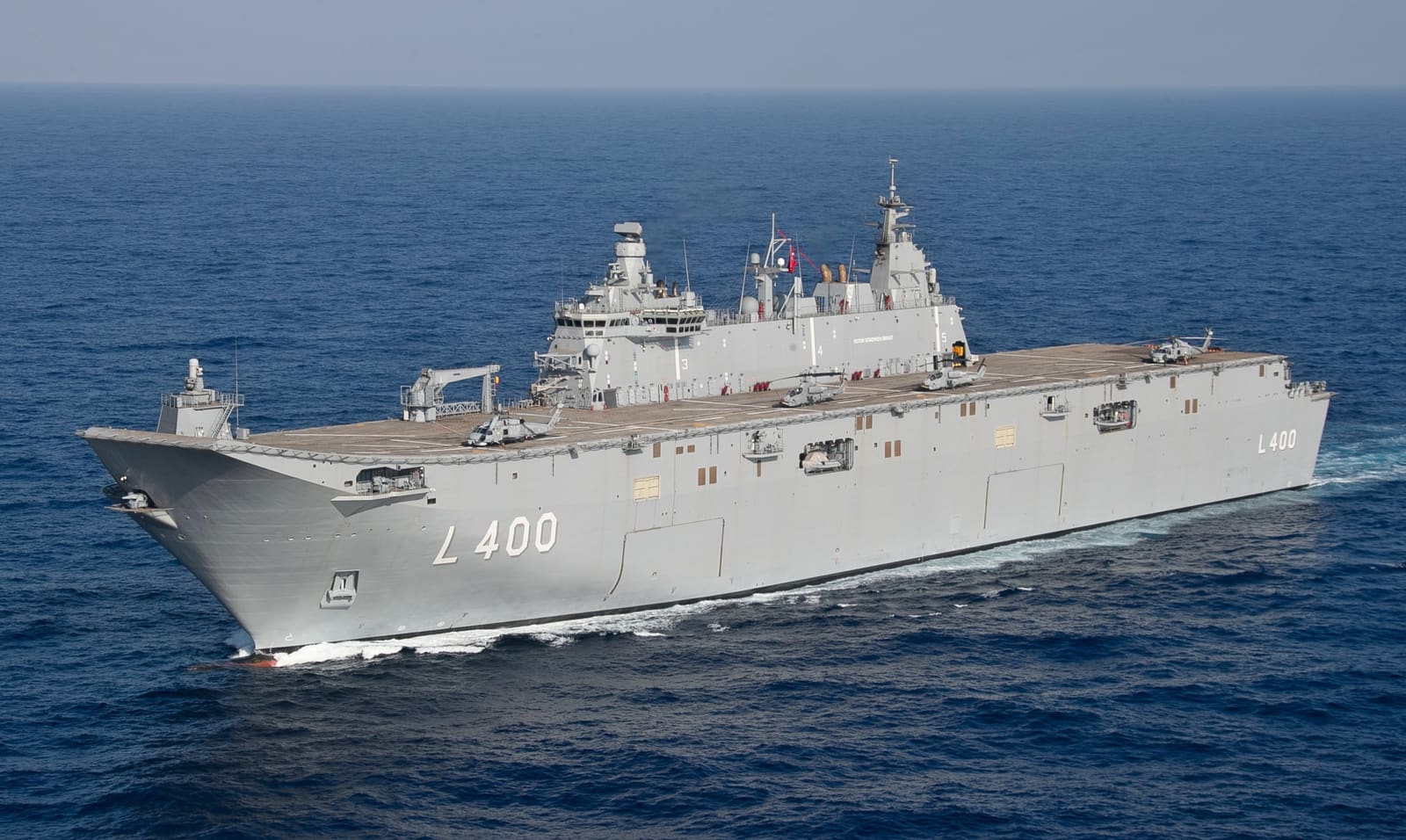
For identification, TCG Anadolu, the carrier Baykar is developing Kızılelma to operate from, is shown below during a 2023 multinational naval exercise in the Mediterranean.
No clean-license public photo of the JET-230 missile itself is currently available; Roketsan has not published imagery of the weapon, and searches of Wikimedia Commons and DVIDS turned up nothing usable.
Sources
- Bayraktar Kizilelma Strikes With Supersonic Missile — Baykar (official press release), Jul 15, 2026
- Bayraktar Kizilelma Hits Target With Supersonic JET-230 Missile — Türkiye Today, Jul 15, 2026
- Kizilelma UAV With Ukrainian Engine Fires JET-230 Missile for First Time, Successfully Hits Its Target — Defense Express (Ukraine), Jul 15, 2026
- Bayraktar Kizilelma Fires Roketsan's JET-230, First Supersonic Air-to-Ground Shot at 120 km — Quwa, Jul 14, 2026
Systems mentioned
Every system named in this story, with its photo and, where available, a video. Tap a card to open the full spec sheet.
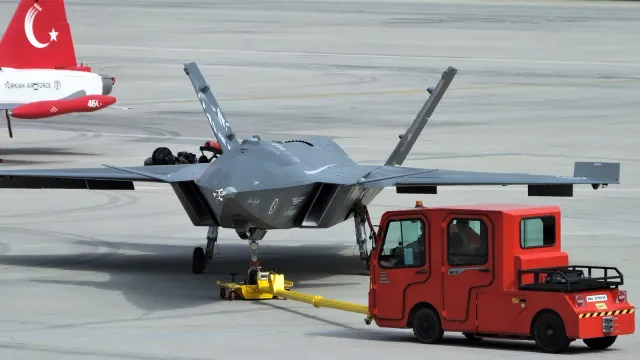
UAV / drone
Bayraktar KizilelmaFrequently asked questions
How far can the JET-230 missile travel? +
In the July 13, 2026 test, a Kizilelma-launched JET-230 struck a naval target at a confirmed range of more than 120 km. Roketsan and Baykar have stated the missile is designed for over 200 km, but that figure is a manufacturer claim that has not been independently verified in a public test.
Why does Kizilelma's new engine matter? +
The production-standard Kizilelma has moved from the non-afterburning Ivchenko-Progress AI-25TLT turbofan used on the first prototypes to the afterburning AI-322F, a Ukrainian engine rated around 24.5 kN dry and roughly 44 kN with afterburner. That extra thrust is what lets the aircraft carry a heavier stand-off weapon like JET-230 and fly the higher-speed profile a supersonic missile shot benefits from.
Can Kizilelma carry guided bombs too? +
Yes. In June 2026 the same S2 airframe test-fired TEBER-82 and LGK-82 guided glide bombs, in the 250 kg class, using Turkey's indigenous TOYGUN electro-optical targeting pod, a test Baykar described as its first fully domestically guided munitions drop from the type.
Where would Turkey deploy Kizilelma operationally? +
Baykar is developing Kizilelma for both conventional land air bases and carrier operations from TCG Anadolu, Turkey's light aircraft carrier and amphibious assault ship. A stand-off missile like JET-230 is relevant to both basing modes, since it lets the launch aircraft stay outside the engagement envelope of dense air-defense systems.
More news


_steams_in_the_Mediterranean_Sea.jpg)