Turkey's Second KAAN Fighter Prototype Starts Taxi Tests
TAI's P1 prototype moved under its own power July 31 as Turkey races toward a 2028 delivery date and a $10B Indonesian export contract.

Dimir (Hindukush2), Wikimedia Commons, CC BY-SA 4.0
Turkish Aerospace Industries moved its second KAAN fighter prototype, designated P1, under its own power for the first time on July 31, completing a pre-flight taxi test at the company’s Ankara facility and putting Turkey’s indigenous fifth-generation fighter program on the final approach to its second-ever flight.
A second, more mature prototype takes the runway
KAAN’s first prototype, P0, made program history on February 21, 2024, with a 13-minute maiden flight that reached roughly 8,000 feet and 230 knots, followed by a longer second flight that May. P1 is a distinct, more mature airframe built to carry the actual flight-test campaign forward, with a third prototype, P2, already under assembly behind it. A powered taxi test is the standard final gate before a new aircraft is cleared to fly: it confirms the engines run cleanly at operational power, that the brakes and nosewheel steering respond correctly, and that the flight-control surfaces move as commanded, all while the jet is still safely on the ground. TAI has not disclosed further technical detail from the test beyond confirming it was completed with technical personnel present, but the company’s own timeline leaves little ambiguity about what comes next.
Speaking at the Farnborough International Airshow as the taxi-test news broke, TAI CEO Mehmet Demiroglu set the clearest public timeline yet for the program. “We hope to see KAAN in the sky within a few months,” he said. “We also aim to fly the second aircraft by the end of the year.” He added: “Our goal is to have two KAANs flying one after the other, or side by side, at year-end,” a target that would mark the first time the program has had two prototypes airborne together, a meaningful jump in flight-test tempo from the single-aircraft campaign that has defined KAAN since 2024.
“We hope to see KAAN in the sky within a few months. We also aim to fly the second aircraft by the end of the year,” said Mehmet Demiroglu, CEO of Turkish Aerospace Industries (Turkiye Today, July 31, 2026).
The engine problem the taxi test doesn’t solve
KAAN, formally the Milli Muharip Ucak (MMU) program and also referred to by its earlier working name TF-X, is a twin-engine, low-observable multirole fighter designed to eventually replace the Turkish Air Force’s roughly 240 F-16s, including aircraft like the F-16C Block 52 and newer F-16C Block 70 that make up the bulk of Turkey’s current fighter fleet. Reported figures point to an initial production contract for 20 Block 10 aircraft, inside a total planned run of roughly 250 series-production jets plus the handful of pre-production prototypes, with first delivery to the Turkish Air Force targeted for 2028. WeaponSpecs’ own database lists KAAN’s twin engines, Mach 1.8 top speed and a service ceiling near 16,800 meters, broadly in line with Turkiye Today’s July 31 figure of 55,000 feet; the two sources diverge more on wingspan, with WeaponSpecs recording 12 meters against Turkiye Today’s reported 14 meters, a discrepancy this desk cannot yet resolve and is noting rather than picking a side on.
The taxi test says nothing about the program’s most consequential open question: what powers the jet once it reaches series production. KAAN’s prototypes and roughly the first 40 production aircraft are slated to fly on imported General Electric F110-GE-129 turbofans, each rated around 29,000 lbf of thrust, with Washington having cleared export of 80 such engines, enough for that initial batch of twin-engine jets. Turkey’s answer to that dependency is the domestically developed TF35000, targeting roughly 35,000 lbf (about 156 kN) of thrust, a meaningful step up from the F110. TEI general manager Prof. Mahmut Faruk Aksit announced in February 2026 that TF35000 had entered Critical Design Review, a formal engineering milestone, but as of mid-2026 no completed first engine run or flight-ready prototype had been publicly reported, and the engine is not expected to power production KAANs until around 2032. Until then, every KAAN that flies, including the export jets ordered by Indonesia, depends on American engine hardware and the export approvals that come with it, a strategic exposure Ankara has been open about wanting to close.
Why an export customer is already watching closely
The taxi test lands roughly a year after Turkey’s most consequential KAAN news to date: a government-to-government deal signed with Indonesia at IDEF Istanbul in July 2025 for 48 jets worth more than $10 billion, Turkey’s first fighter export and by far its largest defense export contract, structured to phase deliveries over roughly a decade alongside local Indonesian assembly and technology transfer. That deal predates this week’s development and isn’t new, but it is the reason P1’s flight-test tempo now matters commercially as well as technically: an export customer that has already committed billions of dollars is watching the same maiden-flight timeline as the Turkish Air Force, and any slip pushes back deliveries on both sides of that contract at once. A second prototype flying alongside P1 by year-end, if TAI hits its own target, would be the clearest evidence yet that the program can sustain the flight-test pace its delivery commitments require.
Sources
- Turkey's Latest Kaan Fighter Prototype Begins Taxi Tests — The War Zone, Jul 31, 2026
- Turkiye's homegrown Kaan fighter jet completes pre-flight taxi test — Daily Sabah, Jul 31, 2026
- KAAN's new prototype begins taxi tests ahead of maiden flight — Turkiye Today, Jul 31, 2026
- Turkiye's KAAN P1 Nears Maiden Flight as TF35000 Engine Race Challenges F110 Dependence — Defence Security Asia, Jul 27, 2026
Systems mentioned
Every system named in this story, with its photo and, where available, a video. Tap a card to open the full spec sheet.
Compare these side by side →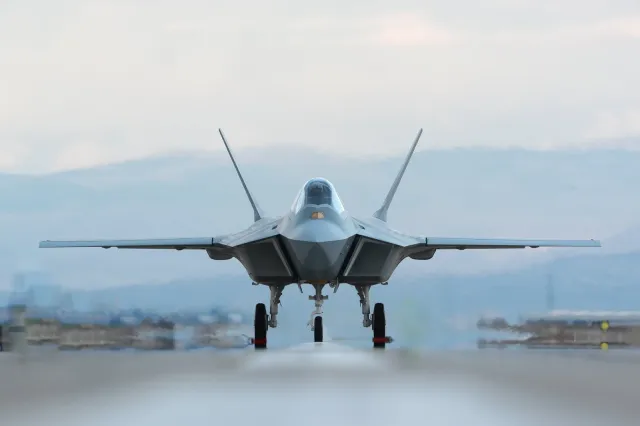
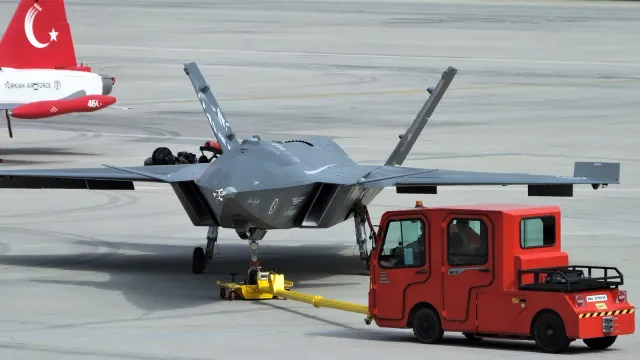
UAV / drone
Bayraktar Kizilelma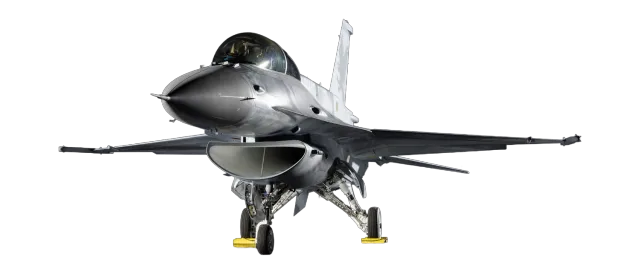
Fighter aircraft
F-16C Block 52 Fighting Falcon Fighter aircraft
F-16C Block 70/72 Fighting FalconFrequently asked questions
What is KAAN? +
KAAN (also known by its program name Milli Muharip Ucak, or MMU, and formerly TF-X) is Turkey's indigenous twin-engine, low-observable fifth-generation fighter, built by Turkish Aerospace Industries (TAI/TUSAS) to eventually replace the Turkish Air Force's roughly 240 F-16s.
Why does the taxi test matter? +
Powered taxi testing verifies that a prototype's engines, brakes, steering and flight-control systems all work correctly together on the ground, the last major checkpoint before a jet is cleared to fly. P1 is the more flight-mature of KAAN's two active prototypes, so its taxi test is the clearest signal yet that a maiden flight is close.
Is KAAN reliant on US engines? +
Yes, for now. Early aircraft and roughly the first 40 production jets use imported General Electric F110-GE-129 turbofans, with Washington having cleared export of 80 such engines. Turkey's domestic TF35000 engine, which cleared its Critical Design Review in February 2026, is not expected to power production KAANs until around 2032.
Has anyone bought KAAN? +
Indonesia signed a government-to-government deal in July 2025 for 48 KAAN jets worth more than $10 billion, phased over roughly a decade with local assembly and technology transfer in Indonesia. It is Turkey's first fighter export and its largest defense export ever, though it predates this week's taxi test by a year.
More news


