Indonesia signs ~$630M BrahMos missile deal with India
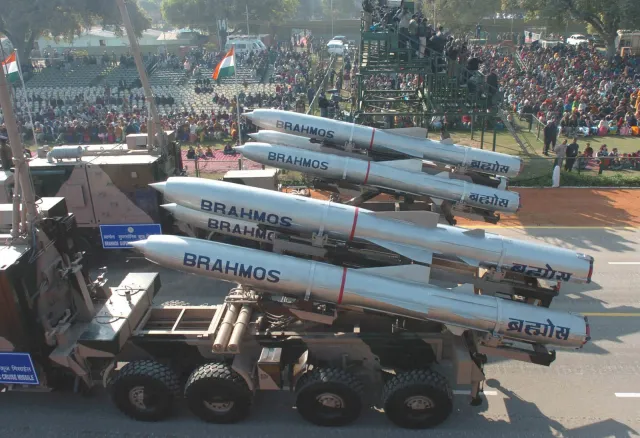
Indonesia has become BrahMos's third export customer in an agreement worth an estimated $630 million, signed alongside high-level India-Indonesia talks and following the Philippines and Vietnam into the supersonic cruise missile's client list.

Ank Kumar, Infosys Limited, CC BY-SA 4.0, via Wikimedia Commons
By the numbers

Infographic: WeaponSpecs News Desk
Indonesia has signed an agreement to purchase India’s BrahMos supersonic cruise missile in a deal reported at approximately $630 million, becoming the missile’s third export customer after the Philippines and Vietnam, according to Naval News and The Jakarta Post. The agreement was signed on or around July 7, 2026, during a period of elevated India-Indonesia engagement that included talks between the two countries’ leaders, and marks New Delhi’s largest publicly reported BrahMos export contract to date.
For BrahMos, a joint India-Russia missile developed by BrahMos Aerospace, a partnership between India’s Defence Research and Development Organisation and Russia’s NPO Mashinostroyeniya, this is the latest step in a slow but steady export expansion that began with the Philippines’ 2022 order and continued with Vietnam’s 2023 agreement. Indonesia’s entry brings ASEAN’s largest economy into that customer circle, at a moment when India is actively trying to establish itself as a credible exporter of complete weapons systems rather than components or licensed sub-assemblies.
What BrahMos actually is
BrahMos is a supersonic anti-ship and land-attack cruise missile capable of speeds around Mach 2.8, powered by a ramjet engine with a solid rocket booster for initial acceleration. According to WeaponSpecs’ own systems database, it carries a roughly 200-kilogram semi-armor-piercing or high-explosive blast-fragmentation warhead, guided by inertial navigation with GPS/GLONASS midcourse updates and active radar terminal homing, and can be launched from ships, submarines, aircraft and land-based platforms. Its reported range sits at approximately 450 kilometers, an extended-range figure that became publicly discussable after India’s 2016 accession to the Missile Technology Control Regime, which had previously capped exportable cruise missile ranges at 300 kilometers.
That speed is the missile’s defining commercial pitch. A supersonic missile gives a defending warship’s crew and automated defenses dramatically less reaction time than a subsonic weapon covering the same distance, a real tactical distinction from missiles like the US-made Harpoon or French Exocet that Indonesia and other regional navies already operate. It’s frequently described, including in WeaponSpecs’ own system summary, as the fastest anti-ship cruise missile in operational service anywhere, a claim rooted in its publicly documented speed figures rather than a marketing assertion alone.
Why Indonesia, and why now
Indonesia sits astride the Malacca Strait, one of the world’s busiest and most strategically sensitive shipping chokepoints, and as ASEAN’s largest economy it has been steadily modernizing its military procurement across multiple suppliers in recent years. A supersonic anti-ship missile fits directly into a coastal-defense and sea-denial posture built around controlling access to that strait, complementing rather than replacing the country’s existing inventory of subsonic Western missiles.
The deal also lands squarely inside India’s broader Indo-Pacific positioning. New Delhi has been explicit in recent years about wanting defense-export relationships that build strategic goodwill alongside commercial revenue, particularly with partners it sees as counterweights to Chinese influence in the region. A confirmed, high-value BrahMos sale to Indonesia gives India a third data point, after the Philippines and Vietnam, that its co-developed missile can win contracts against established Russian, American, French and Chinese suppliers competing for the same regional defense budgets.
Each of the three prior BrahMos deals has followed a broadly similar shape: a Southeast or South Asian navy facing a maritime chokepoint or contested waters, weighing a supersonic missile against slower but cheaper Western alternatives, and ultimately choosing speed and India’s financing terms over an established Western brand name. The Philippines’ 2022 order equipped its coastal defense regiment facing the South China Sea, and Vietnam’s 2023 agreement followed a similar logic along its own contested maritime approaches. Indonesia’s decision extends that pattern into the Malacca Strait, arguably the single most consequential chokepoint of the three given the volume of global shipping that transits it daily.
The reported deal value, and what’s still unconfirmed
Public reporting on the contract’s value has clustered in a range of roughly $600 million to $650 million, which this story states as “approximately $630 million” rather than a single false-precision figure the underlying sourcing doesn’t support. Neither Naval News nor The Jakarta Post published a fully itemized contract breakdown covering unit counts, delivery timeline, or which specific platforms (naval vessels, coastal batteries, or aircraft) will carry Indonesia’s BrahMos missiles, details that are common to keep confidential in early-stage defense export announcements and that this story does not attempt to guess at.
A Bloomberg report on the same deal was identified during research but returned an HTTP 403 error on verification and is not cited here, consistent with WeaponSpecs’ policy of only citing sources whose content can be independently confirmed to load.
Sources
- Indonesia Signs BrahMos Missile Deal With India — Naval News, Jul 7, 2026
- Indonesia, India sign BrahMos missile deal — The Jakarta Post, Jul 7, 2026
Systems mentioned
Every system named in this story, with its photo and, where available, a video. Tap a card to open the full spec sheet.
Frequently asked questions
Why did Indonesia choose BrahMos over Western alternatives? +
BrahMos is a supersonic missile that closes on a target far faster than subsonic anti-ship weapons like Harpoon, cutting the time a defending ship has to react. India has also offered financing and industrial-cooperation terms that Western suppliers have been less willing to match, a pattern already visible in its Philippines and Vietnam deals.
What does this mean for India's defense-export ambitions? +
It's India's third confirmed BrahMos export success, after the Philippines in 2022 and Vietnam in 2023, and its largest reported contract value yet. That gives New Delhi a track record as a credible systems exporter beyond one-off sales, a central goal of its defense-industrial policy.
Is this the same BrahMos used by India's own forces? +
It's the same missile family, developed jointly by India's DRDO and Russia's NPO Mashinostroyeniya through the BrahMos Aerospace joint venture, but export variants are built to comply with the Missile Technology Control Regime's 300-kilometer range cap that applied before India's 2016 MTCR accession. The exact range and seeker configuration of Indonesia's variant has not been made public, so specifics of the export configuration are not independently confirmed here.
How does BrahMos compare to China's growing missile exports in the region? +
China has expanded exports of systems like the CM-302 anti-ship missile and various ballistic-missile families to a smaller circle of partners, largely on state-to-state terms that are harder to independently verify. BrahMos's three confirmed Southeast/South Asian customers and India-Russia co-development give it a more transparent commercial track record for outside comparison, without implying a judgment on either system's capability.
More news


