Why 78% of Cruise Missiles Still Fly Subsonic
21 of 27 cruise missiles in the WeaponSpecs database fly under Mach 1, 78%. It's a design choice: altitude beats speed as the real stealth lever.

Via Wikimedia Commons, Babur cruise missile displayed at IDEAS 2008, CC BY-SA 3.0 (shown for identification)
Of 27 cruise and anti-ship missiles in the WeaponSpecs database that publish a top speed, 21 (78%) fly at or below Mach 1, some as slow as Mach 0.7, barely faster than an airliner. That is not a sign the field is stuck in the past. It is a deliberate tradeoff: a missile skimming a few meters above the ocean stays below a warship’s radar horizon until it is already close, and altitude, not raw speed, is the variable actually buying that stealth.
How Many Cruise and Anti-Ship Missiles in the Database Are Actually Supersonic?
Just 6 of the 27 missiles in this dataset (22%) clear Mach 1. The other 21 (78%) sit at or below it, and the gap between the two groups is not subtle: the slowest supersonic entry, Hsiung Feng III at Mach 2.5, is still more than 2.6 times faster than the fastest subsonic one.
| Missile | Origin | Range (km) | Top speed (Mach) | Class |
|---|---|---|---|---|
| Kh-31 | Russia (state claim) | 110 | 4 | Supersonic |
| YJ-12 | China (state claim) | 400 | 3 | Supersonic |
| BrahMos | India (Indo-Russian JV) | 450 | 3 | Supersonic |
| P-800 Oniks | Russia (state claim) | 600 | 3 | Supersonic |
| YJ-18 | China (state claim) | 540 | 3 | Supersonic |
| Hsiung Feng III | Taiwan | 150 | 3 | Supersonic |
| Kh-59 | Russia (state claim) | 285 | 1 | Subsonic |
| Exocet AM39 | France | 70 | 1 | Subsonic |
| Naval Strike Missile | Norway | 185 | 1 | Subsonic |
| Exocet MM40 Block 3 | France | 200 | 1 | Subsonic |
| R-360 Neptune | Ukraine | 300 | 1 | Subsonic |
| C-802AK | China (state claim) | 180 | 1 | Subsonic |
| Gabriel | Israel | 200 | 1 | Subsonic |
| Teseo/Otomat Mk2 Block IV | Italy | 180 | 1 | Subsonic |
| YJ-83 | China (state claim) | 200 | 1 | Subsonic |
| Harpoon Block II | United States | 124 | 1 | Subsonic |
| AGM-158C LRASM | United States | 370 | 1 | Subsonic |
| Marte ER | Italy | 100 | 1 | Subsonic |
| Babur-3 | Pakistan | 700 | 1 | Subsonic |
| AGM-158B JASSM-ER | United States | 925 | 1 | Subsonic |
| Kalibr (3M-14) | Russia (state claim) | 2,500 | 1 | Subsonic |
| Storm Shadow | United Kingdom | 560 | 1 | Subsonic |
| Taurus KEPD 350 | Germany | 500 | 1 | Subsonic |
| Kh-35U | Russia (state claim) | 260 | 1 | Subsonic |
| Kh-101 | Russia (state claim) | 4,500 | 1 | Subsonic |
| Tomahawk Block V | United States | 1,600 | 1 | Subsonic |
| Kh-55 | Russia (state claim) | 2,500 | 1 | Subsonic |
The dashed line marks Mach 1.0. Six missiles clear it; the other twenty-one, spanning eight countries and four decades of design, cluster tightly between Mach 0.7 and Mach 0.95. Eleven of the twenty-seven missiles (41%) carry Russian or Chinese state or manufacturer figures, flagged here as unverified claims, not a judgment on capability.
Being a Russian or Chinese state claim is not the same thing as being wrong, and it is not the same thing as being supersonic either. BrahMos (India, an Indo-Russian joint venture) and Hsiung Feng III (Taiwan) both clear Mach 1 without carrying that flag, while several Chinese subsonic missiles, YJ-83 and C-802AK among them, sit in the crowded subsonic cluster alongside Western and Ukrainian designs. The supersonic-versus-subsonic split and the verified-versus-state-claim split are two separate axes, and this dataset shows plenty of missiles on both sides of each.
Why Does Flying Low Matter More Than Flying Fast?
Radar detection range is bounded by the horizon, and the horizon shrinks fast as a target’s altitude drops. According to Wikipedia’s overview of sea-skimming missile design, a sea-skimmer flying at very low altitude can often go undetected by shipboard radar until it closes to somewhere in the range of 28 to 46km, giving a defending crew as little as 25 to 60 seconds to react once it is finally seen. That is the physical mechanism this entire dataset is built around: altitude, not speed, is what determines how far away a threat becomes visible in the first place.
Dr Sidharth Kaushal, a sea power research fellow at RUSI, has put concrete numbers on that same tradeoff for a specific case.
“A missile at a sea-skimming altitude, like the 3M-24’s 10m for instance, may only be detected at a range of 20nm. Detection at this range would give a ship around two minute’s warning for a subsonic missile,” said Dr Sidharth Kaushal, sea power research fellow at RUSI (Army Technology).
Kaushal’s own figures also note the flip side: a supersonic missile that has to fly higher to stay aerodynamically controllable at speed can be picked up at ranges up to 50 nautical miles, more than double the sea-skimmer’s 20nm horizon. That gap is worth turning into a simple, illustrative time-to-impact calculation, using the standard sea-level speed of sound (about 1,225 km/h) and Kaushal’s two cited detection ranges.
Illustrative simplified math, not measured combat data for any single missile: a Mach 0.8 sea-skimmer detected at Kaushal's cited 20nm gives about 136 seconds of warning, close to his own "around two minutes" figure. The starred bar is a hypothetical, a Mach 3.0 missile detected at that same 20nm horizon would give only about 36 seconds. But a real supersonic missile is typically detected farther out, around 50nm per Kaushal, which puts actual warning time at about 91 seconds, a roughly 35% cut from the subsonic baseline rather than the 75% cut the raw speed ratio would suggest.
That 35%-versus-75% gap is the article’s central point. The naive assumption is that a missile 3.75 times faster should give a defender roughly 3.75 times less warning. It doesn’t, because the altitude a supersonic missile needs to stay controllable at that speed gives back most of the advantage in detection terms. Speed alone is a much weaker stealth lever than the raw Mach number suggests. Altitude is the dominant variable, and a subsonic missile that can hug the wave tops the entire way is trading top speed for a detection range that arguably matters more.
What Does Supersonic Actually Cost a Missile Designer?
The speed-for-stealth tradeoff has a mirror-image cost on the range side of the ledger. Every supersonic missile in this dataset tops out at 600km (P-800 Oniks in its Russian non-export configuration), while several subsonic designs run far past that: 1,600km for Tomahawk Block V, 2,500km for both Kalibr and Kh-55, and 4,500km for Kh-101, a Russian state figure. A supersonic engine burns fuel fast and a sea-skimming sensor suite adds weight and drag, and a missile designer gets to spend a limited energy and payload budget on speed, range, or altitude tolerance, not all three at once.
No single system illustrates that tradeoff better than the P-800 Oniks, because it is the same missile flying three different profiles. Flying pure low-altitude sea-skim the entire way, it manages only about 120km. Flying a hi-lo profile, cruising high for fuel efficiency and diving to sea-skim only in the terminal approach, it stretches to roughly 300km. Flying full high-altitude cruise with no sea-skimming at all, the version Russia’s own military reportedly fields non-export, it claims up to 600km, the figure in the WeaponSpecs database and one worth treating as a Russian state or military claim rather than an independently confirmed figure. Same airframe, same engine, three very different ranges, purely as a function of how much stealth the flight profile sacrifices for fuel efficiency.
That is the mechanism behind every subsonic long-range missile in this list. Kh-101’s claimed 4,500km and Tomahawk’s 1,600km are not achieved by being faster; they are achieved by cruising efficiently at altitude for most of the flight and accepting a shorter, lower final approach, if any low-altitude approach at all. Supersonic missiles buy detection avoidance through raw closing speed over a shorter distance. Subsonic missiles buy it through altitude discipline over a much longer one. Neither is free.
What Should a Buyer or Analyst Take From This?
Subsonic sea-skimmers are not behind the times. Across this dataset they are the more common design specifically because sea-skimming buys both a smaller detection footprint and a longer range on the same fuel and airframe budget, a genuine two-for-one that a supersonic missile cannot match on either count. What supersonic buys instead is a harder physical intercept problem once a missile is finally detected: a faster closing speed leaves a ship’s point-defense systems less time to react, re-engage, and confirm a kill before impact, which matters even though that detection happens farther out.
There is no universally better answer here, only role fit. A navy expecting to fight inside a contested littoral where detection is likely regardless of altitude might prefer the shorter, faster intercept window a supersonic missile forces. A navy or air force valuing standoff range and a longer approach that stays hidden as long as possible has 21 of 27 systems in this database making the opposite bet. Reading a missile’s Mach number in isolation, without also reading its range and flight-profile discipline, misses the tradeoff that is actually driving the design.
Browse the full missile category for every system in this analysis, run a side-by-side in Compare, or build a mission-specific shortlist with the Advisor tool.
Sources
Systems in this comparison
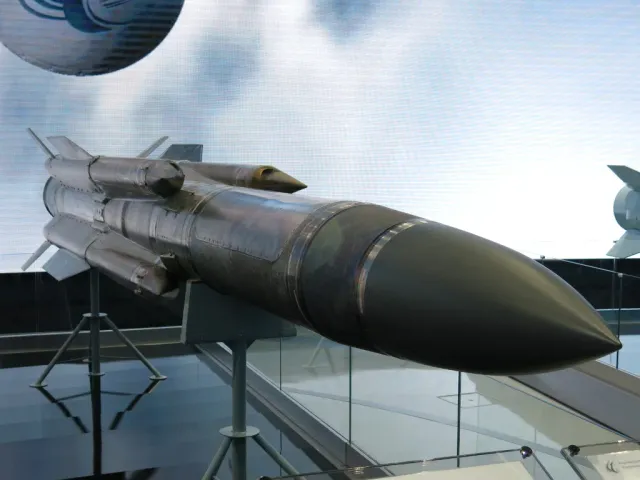
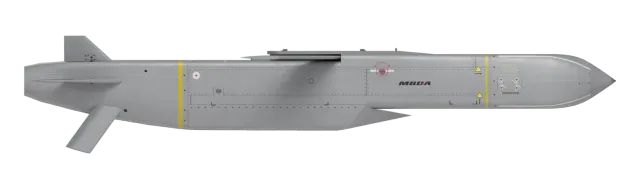
Every system covered above, with its photo and, where available, a video. Tap a card to open the full spec sheet.
Compare these side by side →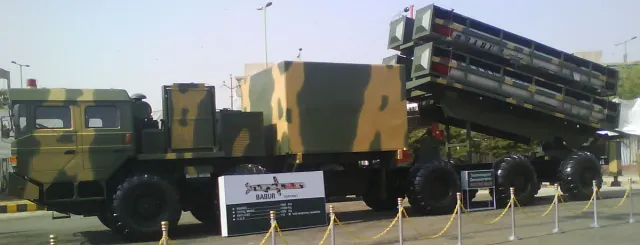
Frequently asked questions
Are subsonic cruise missiles obsolete compared to supersonic designs? +
No. Of 27 cruise and anti-ship missiles in the WeaponSpecs database that disclose a top speed, 21 (78%) fly at or below Mach 1, including missiles fielded as recently as the 2020s. That's a deliberate design tradeoff, not obsolescence: flying low and slow keeps a missile below a warship's radar horizon longer, and the same airframe choices that enable sea-skimming also tend to buy range, with subsonic designs in the database reaching as far as 4,500km versus a 600km ceiling for every supersonic missile listed.
Why do sea-skimming missiles fly so close to the water? +
Radar can only see as far as the horizon lets it, and that horizon shrinks fast the lower a target flies. A missile skimming a few meters above the sea can go undetected until it is very close to its target. Per RUSI's Dr Sidharth Kaushal, a sea-skimming missile flying at roughly 10 meters altitude may only be picked up around 20 nautical miles out, giving a defending ship around two minutes of warning against a subsonic threat.
How much warning does a warship actually get against an incoming cruise missile? +
Using standard sea-level sound speed and Kaushal's cited detection ranges, a subsonic (Mach 0.8) sea-skimmer detected at 20 nautical miles gives roughly 136 seconds (about 2.3 minutes) of warning, consistent with Kaushal's own 'around two minutes' figure. This is illustrative simplified math, not a measured combat outcome for any specific missile, and it ignores maneuvering, jamming, and point-defense reaction time.
Why do Russian and Chinese cruise missiles favor supersonic speed more than Western designs? +
Of the six supersonic missiles in the WeaponSpecs database, four (Kh-31, P-800 Oniks, YJ-18, YJ-12) are Russian or Chinese, and 11 of the database's 27 missiles overall (41%) carry figures sourced from Russian or Chinese state or manufacturer claims rather than independent verification. The tradeoff is real regardless of who publishes the number: every supersonic missile in the dataset tops out around 600km of range, while several subsonic Western and Russian designs claim 1,600 to 4,500km.
What is a 'hi-lo' flight profile? +
It's a flight path that cruises at higher, more fuel-efficient altitude for most of a missile's flight, then dives to sea-skimming altitude only in the final approach to a target. Russia's P-800 Oniks shows this tradeoff on a single airframe: roughly 120km of range flying pure low-altitude sea-skim the whole way, about 300km on a hi-lo profile that only skims at the end, and up to 600km (a Russian non-export military figure) flying high-altitude cruise with no sea-skimming at all.
Related reading


