Comparing the World's Nuclear Arsenals in 2026
New START expired Feb 5, 2026, so no treaty now verifies any nation's warhead count; FAS puts the global total near 12,187, led by Russia's 4,400.

U.S. Air Force photo, via Wikimedia Commons, Public domain, LGM-30G Minuteman III test launch
For the first time since New START entered force in 2011, no treaty requires the United States or Russia to let outside inspectors verify how many nuclear warheads the other side actually deploys. The treaty officially expired on February 5, 2026, and nothing has replaced it. That leaves every number in this comparison, including the two arsenals that used to be the most reliably counted in the world, resting on the same kind of outside estimate long used for China, North Korea, India, Pakistan, and Israel. The Federation of American Scientists puts the global inventory at roughly 12,187 warheads, led by Russia’s estimated 4,400-warhead military stockpile and the United States’ 3,700.
Key takeaways:
- New START, the only treaty that required mutual on-site inspection of deployed strategic warheads, expired February 5, 2026, with no replacement in force, so every US and Russian figure below is now an outside estimate, not a verified count.
- FAS estimates Russia’s military stockpile at 4,400 warheads against the United States’ 3,700, together roughly 83% of the global inventory FAS puts at approximately 12,187.
- Of the nine nuclear-armed states, only Russia and the United States have ever operated under a mutually verified counting regime; France and the UK have made general declarations, and China, India, Pakistan, Israel, and North Korea have never published an official figure at all.
- WeaponSpecs’ own database lists Russia’s RS-28 Sarmat as the longest-range nuclear-capable missile at a claimed 18,000 km, 6,000 km beyond the longest range with independently corroborated test data, the US Trident II D5’s 12,000 km.
- The Minuteman III’s own database entry cites “1 deployed under New START,” a treaty-mandated cap that is no longer a legally enforceable requirement now that the treaty has expired, a concrete example of a once-verified number quietly going stale.
How many nuclear warheads does each country actually have?
FAS’s “Status of World Nuclear Forces” project, maintained by Hans M. Kristensen, Matt Korda, Eliana Johns, and Mackenzie Knight-Boyle, is the standard reference for these figures because it is one of the only efforts that reconciles satellite imagery, budget documents, and government statements into one comparable table across all nine nuclear-armed states. As of FAS’s early-2026 assessment, here is the full picture, sorted by military stockpile:
| Country | Military stockpile | Total inventory | Ever officially declared a figure? |
|---|---|---|---|
| Russia | 4,400 | 5,420 | Some (New START-era declarations, unverified since expiration) |
| United States | 3,700 | 5,042 | Some (New START-era declarations, unverified since expiration) |
| China | 620 | 620 | No official number ever published |
| France | 290 | 370 | General declarations only, no full accounting |
| United Kingdom | 225 | 225 | General declarations only, no full accounting |
| India | 190 | 190 | No |
| Pakistan | 170 | 170 | No |
| Israel | 90 | 90 | Never officially confirmed possessing nuclear weapons at all |
| North Korea | 60 | 60 | No |
Global total: FAS estimates approximately 12,187 warheads worldwide, about 9,745 of them in active military stockpiles, and roughly 3,912 believed deployed on operational forces. SIPRI’s 2025 yearbook independently arrives at a broadly consistent figure, about 12,241 warheads as of January 2025.
Only Russia and the United States have ever operated under a mutually verified counting mechanism, and even that mechanism just lapsed. France and the United Kingdom have made general declarations, London has stated a ceiling on its operational stockpile and Paris has described the shape of its arsenal, without publishing the kind of number-by-number accounting FAS assembles. China, India, Pakistan, and North Korea have released nothing official. Every figure for those four is a pure outside analyst estimate built from indirect evidence.
Israel is the starkest case on the list. FAS estimates Israel holds approximately 90 warheads; Israel has never officially confirmed possessing nuclear weapons at all, a deliberate policy of ambiguity it has maintained for decades. The number in the table above exists only because outside researchers built it from indirect evidence, not because any Israeli government statement confirms it.
Bars are square-root scaled so China through North Korea stay visible against Russia and the US across a 73x span; the table above has the real linear figures. Even the two accent-colored leaders rest on a counting mechanism that just expired.
“The nuclear weapon inventories of the nine-nuclear armed states… are largely shrouded in secrecy: only three of the nine states have ever publicly declared the size of their nuclear stockpiles… This means that any assessments of the size and composition of global nuclear arsenals are estimates. Such estimates are fraught with uncertainty because of the scarcity of authoritative sources and because of the nature of the methods used to analyse the limited data that is publicly available,” said Hans M. Kristensen, Director of the Nuclear Information Project at the Federation of American Scientists, and Matt Korda, Associate Senior Researcher at the SIPRI WMD Programme (SIPRI Topical Backgrounder, 14 June 2021).
Why did even the most reliable numbers on this page just get less reliable?
New START, the 2011 US-Russia Strategic Arms Reduction Treaty, was the only nuclear arms-control agreement in history that required mutual, on-site inspection and verified counting of deployed strategic warheads, capped at 1,550 per side. It officially expired on February 5, 2026, after Washington confirmed it would not seek an extension, according to Politico’s reporting from that day and Wikipedia’s account of the treaty. Russia’s Vladimir Putin had offered in September 2025 to keep observing the treaty’s numerical limits voluntarily for up to one year past expiration, until February 5, 2027, if the US reciprocated. That offer is a unilateral political statement, not a binding, inspected treaty, and it commits Russia to nothing that outside inspectors can independently check.
The practical effect: every US and Russian warhead figure in this piece now rests on the same kind of open-source estimate long applied to China, North Korea, India, Pakistan, and Israel. WeaponSpecs’ own database offers a small, concrete illustration. The Minuteman III’s entry describes its warhead loadout as “1-3 MIRV (W78/W87), 1 deployed under New START,” a treaty-mandated single-warhead download Washington adopted specifically to satisfy New START’s counting rules. With the treaty expired, that download is no longer legally binding. The “1 deployed” figure, once one of the most independently verified numbers in the entire nuclear world, is now a number that could change without any external inspection catching it.
Which nuclear-capable missile publishes the longest range?
Sorted by published maximum range, WeaponSpecs’ database of 13 nuclear-capable strategic missiles is led by Russia’s RS-28 Sarmat at a claimed 18,000 km, a Russian manufacturer and state figure with no independent Western confirmation. China’s DF-41 and DF-61 and North Korea’s Hwasong-18 tie for second at a claimed 15,000 km each, also state figures; Hwasong-18 is listed as announced rather than fully fielded, meaning it has not been flight-tested to that claimed range. Among missiles from a country that routinely publishes independently corroborated test data, the US Minuteman III tops out at 13,000 km silo-based, and the submarine-launched Trident II D5 at 12,000 km.
The retired Peacekeeper is included for historical reference only, not as part of the current US arsenal. Every tan bar rests on a manufacturer or state figure WeaponSpecs has not independently verified.
One honest data-quality note worth flagging rather than burying: three missiles in the database, China’s DF-31AG, Russia’s RS-24 Yars, and France’s M51, all list an identical maximum reentry speed of Mach 25, despite being different missiles from different countries built across different decades. That kind of exact round-number agreement across unrelated systems is far more likely to reflect a generic reentry-vehicle speed convention widely used in open-source reference material than three separately measured, missile-specific test results. Treat “Mach 25” wherever it appears in this database as a plausible reentry-speed ballpark, not a precise measured figure for any one missile.
How many warheads can a single missile actually carry?
MIRV, multiple independently targetable reentry vehicle, technology lets one missile release several warheads toward separate aimpoints after boost phase. How many depends on payload capacity, and the WeaponSpecs database records this as a range for six of these missiles, reflecting a genuine spread in open-source estimates rather than one number analysts agree on:
DF-41's band spans more than 3x from low to high estimate; Bulava publishes no range at all, just a flat 6, which reflects one confident-sounding source, not necessarily a more verified one.
Russia’s Sarmat carries the widest published band, 10 to 15 warheads, alongside a stated alternative loadout of up to three Avangard hypersonic glide vehicles instead of a MIRV bus entirely. China’s DF-41 spans 3 to 10, the widest proportional swing in the set. At the narrow end, Russia’s Bulava is credited with a flat 6 warheads, no published range at all, which does not make it a more verified figure, just a more precisely stated one from the same unverified source.
The width of an estimate is itself informative. China’s DF-61, not charted above because its own database entry states an estimate of up to roughly 12 warheads with, in its own words, “no official figure” at all, illustrates the far end of that spectrum: not just an unverified number, but one where analysts openly acknowledge they are estimating from indirect evidence rather than working from a leaked spec sheet or partial disclosure. Compare that to the Minuteman III’s “1 deployed under New START,” a number that, until this year, rested on an actual verified inspection regime rather than pure inference. That gap between a treaty-verified number and an open-source guess is exactly what disappeared on February 5, 2026.
The full comparison, all 15 systems
| Missile | Country | Range (km) | Warhead / MIRV | Status |
|---|---|---|---|---|
| RS-28 Sarmat | Russia* | 18,000 | up to 10-15 MIRV or 3 Avangard HGVs | Active |
| DF-41 | China* | 15,000 | est. 3-10 MIRV (estimates vary) | Active |
| DF-61 | China* | 15,000 | est. up to ~12 MIRV, no official figure | Active |
| Hwasong-18 | North Korea* | 15,000 | 1 (single warhead) | Announced, not tested to claimed range |
| Minuteman III | United States | 13,000 | 1-3 MIRV (W78/W87), 1 deployed under New START | Active |
| Sentinel | United States | 13,000 | 1 (W87-0/W87-1) | Announced, not yet fielded |
| Trident II D5 | United States | 12,000 | up to 8-12 MIRV (W76/W88) | Active |
| DF-31AG | China* | 11,700 | 1 (possible MRV/MIRV on variants) | Active |
| RS-24 Yars | Russia* | 11,000 | 3-4 MIRV (~150-500 kt each) | Active |
| JL-3 | China* | 10,000 | MIRV-capable, est. 3 | Active |
| M51 | France | 10,000 | 6-10 MIRV (TN75/TNO) | Active |
| Peacekeeper | United States | 9,600 | up to 10 MIRV (W87) | Retired, historical reference only |
| Bulava | Russia* | 9,300 | 6 MIRV (~100-150 kt each) | Active |
| Dark Eagle (LRHW) | United States | 3,500 | N/A, conventional hypersonic glide vehicle | Conventional, non-nuclear |
| TAYFUN Block 4 | Turkey | 1,000 | N/A, conventional HE/fragmentation | Conventional, non-nuclear |
* Russian, Chinese, or North Korean manufacturer/state figure, not independently verified by WeaponSpecs.
The last two rows are conventional systems, not nuclear-capable, included only to show that “strategic missile” and “nuclear missile” are not the same category. Neither the Dark Eagle nor the TAYFUN Block 4 belongs in the nuclear-capable rankings above.
The bottom line
None of this is cause for alarm, it is a case for precision. An analyst who treats every figure here, Russian, Chinese, American, or otherwise, as a bounded range rather than a confirmed count will read the real state of the world’s arsenals more accurately than one chasing a single exact number. That was already true for seven of these nine countries before this year. As of February 2026 it is true for the other two as well, the arsenals that briefly had something better.
Compare individual strategic missiles, including the Sarmat, Minuteman III, and Trident II D5, head to head in the comparison tool, or browse the full strategic-missile category on WeaponSpecs.
Sources
Systems in this comparison
Every system covered above, with its photo and, where available, a video. Tap a card to open the full spec sheet.
Compare these side by side →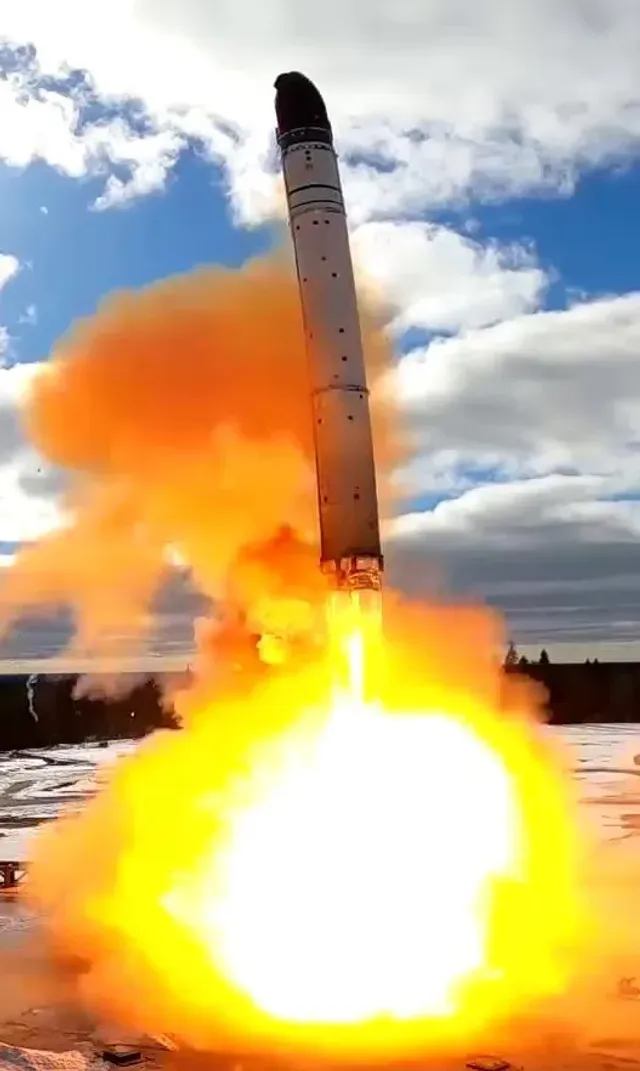
Strategic missiles
RS-28 Sarmat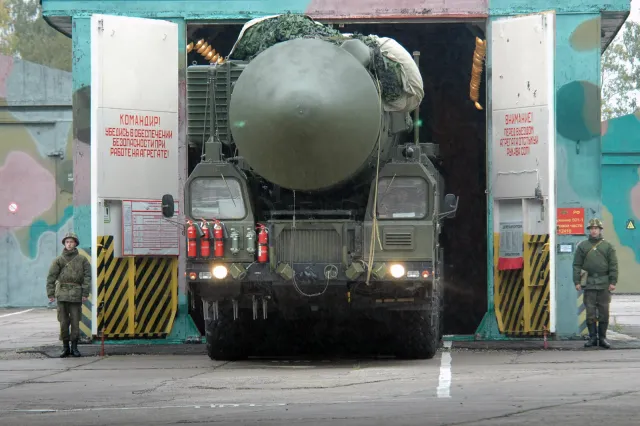
Strategic missiles
RS-24 Yars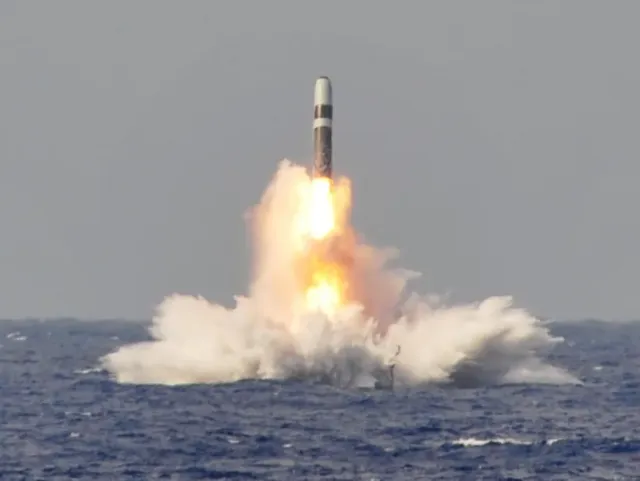
Strategic missiles
UGM-133A Trident II D5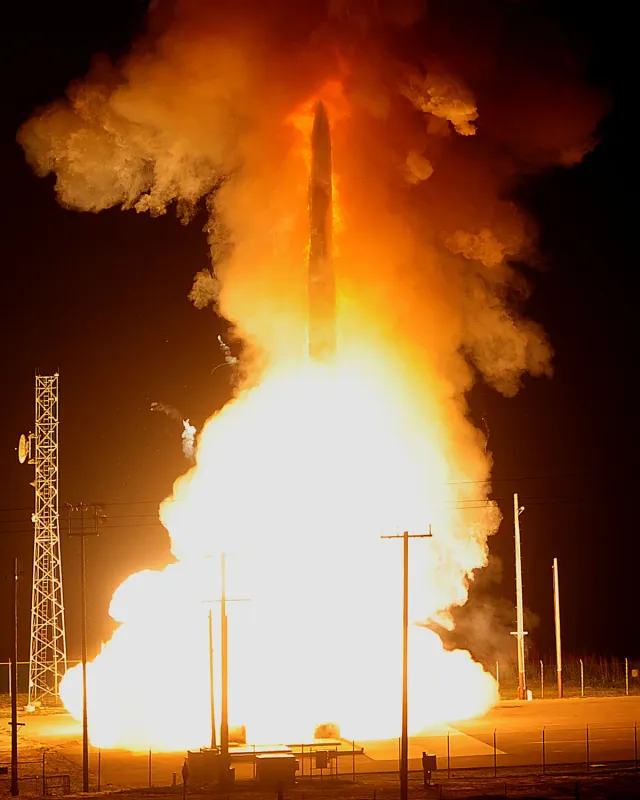
Strategic missiles
LGM-30G Minuteman III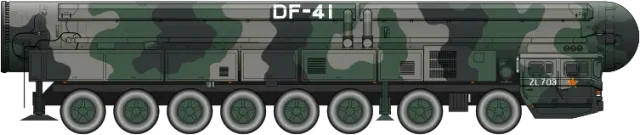
Frequently asked questions
How many nuclear warheads does the US have compared to Russia in 2026? +
The Federation of American Scientists estimates the United States holds a military stockpile of 3,700 warheads against Russia's 4,400, per FAS's early-2026 'Status of World Nuclear Forces' assessment. Counting warheads retired and awaiting dismantlement, total inventories sit at 5,042 for the US and 5,420 for Russia. Both figures are outside researcher estimates, not official government-published exact counts, and that gap in precision has only widened since New START expired in February 2026.
Why do China's and North Korea's warhead counts remain estimates with no official figure? +
Neither government has ever published an actual stockpile number. China's stated nuclear policy emphasizes minimum deterrence and no-first-use without disclosing a count, so FAS's figure of 620 warheads is built from satellite imagery of missile-silo construction and other open-source indicators, not a government release. North Korea, credited with roughly 60 warheads, publishes even less; most of what's known comes from missile and satellite tests plus estimated fissile-material production, not any declared inventory.
What happened to New START, and why does its expiration matter for verifying arsenal size? +
New START, the US-Russia treaty capping each side at 1,550 deployed strategic warheads with mutual on-site inspections, officially expired on February 5, 2026, with no successor treaty in force. For the first time since it entered force in 2011, no agreement requires either country to let outside inspectors verify how many warheads it actually deploys. Putin offered in September 2025 to keep observing the treaty's numerical limits voluntarily for up to a year past expiration, but that is a unilateral political statement, not a binding, inspected treaty.
Which nuclear-capable missile in the WeaponSpecs database publishes the longest range? +
Russia's RS-28 Sarmat publishes the longest range in the WeaponSpecs database at 18,000 km, a Russian manufacturer and state figure with no independent Western confirmation. China's DF-41 and DF-61 and North Korea's Hwasong-18 tie for second at a claimed 15,000 km each. Among missiles fielded by a country that routinely publishes independently corroborated test data, the US Trident II D5 tops out at 12,000 km.
How many warheads can a single MIRV missile carry? +
It varies widely, and the width of the published range matters as much as the number itself. Russia's RS-28 Sarmat is credited with up to 10 to 15 independently targetable warheads, the widest published band in the WeaponSpecs database, while the US Trident II D5 carries an estimated 8 to 12. A tighter band generally signals a more established, longer-scrutinized design; a wide band signals more analyst uncertainty about the real payload.
Related reading


