Troop Capacity Per Ton: What IFV Weight Actually Buys
FNSS Zaha carries 21 troops at 30 tonnes, more than any IFV in our database; Ajax carries 3 at 38 tonnes, a 13.96x range across 67 ranked systems.

Via Wikimedia Commons, FNSS ZAHA amphibious assault vehicle at IDEF 2019, CC BY-SA 4.0
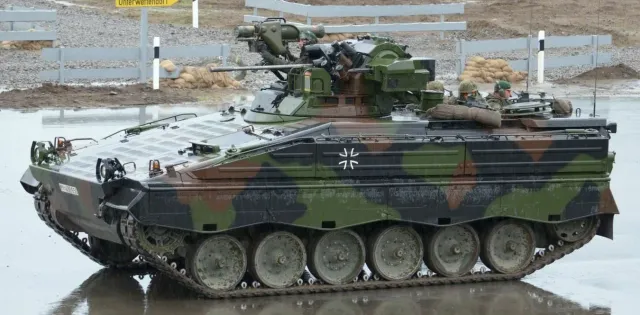
The FNSS Zaha, a Turkish amphibious troop carrier, publishes room for 21 dismounted troops at a combat weight of just 30 tonnes, lighter than Germany’s Marder, which carries a third as many troops (6) at 33.5 tonnes. Across the 67 IFV and APC-class systems in WeaponSpecs’ database that publish both figures, troop capacity per ton of weight spans a 13.96x range, from Israel’s RAM 2000 Sandcat at 1.103 troops per ton down to the UK’s Ajax at 0.079. That range is not a quality ranking. It is a map of where a vehicle’s weight budget actually goes.
Key takeaways:
- The FNSS Zaha carries 21 troops at 30 tonnes, more than double the next-highest dismount capacity of any IFV/APC-class vehicle in the WeaponSpecs database.
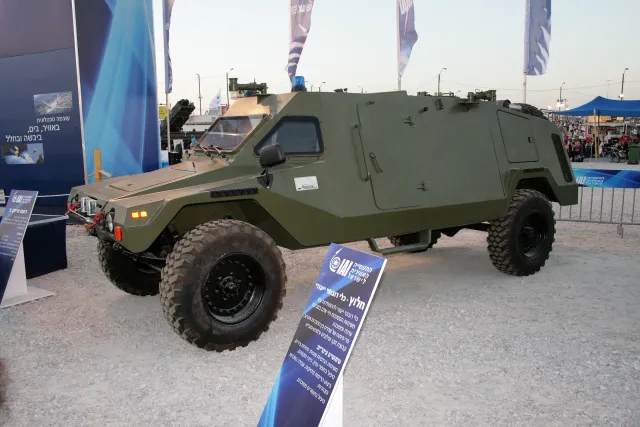
- The RAM 2000 Sandcat posts the highest troops-per-ton ratio overall at 1.103 (8 troops, 7.3 tonnes), the lightest vehicle in the comparison.
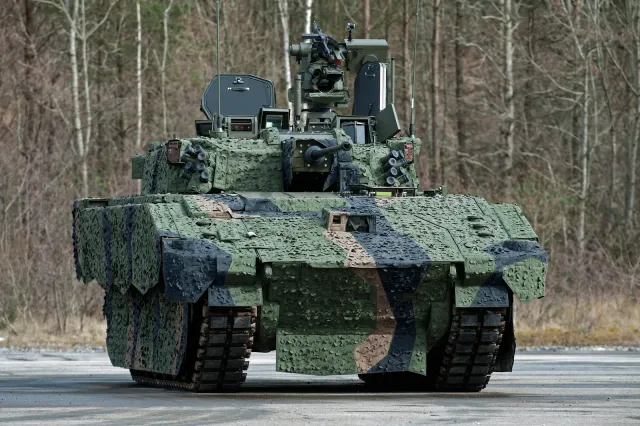
- The UK’s Ajax posts the lowest ratio at 0.079 (3 troops, 38 tonnes), but it is built as a reconnaissance and scout vehicle, not a dedicated troop carrier.
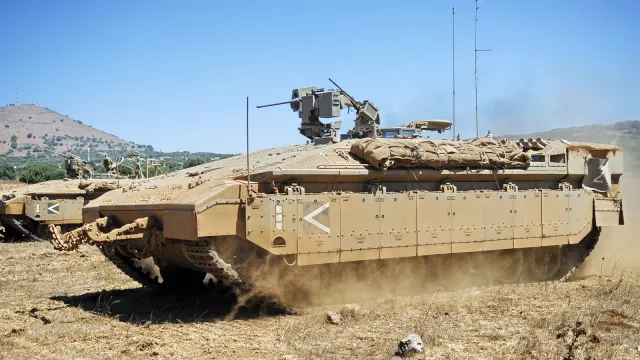
- The four database systems flagged with explosive reactive armor, both Bradley variants, the Namer, and Russia’s T-15 Armata, average 0.187 troops per ton, about half the 0.368 fleet median.
- 67 of 76 (88%) IFV-type systems in the database publish both a combat weight and a troop capacity figure.
What does troop capacity per ton actually reveal?
A vehicle’s combat weight pays for several things at once: armor, a turret and its weapon system, a powertrain strong enough to move all of that, fuel, ammunition, and, last, seats for dismounted infantry. Troop capacity per ton is a rough way to see how much of that weight budget a given design spent on the seats versus everything else. It says nothing about a vehicle’s survivability, firepower, or battlefield record on its own, a low ratio can just as easily mean “built to survive a direct hit” as it can mean “inefficient.”
Of the 76 systems tagged systemType: ifv in WeaponSpecs’ database, spanning true tracked IFVs, wheeled APCs, and MRAP-style protected carriers, 67 (88%) publish both a combat weight and a troop capacity figure, letting the ratio be computed directly rather than estimated.
The lightweight cluster at lower left, Sandcat, Casspir, Stryker, carries troops nearly as cheaply in weight terms as the amphibious Zaha. The heavy cluster at the right, CV90, Bradley, Marder, Puma, Namer, carries roughly the same troop count at two to three times the tonnage, because that extra weight bought armor and a turret, not seats.
Why do the lightest vehicles carry the most troops per ton?
The top of the ranking is dominated by wheeled MRAP-style carriers and light APCs: Israel’s Sandcat, South Africa’s Casspir, Indonesia’s Anoa, Turkey’s Kirpi, and the tracked, amphibious Zaha. None of these publish reactive armor, and their armor packages are built around mine and small-arms protection rather than surviving a hit from another IFV’s autocannon or an anti-tank guided missile. A wheeled hull with a flat armor plate and no turret ring to reinforce also carries a lighter structural weight than a tracked chassis built to mount a stabilized cannon. That combination, lighter base armor plus no heavy turret, is what lets the Sandcat put 8 troops into 7.3 tonnes and the Zaha put 21 into 30.
Why do the heaviest, most protected IFVs carry so few troops per ton?
At the bottom of the ranking sit Germany’s Puma (43 tonnes, 6 troops) and Marder (33.5 tonnes, 6 troops), Israel’s Namer (60 tonnes, 9 troops), and both Bradley variants. These are the vehicles built to operate directly alongside main battle tanks, and their weight goes into composite armor packages, in the Bradley’s and Namer’s case supplemented with explosive reactive armor tiles, plus a stabilized turret and, for the Namer, no turret armament at all beyond a remote weapon station, freeing weight for armor instead. The database’s four reactive-armor-flagged systems average 0.187 troops per ton, roughly half the 0.368 median across all 67 ranked systems.
“The current trend of vehicle weight increases across the gamut of military combat trucks and tanks is unsustainable,” said Oscar Widlund, senior analyst for land warfare programs at IHS Jane’s, in a National Defense Magazine interview. Widlund pointed to active protection systems and signature management as alternatives to simply adding more armor, a debate that predates the war in Ukraine and remains unresolved: every heavy IFV in this comparison has kept adding weight through successive upgrade variants rather than reversing course.
Russia’s T-15 Armata (48.0 tonnes, 9 troops, 0.188 troops per ton) sits in the same heavy-and-protected band, but its figures carry an extra caveat: the T-15 has been publicly displayed since 2015 and remains listed as “announced” rather than fielded at scale, so its published specifications are manufacturer and state figures that have not been independently verified against a large operational fleet the way the Bradley’s or Puma’s have.
Why does the Ajax rank last despite weighing less than the Namer?
The Ajax looks like an outlier at first glance: at 38 tonnes it is lighter than the Puma, Lynx KF41, Achzarit, and Namer, yet it carries only 3 people, the lowest troops-per-ton figure in the database at 0.079. The explanation is role, not inefficiency. The Ajax was built for the British Army’s Scout SV program as a tracked reconnaissance and strike vehicle, fitted with a 40mm cased telescoped cannon and an extensive sensor suite, with a 3-person crew rather than a dismount squad. Comparing it on a troops-per-ton basis against a dedicated troop carrier like the Zaha or Stryker measures two different design briefs against the same yardstick, which is exactly why the figure needs the caveat rather than a bare ranking position.
Full ranking: troop capacity per ton across 67 IFV/APC-class systems
| System | Country | Weight (t) | Troops | Troops/ton |
|---|---|---|---|---|
| RAM 2000 Sandcat | Israel | 7.3 | 8 | 1.103 |
| Casspir | South Africa | 12.5 | 12 | 0.960 |
| Anoa | Indonesia | 13 | 10 | 0.769 |
| Kirpi | Turkey | 15 | 11 | 0.733 |
| Zaha | Turkey | 30 | 21 | 0.700 |
| FV432 | United Kingdom | 15.3 | 10 | 0.654 |
| Vuran | Turkey | 14 | 9 | 0.643 |
| Cobra II | Turkey | 12.5 | 8 | 0.640 |
| VBTP-MR Guarani | Brazil | 18 | 11 | 0.611 |
| BMP-1 | Russia | 13.2 | 8 | 0.606 |
| Hızır | Turkey | 15 | 9 | 0.600 |
| Fuchs | Germany | 17 | 10 | 0.588 |
| NMS 4x4 | Turkey | 12.5 | 7 | 0.560 |
| Bushmaster | Australia | 14.5 | 8 | 0.552 |
| Ejder Yalçın | Turkey | 16.5 | 9 | 0.545 |
| BTR-80 | Russia | 13.6 | 7 | 0.515 |
| BMD-2 | Russia | 8 | 4 | 0.500 |
| ACV-15 | Turkey | 14 | 7 | 0.500 |
| PARS 6x6 | Turkey | 16 | 8 | 0.500 |
| K808 White Tiger | South Korea | 20 | 10 | 0.500 |
| BMP-2 | Russia | 14.3 | 7 | 0.490 |
| M1126 Stryker | United States | 19 | 9 | 0.474 |
| Serval (VBMR-Leger) | France | 17 | 8 | 0.471 |
| BTR-82A | Russia | 15.4 | 7 | 0.455 |
| Lazar 3 | Serbia | 22 | 10 | 0.455 |
| Arma | Turkey | 22 | 10 | 0.455 |
| BMD-4M | Russia | 13.6 | 6 | 0.441 |
| TITUS | France/Czech Republic | 23 | 10 | 0.435 |
| Eagle V | Switzerland | 9.5 | 4 | 0.421 |
| Piranha III | Switzerland | 17 | 7 | 0.412 |
| Ratel | South Africa | 18.5 | 7 | 0.378 |
| Amphibious Combat Vehicle (ACV) | United States | 34.5 | 13 | 0.377 |
| BMP-3 | Russia | 18.7 | 7 | 0.374 |
| BTR-4 | Ukraine | 19 | 7 | 0.368 |
| Kaplan-20 | Turkey | 22 | 8 | 0.364 |
| 6x6 | Finland | 22 | 8 | 0.364 |
| K21 | South Korea | 25.6 | 9 | 0.352 |
| Rosomak | Poland | 24 | 8 | 0.333 |
| ZBL-08 | China | 21 | 7 | 0.333 |
| Kestrel WhAP 8x8 | India | 25 | 8 | 0.320 |
| ZBD-04A | China | 22.5 | 7 | 0.311 |
| AMV (Armoured Modular Vehicle) | Finland | 26 | 8 | 0.308 |
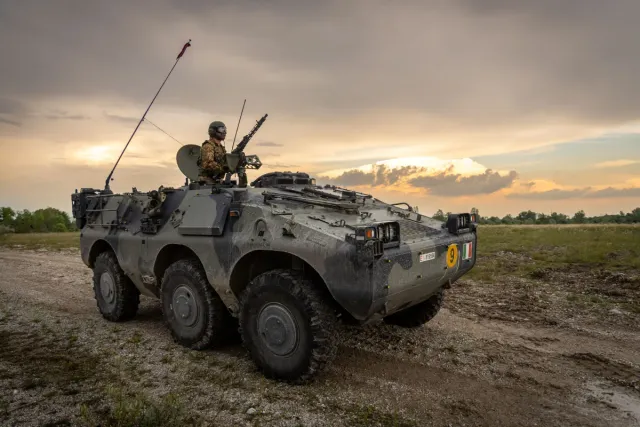
| Dardo | Italy | 23 | 7 | 0.304 |
| Bionix | Singapore | 23.6 | 7 | 0.297 |
| Freccia | Italy | 24 | 7 | 0.292 |
| ASCOD | Spain | 28 | 8 | 0.286 |
| VBCI | France | 32 | 9 | 0.281 |
| Tulpar | Turkey | 29 | 8 | 0.276 |
| Type 89 IFV | Japan | 26.5 | 7 | 0.264 |
| Eitan | Israel | 35 | 9 | 0.257 |
| Warrior IFV | United Kingdom | 28 | 7 | 0.250 |
| Hawkei | Australia | 8.1 | 2 | 0.247 |
| LAV-25 | United States | 12.8 | 3 | 0.234 |
| CV90 | Sweden | 35 | 8 | 0.229 |
| Pizarro | Spain | 26.5 | 6 | 0.226 |
| M2A3 Bradley | United States | 27.6 | 6 | 0.217 |
| Borsuk | Poland | 28 | 6 | 0.214 |
| Boxer | Germany | 38.5 | 8 | 0.208 |
| M2A4 Bradley | United States | 36.3 | 7 | 0.193 |
| T-15 | Russia | 48 | 9 | 0.188* |
| Lynx KF41 | Germany | 44 | 8 | 0.182 |
| Marder | Germany | 33.5 | 6 | 0.179 |
| Hunter AFV | Singapore | 30 | 5 | 0.167 |
| Achzarit | Israel | 44 | 7 | 0.159 |
| Namer | Israel | 60 | 9 | 0.150 |
| Puma | Germany | 43 | 6 | 0.140 |
| Ajax | United Kingdom | 38 | 3 | 0.079* |
*T-15 Armata figures are Russian state/manufacturer claims for a system still listed as “announced” rather than fielded at scale, not independently verified against operational use. Ajax’s low ratio reflects its reconnaissance/scout role rather than a dedicated troop-carrying design; see the FAQ above.
None of this is targeting or operational guidance. It is a weight-budget comparison built from publicly disclosed physical specifications, with the manufacturer-claim figures flagged where they apply. If you want to compare any two of these vehicles side by side on the full spec sheet, use the Compare tool, build a mixed force in the Force Builder, or browse the full IFV category for the underlying system pages this analysis draws from.
Sources
Systems in this comparison
Every system covered above, with its photo and, where available, a video. Tap a card to open the full spec sheet.
Compare these side by side →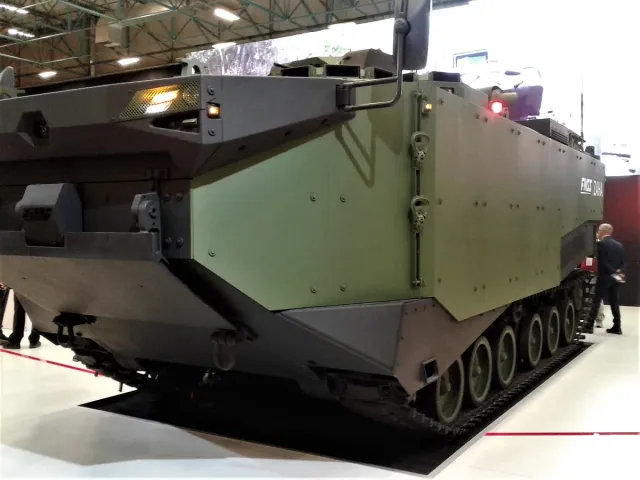
Frequently asked questions
What does "troop capacity per ton" actually measure? +
It is a vehicle's published dismount troop capacity divided by its combat weight in tonnes. It is not a performance or quality score. A high ratio means a larger share of the vehicle's weight budget goes to seats rather than armor, a turret, or a powertrain built to move that armor. A low ratio means the opposite: the weight is going somewhere other than passenger capacity, usually protection.
Why does the FNSS Zaha carry so many more troops than other IFVs? +
The Zaha is an amphibious marine assault vehicle designed around dismount count and buoyancy rather than heavy composite or reactive armor. At a published 30 tonnes it carries 21 troops, more than double the next-highest figure among the 67 IFV/APC-class systems in the WeaponSpecs database that publish both weight and capacity.
Why do the heaviest, most protected IFVs carry the fewest troops per ton? +
Namer, Puma, Marder, and both Bradley variants sit near the bottom of the ranking despite weighing 27 to 60 tonnes. Their weight budget goes into composite or explosive reactive armor, a manned or remote turret, and a powertrain heavy enough to move that armor, not additional seats. The four systems in the database flagged with reactive armor average 0.187 troops per ton, about half the 0.368 fleet median.
Why does the Ajax rank last despite weighing less than the Namer? +
The Ajax is fundamentally a tracked reconnaissance and scout vehicle built for the British Army's Scout SV program, fitted with sensors and a 40mm cannon rather than sized around dismounted infantry. Its database entry lists a 3-person capacity at 38 tonnes, the lowest ratio in the comparison, but that reflects its scout role rather than an inefficient troop-carrier design.
Does a high troops-per-ton ratio mean a vehicle is better designed? +
No. It is a design-tradeoff snapshot, not a performance ranking. A wheeled MRAP-style vehicle with a high ratio is typically trading away armor thickness that a tracked heavy IFV carries deliberately, because it is expected to fight alongside main battle tanks on a frontline rather than move troops behind one.
Related reading


