 China
China China Aerospace Science and Industry Corporation
HQ-9
China's long-range surface-to-air missile system, broadly comparable to the Russian S-300/S-400 and American Patriot families, capable of engaging aircraft, cruise missiles and some ballistic missiles. It has been exported as the FD-2000 and forms the backbone of Chinese strategic air defense.
In service since 2001 · 3 operator countries
Compiled from public sources ·primary reference ↗ ·last verified 2026-07-02
200
km range
27,000
m altitude
6
targets
300
km radar
Pricing: Unit cost not publicly disclosed; export batteries estimated in the hundreds of millions USD
Procurement snapshot
Availability & export
Chinese state channel
State export agencies (NORINCO/CATIC); limited availability to Western-aligned states.
Channel: State export agency
Fielded & proven
Limited · 3 operators
In service since 2001. Status: active.
Lifecycle cost (est.)
No public unit price to model from. Why so few systems publish one →
Interoperability
No standardised NATO calibre / datalink detected in public specs.
Derived guidance from public data, export regime by country of origin, lifecycle from the GAO ~30% acquisition rule. Verify eligibility, pricing and offsets with the manufacturer and your acquisition authority.
Full specifications
Performance
Speed, range, altitude and engagement capability.
| Max speed (Mach) Maximum speed as a multiple of the speed of sound. Mach 2+ is typical for air-superiority fighters. | 4.2 Mach |
|---|---|
| Engagement range Maximum distance at which an air-defense system can intercept targets. Higher covers more airspace. | 200 km |
| Engagement altitude Maximum target altitude the system can reach. | 27,000 m |
| Simultaneous targets Number of targets the system can engage at once. Higher resists saturation attacks. | 6 |
Firepower
Armament, payload and guidance.
| Main armament Primary weapon: main gun, cannon or missile type. | HQ-9 interceptor missile |
|---|---|
| Warhead Warhead mass. Heavier generally means larger effect radius, at the cost of range. | 180 kg |
| Warhead type Blast-fragmentation, shaped charge (HEAT), penetrator, thermobaric or nuclear-capable. | Fragmentation |
| Guidance How the weapon finds its target: inertial, GPS/GLONASS, active/semi-active radar, infrared, laser, TV, wire. | Track-via-missile, Semi-active radar homing |
Sensors & avionics
Radar, sensor suite and datalinks.
| Radar Primary radar. AESA (active electronically scanned array) is the current state of the art. | HT-233 phased array engagement radar |
|---|---|
| Radar range Published detection range against a typical fighter-sized target. Higher sees first. | 300 km |
| Datalink Network connectivity: Link 16, MADL, national datalinks. Enables cooperative engagement. | Battalion command network |
Program
Cost, production scale and operators.
| Operator countries Number of countries operating the system. More operators means broader support ecosystem. | 3 |
|---|
Specifications compiled from public China Aerospace Science and Industry Corporation and reference sources ↗. Published defense figures are approximations, treat comparisons as directional. Last verified 2026-07-02.
Compare with rivals
See how it stacks up
 Rheinmetall Skyranger 30
  KBP Instrument Design Bureau Pantsir-S1
 Head-to-head comparisons
HQ-9 vs
 Patriot PAC-3
  NASAMS
  SPYDER
  SAMP/T (Aster 30)
 Frequently asked questions
What is the engagement range of the China Aerospace Science and Industry Corporation HQ-9? +
The China Aerospace Science and Industry Corporation HQ-9 has a maximum engagement range of 200 km.
What is the main armament of the China Aerospace Science and Industry Corporation HQ-9? +
The China Aerospace Science and Industry Corporation HQ-9's primary weapon is the HQ-9 interceptor missile.
What is the China Aerospace Science and Industry Corporation HQ-9 used for? +
The China Aerospace Science and Industry Corporation HQ-9 is a air defense system typically used for air defense.
How many countries operate the China Aerospace Science and Industry Corporation HQ-9? +
The China Aerospace Science and Industry Corporation HQ-9 is operated by 3 countries.
How much does the China Aerospace Science and Industry Corporation HQ-9 cost? +
China Aerospace Science and Industry Corporation HQ-9: Unit cost not publicly disclosed; export batteries estimated in the hundreds of millions USD. Defense program costs are rarely fully public and vary by contract and configuration.
Similar systems
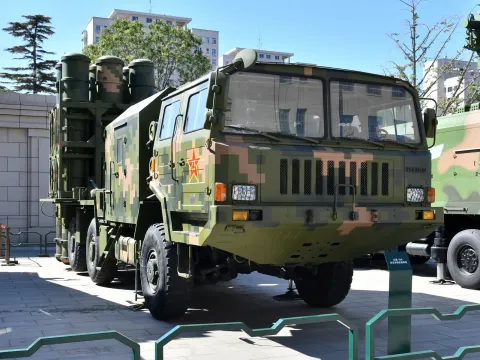
China Aerospace Science and Industry Corporation
HQ-16
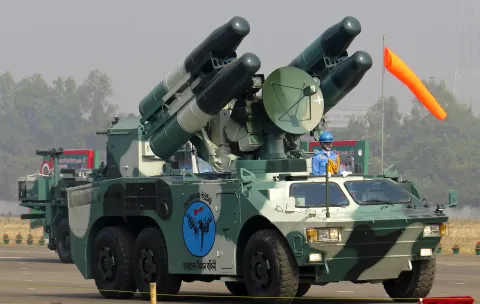
China Aerospace Science and Industry Corporation
HQ-7
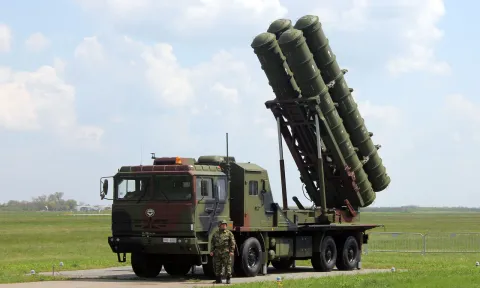
China Aerospace Science and Industry Corporation
HQ-22
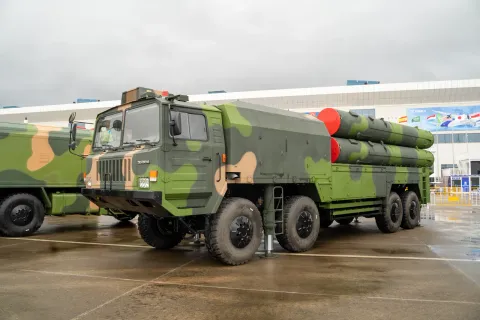
China Aerospace Science and Industry Corporation