Zelensky Names Drapatyi Ukraine's New Commander-in-Chief
President Volodymyr Zelensky replaced Gen. Oleksandr Syrskyi with Maj. Gen. Mykhailo Drapatyi as commander-in-chief on July 21, the biggest shake-up of Ukraine's wartime military leadership since the 2024 invasion, after days of street protests over a defense minister's dismissal.

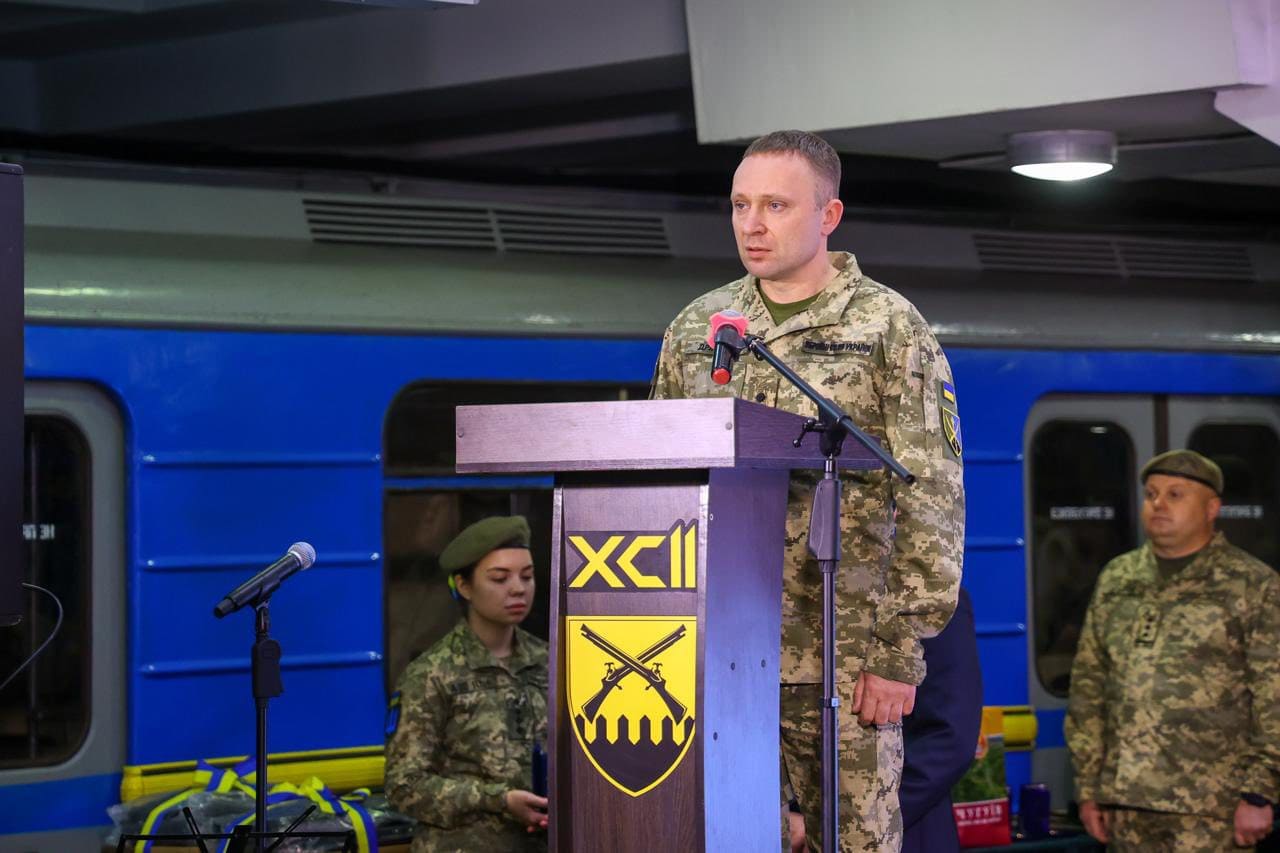
Press Service of the Office of the President of Ukraine, official Telegram channel of President Volodymyr Zelenskyy, CC BY 4.0, via Wikimedia Commons
President Volodymyr Zelensky appointed Maj. Gen. Mykhailo Drapatyi as commander-in-chief of Ukraine’s Armed Forces on July 21, replacing Gen. Oleksandr Syrskyi in the most significant shake-up of the country’s wartime military leadership since Syrskyi himself took the post in February 2024. The change came after nearly a week of street protests demanding Syrskyi’s removal, triggered by Zelensky’s dismissal of a reform-minded defense minister earlier in July.
Drapatyi, 43, most recently commanded the Joint Forces group responsible for the Kharkiv sector, one of the war’s most contested fronts. He replaces Syrskyi, 60, a Soviet-trained general who led Ukraine’s defense of Kyiv in 2022 and the Kursk incursion, but who had become a lightning rod for criticism over battlefield losses and a command culture protesters said punished soldiers for headquarters’ failures.
A resignation offered and refused
Drapatyi’s appointment carries a detail that sets him apart from the general he is replacing: he has already tried to resign once and take responsibility for a deadly failure under his command. As commander of Ukraine’s Ground Forces, he submitted his resignation on June 1, 2025, after a Russian missile struck a training unit in Dnipropetrovsk region, killing 12 soldiers and wounding more than 60, according to Kyiv Independent’s profile of his career. He framed the offer in blunt terms rarely heard from a senior Ukrainian officer.
“Circular responsibility and impunity are poison for the army,” said Mykhailo Drapatyi, then commander of Ukraine’s Ground Forces, announcing his resignation (Kyiv Independent, July 22, 2026).
Zelensky did not treat that resignation as a permanent exit. Drapatyi instead moved that autumn to command the Joint Forces group covering the Kharkiv sector, where Ukrainian units, including the Khartiia Brigade, recaptured territory around Kupiansk under his watch, per the same profile. For soldiers and protesters who spent the past week demanding Syrskyi’s ouster, that combination, a general who owned a battlefield failure publicly rather than deflecting it, then went on to deliver results on a hard front, is central to why Drapatyi’s name kept surfacing as the alternative.
Protests over a defense minister’s exit, not just the war
The immediate trigger for Syrskyi’s dismissal was political, not battlefield news. Zelensky removed Defense Minister Mykhailo Fedorov, a technocrat credited with modernizing Ukraine’s drone and cyber warfare programs, on July 15 as part of a wider cabinet reshuffle, according to Euronews’ coverage of the fallout. Fedorov publicly accused Syrskyi of obstructing reform and said Zelensky had chosen to retain the general over him, a charge that landed hard with a public already frustrated over battlefield setbacks. Protests spread across Ukrainian cities within days, and organizers set an ultimatum: dismiss Syrskyi and nominate Fedorov as defense minister again by July 24, or face an indefinite general protest, per Euronews’ reporting on the demonstrations.
Zelensky’s choice of Drapatyi is notable precisely because Drapatyi had publicly backed Fedorov’s reform push without fully endorsing the protesters’ framing. “The military needs change, but without justice, no change will make sense to the people who carry this war on their shoulders every day,” Drapatyi said, according to Euronews’ reporting, a position that let him appear sympathetic to the reform movement’s substance while staying above the street-level pressure campaign against his own predecessor.
Syrskyi, for his part, did not depart quietly framing his tenure as a failure. “I am handing over to my successor an army that is not only holding its ground but is also on the offensive,” he wrote on Facebook, according to both Euronews and Meduza’s coverage of the handover, which both quoted the post nearly verbatim. Zelensky credited Syrskyi with Ukraine’s defense of Kyiv in 2022, the 2022 Kharkiv counteroffensive, and the 2024 Kursk incursion in his own announcement, per Meduza’s reporting, a formal acknowledgment that stopped short of endorsing the criticism that had built up around him over the past year.
What changes, and what NATO says will not
For a country three years into a full-scale war, replacing the officer who signs off on operational decisions is not a symbolic move alone, but its practical effects will only show up over the coming weeks in how the front lines are managed, not in this appointment itself. Drapatyi inherits a war that, as of this writing, remains active on multiple fronts, and his own record suggests a command style more willing to acknowledge failure publicly and push accountability down the chain than the general he replaces, according to soldiers and analysts cited in Kyiv Independent’s profile, who described him as someone who solicits subordinates’ input rather than relying on top-down direction.
NATO’s response was calibrated to signal continuity rather than concern. A spokesperson for the alliance’s Military Committee said senior command rotations happen routinely and that NATO’s support strategy for Ukraine remains unchanged regardless of who holds the post, while acknowledging that formal contact with Drapatyi had not yet taken place. Former commander-in-chief Valerii Zaluzhnyi, who himself was replaced by Syrskyi in 2024, offered a blunter assessment of what awaits Drapatyi: an “incredibly difficult job, far more difficult than he imagines,” per Meduza’s reporting.
Sources
- Zelensky appoints Mykhailo Drapatyi as Ukraine's new commander-in-chief, dismissing Oleksandr Syrskyi — Meduza, Jul 22, 2026
- Zelenskyy replaces Oleksandr Syrskyi with Mykhailo Drapatyi as Ukraine's commander-in-chief — Euronews, Jul 21, 2026
- Who is Mykhailo Drapatyi, Ukraine's new commander in chief? — Kyiv Independent, Jul 22, 2026
- Dismissed defence minister Fedorov accuses Ukraine's army chief of fuelling divisions, incompetence — Euronews, Jul 16, 2026
Frequently asked questions
Who is replacing whom as Ukraine's top military commander? +
Maj. Gen. Mykhailo Drapatyi, 43, replaces Gen. Oleksandr Syrskyi, 60, as commander-in-chief of Ukraine's Armed Forces, President Zelensky announced July 21, 2026. Syrskyi had held the post since February 2024.
Why was Syrskyi removed now? +
The move followed days of street protests after Zelensky dismissed reform-minded Defense Minister Mykhailo Fedorov on July 15. Fedorov publicly accused Syrskyi of obstructing military reform and said Zelensky had chosen to keep Syrskyi in place over him, fueling public anger that Zelensky was siding with the military hierarchy over reformers. Protest organizers had set a July 24 deadline demanding Syrskyi's dismissal.
What is the June 2025 resignation Drapatyi is known for? +
As commander of Ukraine's Ground Forces, Drapatyi submitted his resignation on June 1, 2025, taking personal responsibility after a Russian missile strike on a training unit in Dnipropetrovsk region killed 12 soldiers and wounded more than 60. He said at the time that 'circular responsibility and impunity are poison for the army.' Zelensky did not accept the resignation as a permanent departure; Drapatyi instead moved to command the Joint Forces group covering the Kharkiv sector that autumn.
What has NATO said about the change? +
A NATO Military Committee spokesperson said no changes in military-to-military cooperation with Ukraine are expected, describing senior command rotations as routine and NATO's support strategy as unchanged, while noting formal contact with Drapatyi had not yet taken place.
More news


