Two Bradley Replacement Prototypes Land at the Army in 11 Days
General Dynamics and American Rheinmetall each delivered a physical XM30 prototype within an 11-day window, the first time in over two decades of trying that the Army has held two rival hulls at once.

U.S. Army photo by Sgt. Jerron Bruce, DVIDS, public domain
The U.S. Army has spent more than two decades trying to replace the M2 Bradley infantry fighting vehicle, and until this week, no attempt had produced a single piece of rival hardware the Army could put its hands on at the same time. That changed inside an 11-day window. General Dynamics Land Systems delivered its XM30 “Wolf” prototype to Aberdeen Proving Ground, Maryland, in late August, and American Rheinmetall delivered its competing “Lynx” prototype on September 1, both confirmed directly by the companies’ own announcements. For the first time since the Army started looking for a Bradley successor, it now holds two competing, physically built candidates at once.
A replacement program that kept failing before it reached hardware
To understand why that milestone matters, it helps to know what came before it. The M2 Bradley has carried U.S. mechanized infantry into combat since 1981, with the current M2A3 configuration in service since 1995, according to WeaponSpecs’ own M2A3 Bradley record: a 27,600-kilogram tracked vehicle built by BAE Systems, armed with a 25mm M242 Bushmaster chain gun, crewed by three soldiers and carrying six dismounts. It has been upgraded repeatedly since the 1980s, but the Army has long said it has reached the limits of what those upgrades can do against modern threats.
Three separate programs tried and failed to field something newer. The Future Combat Systems Manned Ground Vehicles effort, launched in 1999, was cancelled in 2009. Its successor, the Ground Combat Vehicle program launched in 2010, was cancelled in 2014. A third attempt, the Optionally Manned Fighting Vehicle, saw its first industry solicitation cancelled in January 2020 after a weak response from manufacturers. The Congressional Research Service’s own program brief on the effort, confirmed independently for this story, describes both of the earlier programs as cancelled “for programmatic and cost-associated reasons,” the same failure pattern repeating three times without a prototype to show for it.
OMFV was rebooted, and this time it produced a result. On June 26, 2023, the Army announced Engineering and Manufacturing Development contracts to two vendors, General Dynamics Land Systems and American Rheinmetall Vehicles, at a combined value of approximately $1.6 billion, a figure confirmed both in the Army’s own announcement of the award and in the CRS program brief. The program was redesignated the XM30 Mechanized Infantry Combat Vehicle. Both companies completed a Critical Design Review, and this week’s deliveries are the tangible product of that three-year development effort.
What actually showed up
General Dynamics’ press release, cited by The War Zone, states that its Wolf prototype reached Aberdeen Proving Ground on August 21, arriving in late August ahead of shipment to the Army’s designated test unit. “This on-time delivery will allow Soldiers to start putting the Wolf through its paces, with the ultimate goal of getting it fielded into armored brigades as quickly as possible,” said Geoffrey Norman, GDLS’s Director for U.S. Strategy and Growth, in a statement confirmed against the company’s own release language.
American Rheinmetall’s own newsroom, verified directly for this story, states that the company delivered “the first of eight Lynx XM30 combat vehicle prototypes to the U.S. Army” on September 1, the initial unit of a batch that will grow to eight vehicles this year for both technical evaluation and unit training. The delivery falls under a Phase 3/4 Engineering and Manufacturing Development contract the release values at approximately $764 million, part of the Army’s Transformation in Contact 2.0 initiative.
“Delivering our first prototype to the Army is an important step as the XM30 Combat Vehicle program enters a more visible phase,” said Matt Warnick, CEO of American Rheinmetall (Rheinmetall newsroom, Sept. 1, 2026). “Executing a parallel evaluation timeline requires a level of industrial agility that Team Lynx was built for.”
American Rheinmetall is the prime contractor on Team Lynx, a group that also includes Textron Systems, Raytheon, L3Harris Technologies, Allison Transmission and Anduril Industries, per the same release.

What sets both candidates apart from the Bradley
The Wolf and the Lynx are different vehicles built by different companies, but the Army wrote both to the same requirement, and the results converge in specific ways The War Zone’s reporting lays out clearly. Both mount a Northrop Grumman XM913 50mm automatic cannon, double the caliber of the Bradley’s 25mm Bushmaster. Both use a remotely operated turret and a hybrid-electric powertrain instead of the Bradley’s diesel drivetrain, changes that let the crew shrink from three soldiers to two while dismount capacity holds steady at six, matching the Bradley. Both can also launch loitering munitions from their turret systems: AeroVironment’s Switchblade 300 has been integrated onto the GDLS design, while the Rheinmetall entry is built to fire versions of Raytheon’s Coyote Block 3, a capability the Army has already demonstrated launching from a Bradley’s TOW missile launcher in trials.
| M2A3 Bradley (current) | XM30 Wolf (GDLS) | XM30 Lynx (Rheinmetall) | |
|---|---|---|---|
| Main gun | 25mm M242 Bushmaster | 50mm XM913 | 50mm XM913 |
| Crew | 3 | 2 | 2 |
| Dismounts | 6 | 6 | 6 |
| Propulsion | Diesel (600hp Cummins) | Hybrid-electric | Hybrid-electric |
| Turret | Manned | Remotely operated | Remotely operated |
| Loitering munition | None | Switchblade 300 | Coyote Block 3 (planned) |
Army budget documents reviewed by The War Zone show the service currently plans to acquire at least 108 XM30s through fiscal year 2031, a fraction of the roughly 2,500 Bradleys of various configurations still in Army service today. That gap is a reminder of how early this competition still is relative to the fleet it would eventually replace.
What to watch next
Both prototypes now move to Fort Hood, Texas, where soldiers will put them through evaluation, with further testing planned at the National Training Center at Fort Irwin, California, running into early 2027. The Army has previously said it wants a winning XM30 design fielded by fiscal year 2029, though The War Zone’s reporting notes it remains an open question when the service will actually make that final selection.
What is worth tracking is not the hardware, which both companies have now delivered on roughly the same timeline. It is money. The War Zone reports that a senior Army acquisition official overseeing the program has said the service intends to keep both vendors funded for as long as it can, because running two competing prototype lines in parallel costs meaningfully more than committing to one, even though it is not literally double the price. That framing, repeated in the same reporting, points to budget pressure, not engineering readiness, as the likelier reason the Army eventually narrows the field to a single winner.
Sources
- American Rheinmetall Delivers First Lynx XM30 Combat Vehicle Prototype to U.S. Army (Rheinmetall, Sep 1, 2026)
- Competing Bradley Fighting Vehicle Replacement Prototypes Delivered To The U.S. Army (The War Zone, Sep 1, 2026)
- American Rheinmetall Delivers First Lynx XM30 Combat Vehicle Prototype to U.S. Army (Soldier Systems Daily, Sep 1, 2026)
- New Mechanized Infantry Combat Vehicle prototype contract awarded to two vendors (U.S. Army, Jun 26, 2023)
- The Army's XM-30 Mechanized Infantry Combat Vehicle (Formerly OMFV) (Congressional Research Service)
- American Rheinmetall Vehicles and Team Lynx Awarded Contract for U.S. Army's XM30 Mechanized Infantry Combat Vehicle Program (American Rheinmetall)
Systems mentioned
Every system named in this story, with its photo and, where available, a video. Tap a card to open the full spec sheet.
Compare these side by side →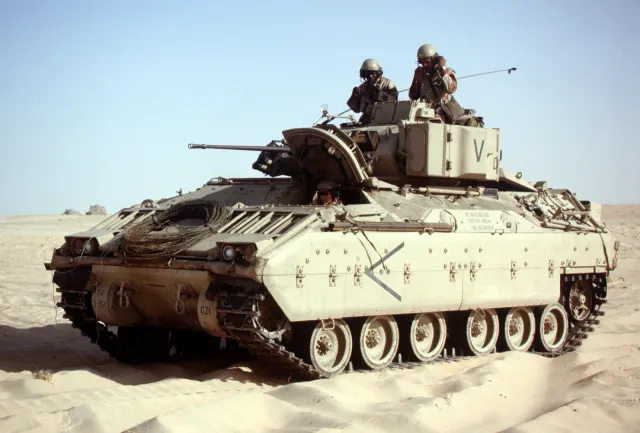
IFV / APC
M2A3 Bradley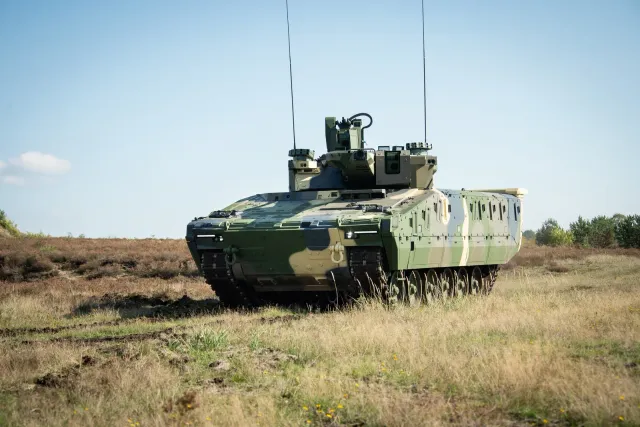
Frequently asked questions
Why has the Army failed to replace the Bradley for over two decades? +
Three prior efforts collapsed before reaching hardware: the Future Combat Systems Manned Ground Vehicles program was cancelled in 2009, its successor the Ground Combat Vehicle program was cancelled in 2014, and the first Optionally Manned Fighting Vehicle solicitation was cancelled in January 2020 after a weak industry response. All three failed on cost or requirements growth before a single prototype was built.
What's actually new about these two vehicles compared to the Bradley? +
Both the Wolf and the Lynx pair a Northrop Grumman XM913 50mm autocannon, double the Bradley's 25mm M242 Bushmaster, with a hybrid-electric powertrain and a remotely operated turret. That lets the Army drop crew size from three to two while still carrying six dismounted soldiers, the same as the Bradley today.
When will the Army pick a winner? +
Both vehicles head next to Fort Hood, Texas, for evaluation, with further testing at the National Training Center at Fort Irwin, California, continuing into early 2027. A down-select is expected in spring 2027, with an aspirational fielding target of fiscal year 2029. A senior Army acquisition official has said the service wants to keep funding both vendors as long as it can, which makes budget, not engineering, the constraint most likely to force an earlier decision.
More news


