Taiwan Signs $847M Anduril Drone Contract for Asymmetric Defense
Taiwan's MND signed an NT$26.9B deal for 1,554 Anduril ALTIUS-700M strike drones and 478 ALTIUS-600ISR scouts, deliveries starting Q4 2026.

Taiwan Presidential Office (總統府), Wikimedia Commons, CC BY 2.0
Taiwan’s Ministry of National Defense signed an NT$26.9 billion (roughly $847 million) contract with Anduril Industries around Aug. 27 for 1,554 ALTIUS-700M loitering munitions and 478 ALTIUS-600ISR reconnaissance drones, executing part of a $1.1 billion U.S. foreign military sale Washington approved in December 2025. Deliveries are due to begin in the fourth quarter of 2026 and run through June 2033. The contract is a concrete step in Taiwan’s “asymmetric,” or porcupine, defense strategy: cheap, numerous drones meant to let ground forces threaten a much larger People’s Liberation Army amphibious force without relying on manned strike aircraft.
What Taiwan is actually buying
The contract splits into two distinct roles. ALTIUS-700M is the heavier of the two, a loitering munition, effectively a strike drone that can circle a target area before diving in, with a reported strike range around 160 kilometers, built to threaten fortified positions and staging areas rather than to observe them. ALTIUS-600ISR is a reconnaissance-focused variant of the drone family Taiwan already flies in a smaller form: ALTIUS-600, a 12.25-kilogram tactical UAV with an EO/IR payload and roughly four hours of endurance that Anduril inherited through its 2021 acquisition of Area-I. Independent reporting puts the 600ISR variant’s operating range in the 400 to 440-kilometer band as a scouting asset, a figure the manufacturer has not published on a dedicated spec page and that this piece treats as reported, not confirmed by primary documentation.
Both figures come from independent reporting on the ALTIUS-700M and 600ISR variants, not from a dedicated manufacturer spec page. The gap illustrates the split in the contract itself: a shorter-range strike asset built to hit fortified targets, paired with a longer-range scout built to find them first.
That gap is the point of buying both variants in the same contract rather than one or the other. A strike drone with a 160-kilometer reach is most useful against targets someone else has already located; a reconnaissance drone with two to three times that range is what finds and tracks a moving amphibious force far enough out to hand off a target before it closes on the coast. Ordering 1,554 of the shorter-range strike variant against 478 of the longer-range scout, roughly a 3-to-1 ratio, suggests Taiwan is prioritizing the ability to actually hit dispersed targets in volume once they are found, over building out a correspondingly large standalone scouting fleet.
Sourcing limits worth stating plainly
This story could not be built on a directly readable government primary source. Genuine attempts were made to reach both the U.S. Defense Security Cooperation Agency’s release on the underlying case and Taiwan’s Ministry of National Defense press pages; neither could be retrieved at the time of writing, so this account relies on independent defense-trade reporting rather than a government release. Readers should weigh that limitation accordingly.
There is also a real numeric conflict in public reporting on unit counts. Independent budget reporting and Army Recognition’s coverage agree on 1,554 ALTIUS-700M and 478 ALTIUS-600ISR units; one other outlet has published a materially different 291-and-600 split. This piece uses the 1,554/478 figures because multiple independent sources corroborate them against the single outlier, and it does not link to or otherwise cite the outlier’s reporting.
Finally, no photograph of this specific contract, these specific drones, or the signing itself was available under a reusable license at the time of writing. The cover image above shows a general Taiwan Armed Forces Day ceremony from 2018, chosen to illustrate Taiwan’s military rather than this program, and the inline photo below shows the smaller ALTIUS-600 variant Taiwan already operates rather than the newly contracted ALTIUS-700M or 600ISR.

Separate from Taiwan’s new drone spending act
This contract draws on a special defense budget Taiwan’s legislature passed in May 2026, executing part of the $1.1 billion FMS package Washington cleared in December 2025. It is a different pot of money from the NT$240 billion (about $7.56 billion) six-year drone spending act Taiwan’s Legislative Yuan passed separately on Aug. 27, the same week, an opposition-drafted bill that notably rejected President Lai’s own larger special-budget request. The two are easy to conflate because they landed in the same week and both concern drones, but the Anduril contract is a foreign purchase funded from an already-approved special budget, while the NT$240 billion act is a domestic, legislature-driven six-year program covering different funding and, presumably, a broader mix of suppliers, not this single Anduril order.
For comparison, Anduril’s own reported lead time on a separate program, the U.S. Army’s Barracuda-500M cruise missile framework agreement announced in May 2026, ran about 12 to 14 months from contract to first deliveries. Against that benchmark, Taiwan’s Q4 2026 delivery start on a contract signed in late August 2026 looks fast, though a foreign military sale executing an already-approved case is a different procurement path than a fresh U.S. Army framework agreement, so the two lead times are not strictly comparable.
The contract itself is a small, concrete data point inside a much larger question: whether Taiwan’s asymmetric strategy, buying large numbers of comparatively cheap drones instead of a smaller number of expensive manned platforms, can actually field fast enough to matter. A 1,554-to-478 split favoring the shorter-range strike variant, a Q4 2026 delivery start, and a completion date running to June 2033 together describe a program built for sustained, staged fielding rather than a single dramatic delivery, and the real test will be whether Anduril hits that Q4 2026 start date given that no government primary source has yet confirmed it independently.
Sources
- Taiwan discloses procurement quantities of ALTIUS-700M and 600ISR drones for asymmetric defense (Army Recognition, Jan 20, 2026)
Systems mentioned
Every system named in this story, with its photo and, where available, a video. Tap a card to open the full spec sheet.
Compare these side by side →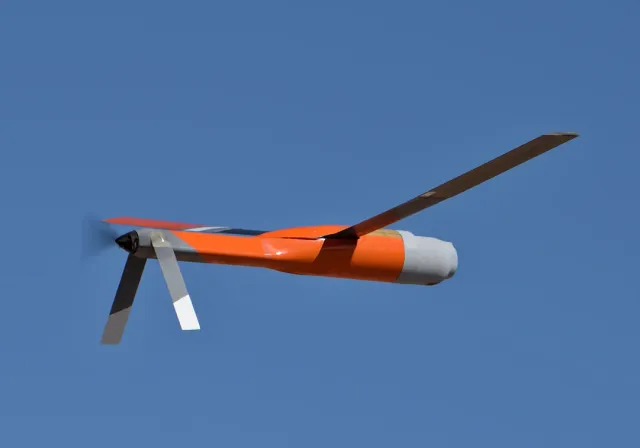
UAV / drone
ALTIUS-600
UAV / drone
Switchblade 600More news


