Taiwan Commissions First of Five New Stealth Corvettes
Taiwan's navy commissioned ROCS Tan Chiang, the first Batch 2 Tuo Chiang-class corvette, with all 12 ships due in service by year's end.

Navy Command Headquarters, Ministry of National Defense (ROC), Taiwan government Open Information Announcement license, reuse permitted with attribution, via Wikimedia Commons
Taiwan’s navy commissioned ROCS Tan Chiang (丹江, hull number PGG-627) at Tsoying Naval Base on July 24, the eighth hull of the Tuo Chiang-class stealth corvette program and the first ship of the class’s second production batch. President Lai Ching-te presided over the ceremony, with all 12 planned Tuo Chiang-class hulls, six from the first batch and six from the second, due to be delivered and commissioned by the end of 2026.
A catamaran built to hide, sprint, and shoot first
The Tuo Chiang class is Taiwan’s answer to a strategic problem it cannot solve by building bigger ships: the People’s Liberation Army Navy has more hulls, more tonnage, and more firepower than Taiwan’s navy will ever field. Instead of competing hull-for-hull, Taiwan’s domestic shipbuilding program leans on speed, stealth, and dispersal. The Tuo Chiang class is a domestically designed and built catamaran corvette, twin-hulled for stability at high speed, with angled surfaces that reduce its radar cross-section, capable of 44 to 45 knots and an operational range of 1,800 to 2,000 nautical miles. Each ship is armed with Hsiung Feng II and Hsiung Feng III anti-ship missiles, an OTO Melara 76mm main gun, and a Phalanx close-in weapons system for point defense against incoming missiles.
The tactical logic is hit-and-run rather than sustained engagement: a dozen small, hard-to-target missile boats spread across the Taiwan Strait present a far more difficult targeting problem for an adversary than a handful of large frigates concentrated in a few locations, and each corvette can fire its missiles and retreat into coastal clutter before a counterstrike arrives. President Lai tied that survivability logic directly to Taiwan’s ability to sustain a fight without outside help.
“A ship built domestically can be maintained and repaired without foreign assistance, bolstering the military’s resilience in a conflict,” said President Lai Ching-te at the commissioning ceremony (Taipei Times, July 25, 2026).

What changed between Batch 1 and Batch 2
Tan Chiang is not a copy of the six Tuo Chiang-class ships that came before it. Batch 1, from lead ship Ta Chiang (PGG-619) through Wan Chiang (PGG-626), carries a Thales STIR 1.2 EO Mk2 fire-control radar, a French-made system Taiwan had operated in earlier STIR-series variants since the 1980s. Batch 2 could not use the same radar, because the French government declined to authorize its export to Taiwan. Naval News, which covered the commissioning directly, reported that Tan Chiang and the four Batch 2 sister ships to follow instead carry an Italian-made Leonardo NA-30S Mk2 fire-control radar.
That swap is a small technical detail with an outsized strategic point attached to it: even a warship Taiwan designs and builds entirely within its own shipyards still depends on foreign-sourced sensors and weapons for key subsystems, and a supplier government’s export policy can force a mid-program hardware change regardless of how far construction has already progressed. Batch 2 construction began in 2024, and the five hulls in that batch are scheduled for delivery between March and December of this year, a compressed timeline that puts real pressure on Taiwan’s shipyards and its ability to train crews and integrate a new radar system across five ships in under twelve months.
No official figure for Tan Chiang’s per-unit or total program cost has been published, and none is estimated here.
Part of a longer buildout, not a one-off answer to Beijing
Commissioning a single corvette does not, by itself, change the military balance across the Taiwan Strait, and Taiwan’s government has not presented Tan Chiang’s entry into service as a response to any specific Chinese action. It is instead one milestone inside a shipbuilding program that has been running for years and is scheduled to finish its current phase within months: the remaining four Batch 2 hulls are due by the end of 2026, at which point Taiwan will have all 12 Tuo Chiang-class corvettes in service simultaneously for the first time.
That completion date matters more than any single commissioning ceremony, because the asymmetric logic behind the class only works at scale. One or two stealth missile boats are a curiosity; twelve dispersed across Taiwan’s coastline and outlying bases are a standing complication for any PLA Navy surface group operating near the strait, since each additional hull the Taiwanese navy can hide and reposition adds another axis from which a Hsiung Feng III missile could be fired. The commissioning comes as Chinese military exercises around Taiwan have continued at a sustained tempo through 2026, a backdrop against which Taipei has framed the entire Tuo Chiang program, not just this one ship, as the core of its near-term naval deterrence posture.
Sources
- Taiwan Navy Commissions First Batch 2 Tuo Chiang-Class Corvette — Naval News, Jul 25, 2026
- New warship Dan Chiang commissioned — Taipei Times, Jul 25, 2026
Systems mentioned
Every system named in this story, with its photo and, where available, a video. Tap a card to open the full spec sheet.
Compare these side by side →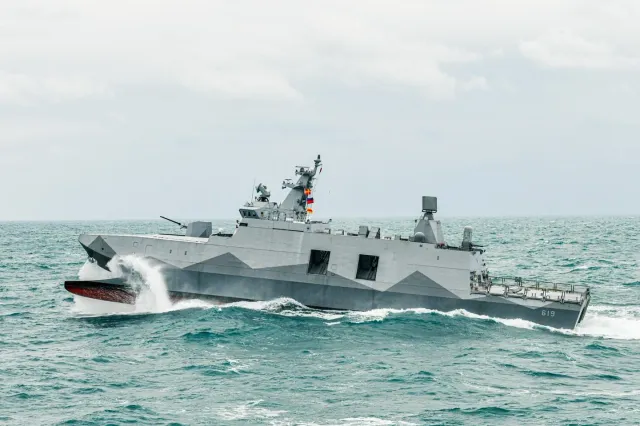
Warship
Tuo Chiang-class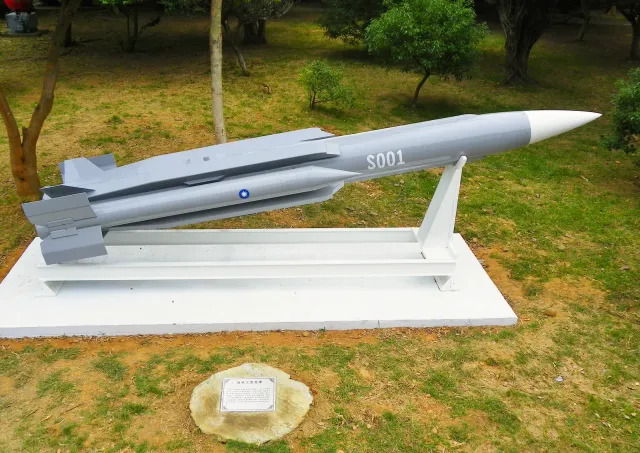
Missile
Hsiung Feng IIIFrequently asked questions
What makes the Tuo Chiang class different from a normal corvette? +
It is a catamaran-hulled stealth design built for hit-and-run missile attacks against larger warships, prioritizing speed, 44-45 knots, and a low radar signature so a numerically smaller Taiwanese navy can still threaten a much larger Chinese navy surface fleet.
Why does the fire-control radar differ between Batch 1 and Batch 2? +
France declined to authorize export of the Thales STIR 1.2 EO Mk2 fire-control radar used on Batch 1 to Taiwan, so the five Batch 2 hulls, starting with Tan Chiang, use an Italian Leonardo NA-30S Mk2 radar instead.
How many of these ships will Taiwan eventually have? +
Twelve in total across both batches, six in Batch 1 and six in Batch 2 including Tan Chiang, all scheduled for delivery and commissioning by the end of 2026.
Is this commissioning a response to a specific Chinese action? +
It is part of Taiwan's long-standing asymmetric-defense shipbuilding program rather than a reaction to a single incident, though it comes amid sustained Chinese military exercise activity around Taiwan through 2026.
More news


