US Clears $4.5B KC-46A Tanker Sale to Qatar
Qatar can buy 4 Boeing tankers plus jammers and missile-warning gear as Washington rearms its biggest Gulf air base after 2025's Iranian strike.

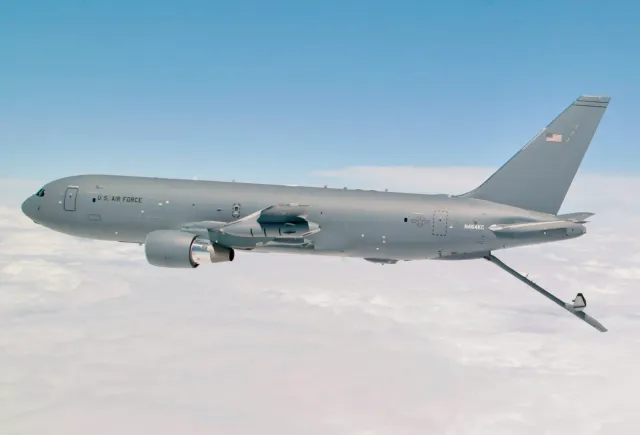
Tech. Sgt. Hampton Stramler, U.S. Air National Guard, DVIDS, public domain
The State Department notified Congress on Aug. 20 that it has cleared a possible $4.5 billion sale of four Boeing KC-46A Pegasus tankers to Qatar, along with spare engines, radar warning receivers and a full set of laser-based missile jammers. Qatar has not signed a contract, and the figure is a State Department ceiling estimate, not a final price. If the deal closes, Qatar becomes the first export customer for a tanker the US Air Force has flown exclusively since it entered service.
Four aircraft, and a defensive-electronics list that says more than the airframe count
The Defense Security Cooperation Agency’s notice lists four KC-46A aircraft as the headline item, but the equipment list attached to it is where the sale gets interesting. Qatar would receive eight Pratt & Whitney PW4062 turbofan engines, four installed on the aircraft and four held as spares, along with ten AN/ALR-69A radar warning receivers (four installed, six spares) and eight LAIRCM system processor replacements. The most telling line item is fifteen Guardian Laser Transmitter Assemblies, the actual laser-jamming hardware for the Large Aircraft Infrared Countermeasure system, with twelve installed across the fleet and three held in reserve.
That’s not a tanker order padded with boilerplate spares. LAIRCM exists to defeat heat-seeking missiles by tracking their infrared seeker and blinding it with a directed laser pulse, a countermeasure built specifically for large, slow, high-value aircraft that can’t outmaneuver an incoming missile. Putting fifteen of those laser assemblies on a four-airframe tanker order is Washington equipping Qatar’s newest strategic asset to survive the exact threat profile that has already proven real in the region.
Al Udeid’s 2025 wake-up call
Qatar hosts Al Udeid Air Base, the largest US military installation in the Middle East and the forward headquarters for US Central Command. In 2025, Iranian missiles struck the base directly, the most serious attack on a US installation in the Gulf in years. The DSCA’s notification does not cite that strike as a reason for the sale, so drawing a straight causal line from the attack to this specific contract would overstate what the document actually says. But the timing and the hardware both point the same direction: a Gulf ally that hosts CENTCOM’s forward headquarters is being sold tanker capacity bundled with the exact class of countermeasure built to defend large aircraft against missile attack, on a base that has already taken one.

What Qatar actually flies, and why refueling is a real gap
Qatar’s air force operates a mixed fleet of Eurofighter Typhoons, Dassault Rafales and Boeing F-15QAs, three of the most capable fighters sold on the export market, but none of that firepower matters much without fuel to extend it. Qatar currently has limited organic aerial-refueling capacity of its own, meaning its fighters either operate close to home or lean on coalition tankers, mostly American, to range further. Four KC-46As would give Doha the ability to extend its own fighters’ reach independently and, just as importantly, let Qatar contribute refueling capacity back into US and coalition operations flying out of Al Udeid rather than only drawing on it.
The WeaponSpecs systems database lists the KC-46A’s unit cost at roughly $152 million, based on a Boeing 767 airframe fitted with a refueling boom and drogue system and 89 built to date, all for the US Air Force. A four-aircraft, $4.5 billion package works out to more than $1.1 billion per airframe once spares, engines and the LAIRCM/GTLA hardware are folded in, a reminder that a tanker’s headline sticker price is a fraction of what actually shows up on an export sale once support equipment and defensive systems are included.
Part of a bigger Gulf rearmament wave, not a standalone deal
This sale lands roughly a month after WeaponSpecs reported that State Department-approved Gulf Cooperation Council arms sales hit $41 billion in the first half of 2026 alone, against just $9 billion for all of 2025. That earlier surge was dominated by air-defense hardware, Patriot batteries, integrated battle command systems, guided rockets, built to shoot incoming threats down. This deal is different in kind: it’s about extending reach and survivability for aircraft that fly, not systems that intercept. Together the two waves describe a Gulf buildup with two tracks running at once, better air defense on the ground and better-protected airpower in the sky, both accelerating in the same twelve-month window.
What happens next
Congressional notification opens a statutory review period before any contract can be finalized; lawmakers can object, though blocking a Gulf ally sale of this scale would be unusual. Even after that window closes, Qatar still has to negotiate and sign an actual contract, and the DSCA’s $4.5 billion figure is explicitly a ceiling, not a locked price. Delivery timelines for KC-46A exports typically run years out given Boeing’s existing US Air Force production backlog, so this is the start of a long acquisition process rather than tankers arriving on a Doha runway anytime soon.
Sources
- Qatar - KC-46A Aerial Refueling Aircraft — U.S. Department of State, Aug 20, 2026
- US approves possible $4.5 billion sale of KC-46As, equipment to Qatar — Military Times, Aug 20, 2026
- US announces $4.5B sale of four KC-46A refueling aircraft to Qatar — Breaking Defense, Aug 20, 2026
Systems mentioned
Every system named in this story, with its photo and, where available, a video. Tap a card to open the full spec sheet.
Transport & tanker
KC-46 PegasusFrequently asked questions
Has Qatar actually bought these planes? +
No. This is a State Department Foreign Military Sale notification to Congress, which starts a review period. Qatar has not signed a contract, and the $4.5 billion figure is a ceiling estimate that could come in lower once terms are finalized.
Why does Qatar need aerial tankers? +
Qatar operates Typhoon, Rafale and F-15QA fighters with limited organic refueling capacity. KC-46As would extend the Qatari Air Force's own reach and let Doha support US and coalition refueling missions from Al Udeid, the largest US base in the Middle East.
What's LAIRCM and why is it on a tanker order? +
The Large Aircraft Infrared Countermeasure system uses laser jammers, the Guardian Laser Transmitter Assemblies in this deal, to defeat heat-seeking missiles targeting large, slow aircraft like tankers. That's a real vulnerability highlighted by Iran's 2025 missile strikes on Al Udeid.
Is this part of a broader Gulf arms buildup? +
Yes. It follows a documented surge in State Department-approved GCC arms sales, $41 billion in the first half of 2026 alone versus $9 billion for all of 2025, though that prior wave was dominated by Patriot and other air-defense systems, not tankers.
More news


