Greek Patriot Battery Intercepts Houthi Missiles at Saudi Refinery
A Greek-operated Patriot battery stationed in Saudi Arabia since 2021 shot down two Houthi ballistic missiles aimed at Yanbu's refinery, as separate strikes hit Jizan in a fast-escalating Red Sea exchange.

Wikimedia Commons, public domain, uploaded by Eagleamn
Overnight July 24 into July 25, Yemen’s Houthi movement fired ballistic missiles, cruise missiles and drones at Saudi Aramco facilities in Jizan and Yanbu, and a Greek-operated Patriot battery stationed at Yanbu shot down two of the ballistic missiles aimed at that city’s refineries. Greek military sources described the engagement as a 100 percent successful intercept of the missiles the battery fired on. The Houthis say Jizan’s refinery was hit and is burning, a claim from a non-state armed group that Saudi authorities and Aramco had not confirmed as of this writing.
A five-year-old deployment does the actual intercepting
The battery that intercepted the two missiles belongs to the Hellenic Force in Saudi Arabia, known by its Greek acronym ELDYSA, which has operated a Patriot air-defense unit at Yanbu since September 2021 under a bilateral Greece-Saudi defense agreement. It is not a one-off or emergency deployment: the unit forms part of a broader Integrated Air and Missile Defense concept protecting Saudi critical infrastructure, and Greek personnel operating the same system reportedly intercepted two Iranian-linked missiles targeting the same refineries back in March 2026, a claim tied to Iran that itself carries the same evidentiary caveat as any state-linked assertion. Saturday’s intercept, at 7:15 a.m. Greece time according to Greek military sources, is being described as the unit’s second confirmed successful engagement this year. That a NATO member’s air-defense crew is the operational layer actually shooting down missiles aimed at Saudi oil infrastructure, rather than a system operated by Saudi Arabia or the United States, says something about how thinly stretched regional air-defense capacity has become as the number of active fronts multiplies.
How the night unfolded
The trigger chain, as described by multiple outlets, begins with a Houthi-declared maritime campaign against Saudi shipping in the Red Sea, following a strike on Sanaa’s airport that the Houthis blame on Saudi Arabia. That campaign prompted Saudi-led coalition airstrikes on Hodeidah port and Kamaran Island on July 24. The Houthis then answered with the missile, drone and cruise-missile barrage against Jizan and Yanbu’s Aramco facilities overnight into July 25. Yemeni Armed Forces spokesman Yahya Saree said the group had carried out “qualitative military operations” using “dozens of ballistic and cruise missiles and drones” against what he called sensitive Aramco facilities.
“The operations successfully achieved their objectives, thanks be to God,” said Yahya Saree, Houthi military spokesman (Fox News, July 25, 2026).
That is a claim from the Houthi movement, a non-state armed group whose battlefield assertions are not independently verified, and it is presented here strictly as their own account. Saudi Arabia’s coalition responded in kind. Maj. Gen. Turki al-Malki, the coalition’s spokesman, said Saudi forces carried out a further round of strikes the same day, describing them as targeting only “legitimate military targets that the terrorist Houthi militia uses to threaten commercial vessels in the Red Sea,” a statement made specifically in response to Saturday’s Aramco attacks rather than a recycled talking point from an earlier incident.
President Donald Trump, meanwhile, addressed the financial exposure of the widening Red Sea disruption directly, tying it to frozen Iranian assets rather than to the oil market.
“Any and all damages done to ships, cargo, or anything related thereto, will be paid for by Iranian money that the United States has in its possession,” said Donald Trump, President of the United States (Fox News, July 25, 2026).
What is confirmed, and what is not
Independent satellite-based fire detection corroborated that something was burning at Jizan following the strikes, lending outside support to at least part of the Houthi claim even though the extent of damage and any casualties remain unconfirmed by Saudi authorities or Aramco. No casualties have been reported from either the Jizan or Yanbu strikes as of this writing. Sources disagree on the exact Patriot variant the Greek battery at Yanbu operates; one aggregated account described it as the newer PAC-3 configuration, but that detail was not confirmed against a primary Hellenic Ministry of Defence statement, so this account treats it as an unconfirmed variant within the broader Patriot family rather than asserting a specific missile type.
This is also, worth stating plainly, a different front from the direct US-Iran exchanges covered elsewhere this week. Iran is widely assessed to back the Houthi movement, an assessment made repeatedly by multiple governments over more than a decade but one that remains, in any single incident, a state-linked claim rather than something independently verifiable here. What makes Saturday’s exchange distinct is the mechanism: a Houthi-Saudi confrontation over Red Sea shipping and Yemeni territory, defended in practice by a Greek NATO ally’s air-defense crew rather than by direct American or Israeli involvement.
Sources
- Greek Patriot's intercepts 2 ballistic missiles over Saudi Arabia's Yanbu — Türkiye Today, Jul 25, 2026
- Greek Patriot battery intercepts Houthi attacks on Saudi Arabia — Euronews, Jul 25, 2026
- Iran conflict 2026: Greek Patriot in Saudi Arabia intercepts two ballistic missiles — Janes, Jul 25, 2026
- Live updates: Iran war, Trump, Houthis, Saudi Arabia escalation — Fox News, Jul 25, 2026
- Houthis target Saudi Aramco sites in Jizan and Yanbu as Red Sea tensions take a new turn — Business Today (India), Jul 25, 2026
- Houthis claim attacks on Aramco facilities in Jizan and Yanbu amid energy security fears — Voice of Emirates, Jul 25, 2026
Systems mentioned
Every system named in this story, with its photo and, where available, a video. Tap a card to open the full spec sheet.
Compare these side by side →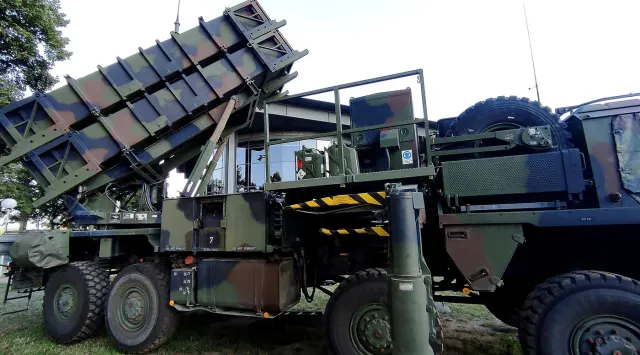
Air defense system
Patriot PAC-3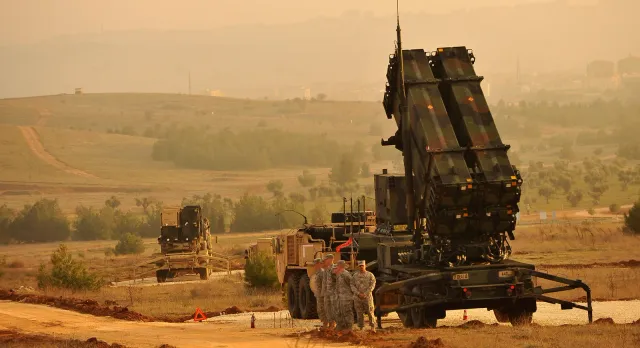
Air defense system
Patriot GEM-T Air defense system
Patriot PAC-2Frequently asked questions
Who actually intercepted the missiles, Saudi Arabia or Greece? +
A Greek-operated Patriot battery, deployed to Yanbu since September 2021 under a bilateral Greece-Saudi defense agreement, engaged and destroyed both ballistic missiles aimed at that city's refineries. Greek military sources described it as a 100 percent successful engagement against the missiles it fired on.
Did the strikes succeed elsewhere? +
The Houthi movement claims Jizan's refinery was hit and burning. That is a claim from a non-state armed group, not independently confirmed by Saudi authorities or Aramco as of this writing, and is reported here explicitly as unverified.
What triggered this round of strikes? +
The Houthis describe the Jizan and Yanbu attacks as retaliation for Saudi-led coalition airstrikes on Hodeidah port and Kamaran Island a day earlier, which followed a Houthi-declared campaign against Saudi shipping in the Red Sea.
Is this part of the wider Iran-US war? +
It is a connected but distinct front. Iran has long backed the Houthi movement, an assessment made by multiple governments but not something independently verifiable in this specific instance, and this exchange is a Houthi-Saudi confrontation, separate from the direct US-Iran strikes covered elsewhere this week.
More news


