France's Final Bastille Day Push: A €36 Billion Bet on Missiles, Drones and Speed
Emmanuel Macron used his last pre-Bastille Day address to the armed forces to declare a multi-year rearmament pledge fulfilled, as France's defense budget climbs toward €64 billion by 2027 on the back of a €36 billion supplement parliament locked in on July 1.

Christophe Licoppe / European Union, 2026, EC Audiovisual Service, via Wikimedia Commons, CC BY 4.0
France’s defense budget is on track to hit 64 billion euros by 2027, three years ahead of schedule, after President Emmanuel Macron used his final pre-Bastille Day address to the armed forces to declare a rearmament pledge he made 18 months ago has been kept. The underlying commitment, an extra 36 billion euros layered onto France’s multi-year military spending law, cleared parliament on July 1, 2026, when the National Assembly voted 375 to 113 to raise the ceiling of the 2024-2030 Military Programming Law to 436 billion euros, according to Anadolu Agency. Macron reaffirmed the commitment on July 13 at the Hotel de Brienne in Paris, on the eve of the July 14 parade, telling assembled military leadership “the commitment has been fulfilled, the facts speak for themselves,” per France 24.
A pledge made in January, banked in July
The 36 billion euro figure is not new. Macron first put a number on it January 15, 2026, in his New Year address to the military at Istres-Le Tube Air Base, telling troops “to be powerful in this brutal world, we must act faster and stronger,” per RFI. The existing Military Programming Law then stood at 413 billion euros; Macron wanted parliament to adopt an updated version, with the extra 36 billion folded in, “by 14 July,” a self-imposed deadline tied to the national holiday.
Parliament met that deadline with two weeks to spare. The revised law passed the Senate first, then the National Assembly on July 1 by a 375-113 margin, per Anadolu Agency, which cited French broadcaster BFM TV. Armed Forces Minister Catherine Vautrin told senators the changes were necessary “given the current geopolitical situation.” The adopted text raises the program’s ceiling to 436 billion euros through 2030 and adds specifics, including 8.5 billion euros for ammunition production and a new “France Munitions” platform to speed up wartime procurement. Macron was expected to sign the bill by July 14.

Three priorities, and a budget that was already climbing
Macron framed the money around three priorities, per RFI: rebuilding ammunition stocks and troop readiness; sovereignty capabilities, including satellite early-warning systems to detect long-range missile launches; and more air-defense systems, counter-drone measures and long-range drones. He also renewed a call for French defense contractors to raise production, warning firms too slow to scale up could be “pushed out of the market.”
Those priorities sit on a budget already rising. RUSI’s analysis breaks down the near-term math: an exceptional 3.5 billion euro increase in 2026 and 3 billion more in 2027, on top of the law’s existing 53.7 billion and 56.9 billion euro trajectory for those years, itself up 13 percent from 2025. Add the supplement and France’s defense budget reaches 64 billion euros in 2027, doubling the roughly 32 billion euros spent annually when Macron took office in 2017, three years ahead of schedule.
Figures per RFI's January 2026 report on Macron's Istres address and RUSI's July 2025 analysis of the underlying Military Programming Law trajectory. The 2027 target reflects the 36 billion euro supplement layered onto the existing law, reached three years ahead of the law's original 2030 horizon.
The Bastille Day framing: fulfilled, not new
Macron’s July 13 remarks did not introduce new figures so much as claim credit for ones already in motion. “In 2017, I announced that the defence budget would be increased, that commitments would be fulfilled… The commitment has been fulfilled; the facts speak for themselves, and history will judge,” he said, per France 24, in his last such speech before leaving office in 2027. He struck a starker note too: “Yes, peace is our goal. Yes, we cherish freedom and the rule of law. And yes, we stand ready to fight to defend them. Always, and at the cost of blood if necessary.”
The same day, in remarks reported by Reuters, Macron turned to industrial capacity, warning money alone won’t close France’s gap between ambition and output: “When it comes to drones, air defence systems, missiles and ammunition, we are not producing quickly enough and we are not producing at sufficient scale.” He called the collapse a month earlier of the Franco-German FCAS fighter jet project a source of “deep regret,” and cautioned against nationalism in procurement: “Patriotism, yes; nationalism, never.”
“At a time when Europe is rearming, to think that the course of history lies in each of us separately accumulating capabilities is an absurdity,” Macron said in his address to France’s armed forces on the eve of Bastille Day (Reuters via U.S. News & World Report, July 13, 2026).
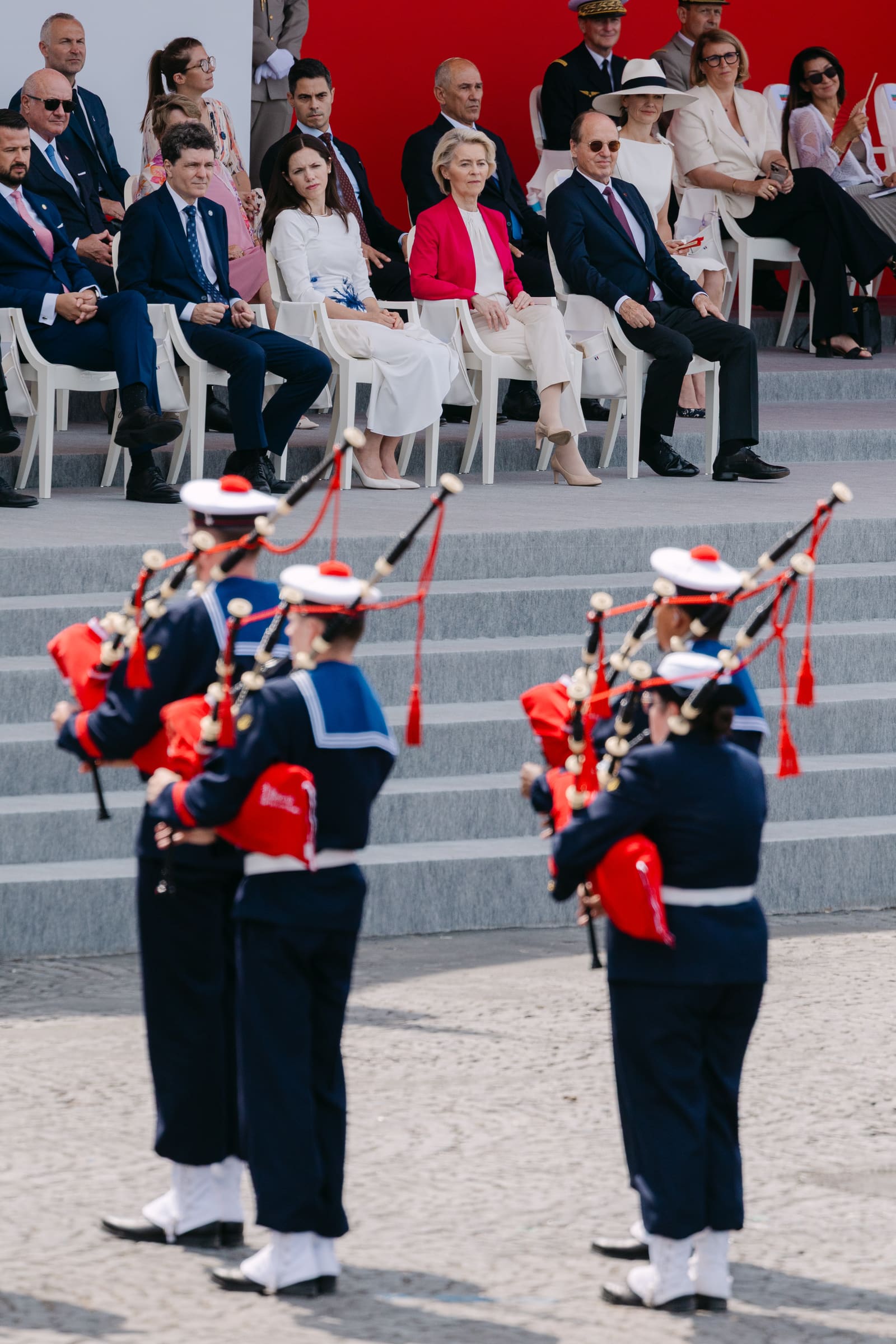
Hours after the speech, Macron hosted a summit of the “Coalition of the Willing,” the France-and-UK-led grouping coordinating military support for Ukraine, drawing Ukrainian President Volodymyr Zelenskyy, per France 24. The next day’s parade carried the same theme under the banner “Europe’s Strategic Awakening”: roughly 6,700 marching troops, close to 98 aircraft and around 315 vehicles down the Champs-Elysees, watched by some 30 heads of state including Germany’s Friedrich Merz and the UK’s Keir Starmer, with about 500 allied troops from 35 Coalition of the Willing nations opening the parade, per Euronews.
A political price tag
Not everyone is convinced the money will be transformative. RUSI cautions that a meaningful share closes gaps between the armed forces’ stated needs and previously allocated budgets rather than representing pure net expansion, and that a real production boost requires multi-year order certainty, not a single year’s increase. Some senators go further, arguing the money mainly catches up on deferred spending that reached an unprecedented 8 billion euros in 2025, up from 4 billion in 2023.
The politics compound the skepticism. A poll by Elabe for Les Echos, published July 2, found just 23 percent of French respondents trust Macron to effectively handle the country’s problems, down 3 points, with 71 percent saying they do not. The push also arrives alongside an austerity budget suspending two public holidays and cutting most other spending, a combination critics say means defense is funded by squeezing everything else.
France operates the Franco-Italian SAMP/T air-defense system, built around the Aster 30 interceptor, as its own long-range ground-based platform, an area Macron’s January remarks named for expansion alongside counter-drone systems and long-range drones.
Sources
- Macron seeks €36bn boost in French defence spending by 2030 — RFI, Jan 15, 2026
- French parliament backs nearly $500B military spending plan — Anadolu Agency (anews.com.tr), Jul 1, 2026
- Macron says France has fulfilled 'commitment to rearm' in annual speech to military — France 24, Jul 13, 2026
- Macron Calls Go-It-Alone Defence Strategies in Europe an 'Absurdity' — Reuters (via U.S. News & World Report), Jul 13, 2026
- France flaunts firepower and unity with allies as Macron hosts final Bastille Day parade — Euronews, Jul 14, 2026
- What to Make of Macron's Recent Defence Spending Commitments? — Royal United Services Institute (RUSI), Jul 13, 2025
- La cote de confiance d'Emmanuel Macron recule de 3 points, à 23% — Elabe (for Les Echos), Jul 2, 2026
Systems mentioned
Every system named in this story, with its photo and, where available, a video. Tap a card to open the full spec sheet.

Air defense system
SAMP/T (Aster 30)Frequently asked questions
What exactly did Macron announce, and when? +
Macron did not unveil a brand-new figure on July 13, 2026. He used his final pre-Bastille Day address to the armed forces, delivered at the Hotel de Brienne on the eve of the July 14 parade, to declare that a rearmament pledge dating back to January 2026 has been fulfilled. The underlying number, an extra 36 billion euros layered onto France's 2024-2030 Military Programming Law, was first announced by Macron on January 15, 2026, and formally passed by the French Parliament on July 1, 2026, when the National Assembly voted 375 to 113 to raise the law's total ceiling to 436 billion euros.
How does the 36 billion euro figure break down year to year? +
Per Macron's own January 2026 remarks and analysis from the Royal United Services Institute, the near-term piece is an extra 3.5 billion euros in 2026 and 3 billion euros in 2027 layered onto the existing Military Programming Law trajectory, which already had defense spending rising toward roughly 57 billion euros in 2026. With that supplement, France's defense budget is projected to reach 64 billion euros in 2027, three years earlier than the original 2030 target, before the remaining tranches of the 36 billion euro package continue through the rest of the decade.
What will the money actually fund? +
Macron's January 2026 address at Istres air base named three priorities: rebuilding ammunition stocks and troop readiness, sovereignty capabilities including satellite-based early-warning systems to detect long-range missile launches, and expanded protection and strike capacity through more air-defense systems, counter-drone measures and long-range drones. The July 1 parliamentary text adds specifics, including 8.5 billion euros for ammunition production through 2030 and a new 'France Munitions' platform intended to accelerate wartime procurement timelines.
Is this a popular move domestically? +
Not obviously. A poll by Elabe for Les Echos published July 2, 2026, the day after parliament passed the budget increase, found only 23 percent of French respondents trust Macron to effectively handle the country's problems, down 3 points from the prior month, with 71 percent saying they do not trust him. The spending increase also arrives alongside an unpopular austerity budget featuring the suspension of two public holidays and cuts elsewhere, a combination that has fueled criticism that rearmament is being funded by squeezing the rest of the state.
More news


