Documents
 Sweden
 Saab AB
ARTHUR
A mobile weapon-locating radar that tracks hostile artillery, mortar and rocket projectiles in flight to compute their point of origin for counter-battery fire, now in its Mod D generation with a 100 km instrumented range.
In service since 1994
Compiled from public sources ·primary reference ↗ ·last verified 2026-07-17
Procurement snapshot
Availability & export
Swedish export-licensed
ISP licensing; EU/Wassenaar controls.
Channel: Direct commercial / G2G
Fielded & proven
Operator data not public
In service since 1994. Status: active · ~80 built.
Lifecycle cost (est.)
No public unit price to model from. Why so few systems publish one →
Interoperability
No standardised NATO calibre / datalink detected in public specs.
Derived guidance from public data, export regime by country of origin, lifecycle from the GAO ~30% acquisition rule. Verify eligibility, pricing and offsets with the manufacturer and your acquisition authority.
Overview
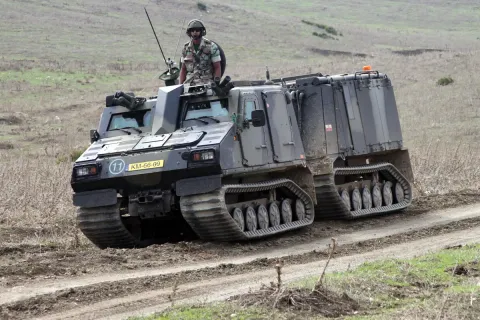
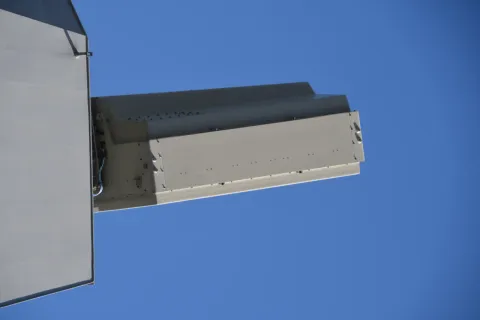
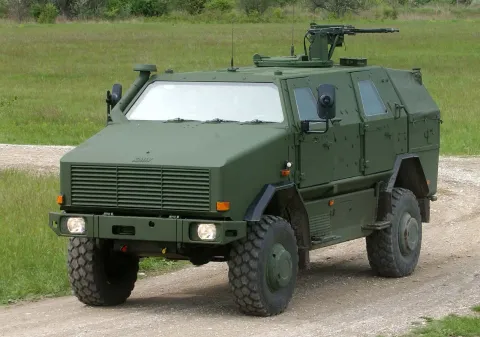
ARTHUR (ARTillery HUnting Radar) continuously scans the horizon, tracks projectiles early in their trajectory, automatically classifies gun, mortar or rocket fire, associates it with the originating battery, and sends an automatic call-for-fire message to the supported fire control system within seconds. It also runs in a fire-control mode to correct friendly artillery, and as a sense-and-warn sensor for incoming-fire alerting, a role it filled extensively in Afghanistan and Iraq. It is the most widely used weapon-locating radar in NATO. The single range figure recorded here needs care: ARTHUR's locating range is inherently dependent on both variant and target type, and the 100 km value is specifically the instrumented range of the current Mod D generation against 300 mm MLRS-class rockets, as published in Saab's own Mod D product sheet. It is not a general detection range against all targets, and it is not comparable to figures quoted for earlier generations. The system has evolved through Mod A (original, roughly 15 to 20 km against guns and 30 to 35 km against 120 mm mortars), Mod B (which met the UK Army's MAMBA requirement, roughly 20 to 25 km against guns and 35 to 40 km against mortars), Mod C (a larger antenna extending range to about 31 km against guns, 55 km against mortars and 50 to 60 km against rockets, with a tracking rate of 100 targets per minute), and the current Mod D, marketed under the UK designation TAIPAN and delivered to the British Army in 2024. Mod C can be upgraded to Mod D. Saab's Mod D sheet states a 120-degree search sector, an accuracy of better than 0.15 percent of distance CEP, and a weight under 4,000 kg in a 12-foot ISO container; Mod D is designed for single-vehicle integration into an armoured personnel carrier or a small ISO container. ARTHUR was originally carried on the Bandvagn 206 tracked carrier and is now typically truck-mounted with ISO fasteners. Roughly 80 units had been built by 2020. Operator counts differ between sources and no single figure is recorded here: Saab's own product page states the radar is operational in twelve countries and sold to thirteen, while Wikipedia lists sixteen named operator nations including Bulgaria, Canada, the Czech Republic, Denmark, Greece, Italy, Malaysia, Norway, Singapore, South Korea, Spain, Sweden, the United Kingdom and Ukraine, the latter operating second-hand ex-UK units. The discrepancy likely reflects different snapshot dates or a distinction between currently operational and ever-sold.
Full specifications
Performance
Speed, range, altitude and engagement capability.
| Engagement range Maximum distance at which an air-defense system can intercept targets. Higher covers more airspace. | 100 km |
|---|---|
| Simultaneous targets Number of targets the system can engage at once. Higher resists saturation attacks. | 100 |
Physical
Dimensions, weight and crew.
| Crew Personnel required to operate. Fewer reduces exposure; autoloaders trade a loader for mechanical complexity. | 4 |
|---|
Sensors & avionics
Radar, sensor suite and datalinks.
| Radar Primary radar. AESA (active electronically scanned array) is the current state of the art. | C-band (G/H-band) lightweight digital solid-state active array (Mod D generation) |
|---|---|
| Radar range Published detection range against a typical fighter-sized target. Higher sees first. | 100 km |
| Sensors IRST, EO/IR turrets, laser designators, sniper pods, thermal sights. | Automatic gun, mortar and rocket classification with battery association, Fire-control mode for adjusting own artillery fire, Sense-and-warn incoming-fire alerting |
| Datalink Network connectivity: Link 16, MADL, national datalinks. Enables cooperative engagement. | Automatic call-for-fire messaging to the supported fire control system |
Program
Cost, production scale and operators.
| Units built Total production run. Higher means proven manufacturing, mature logistics and spares availability. | 80 |
|---|
Specifications compiled from public Saab AB and reference sources ↗. Published defense figures are approximations, treat comparisons as directional. Last verified 2026-07-17.
Compare with rivals
See how it stacks up
 AVIC (Aviation Industry Corporation of China) KJ-2000 (Mainring)
  Boeing E-3 Sentry (AWACS)
 Frequently asked questions
What is the engagement range of the Saab AB ARTHUR? +
The Saab AB ARTHUR has a maximum engagement range of 100 km.
How many crew does the Saab AB ARTHUR require? +
The Saab AB ARTHUR requires a crew of 4.
What is the Saab AB ARTHUR used for? +
The Saab AB ARTHUR is a other typically used for counter battery, weapon locating, fire control, sense and warn.