Documents
 United States
 Anduril Industries
Sentry Tower
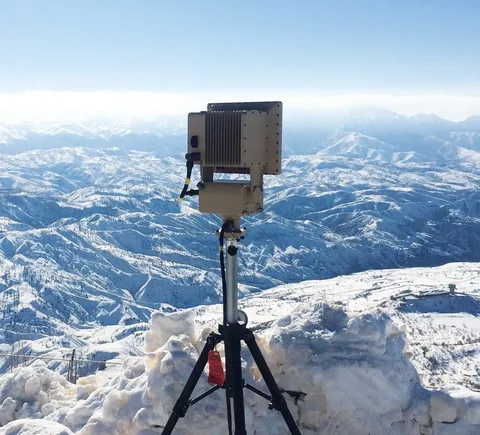
An autonomous, AI-powered surveillance tower that uses onboard sensor fusion and Anduril's Lattice software to detect, identify and track objects of interest across land and maritime domains with minimal human oversight. Each tower carries a mix of electro-optical cameras, thermal sensors and radar, and a single operator can supervise more than ten towers at once. The Extended Range Sentry Tower mounts the sensor head on an 80-foot (24 m) expeditionary mast that can be erected in under three hours and detect targets up to about 12 km (7.5 mi) away, including 5+ miles autonomously. Fielded in standard, long-range, extended-range, maritime, cold-weather and mobile configurations, Sentry is Anduril's original product line: by late 2024 more than 300 towers were deployed, covering roughly 30 percent of the U.S. southern land border, and in 2026 U.S. Customs and Border Protection ordered 200+ Extended Range Sentry Towers under a ~$363M contract.
In service since 2018
Compiled from public sources ·primary reference ↗ ·last verified 2026-07-16
Pricing: U.S. CBP 2026 order of 200+ Extended Range Sentry Towers valued at ~$363M
Procurement snapshot
Availability & export
US ITAR-controlled
Export needs U.S. State Dept (DDTC) approval; end-use & re-transfer restrictions apply.
Channel: Foreign Military Sales (FMS) or Direct Commercial Sale
Fielded & proven
Operator data not public
In service since 2018. Status: active · ~300 built.
Lifecycle cost (est.)
No public unit price to model from. Why so few systems publish one →
Interoperability
No standardised NATO calibre / datalink detected in public specs.
Derived guidance from public data, export regime by country of origin, lifecycle from the GAO ~30% acquisition rule. Verify eligibility, pricing and offsets with the manufacturer and your acquisition authority.
Full specifications
Physical
Dimensions, weight and crew.
| Height Overall height. Lower profile is harder to spot and hit for ground vehicles. | 24 m |
|---|---|
| Crew Personnel required to operate. Fewer reduces exposure; autoloaders trade a loader for mechanical complexity. | 0 |
Sensors & avionics
Radar, sensor suite and datalinks.
| Radar Primary radar. AESA (active electronically scanned array) is the current state of the art. | Integrated radar within multi-sensor head |
|---|---|
| Radar range Published detection range against a typical fighter-sized target. Higher sees first. | 12 km |
| Sensors IRST, EO/IR turrets, laser designators, sniper pods, thermal sights. | Electro-optical cameras, Thermal imaging, Radar |
| Thermal imaging Thermal sights for night and obscured-visibility operations. | Yes |
Program
Cost, production scale and operators.
| Units built Total production run. Higher means proven manufacturing, mature logistics and spares availability. | 300 |
|---|
Specifications compiled from public Anduril Industries and reference sources ↗. Published defense figures are approximations, treat comparisons as directional. Last verified 2026-07-16.
Compare with rivals
See how it stacks up
 AVIC (Aviation Industry Corporation of China) KJ-2000 (Mainring)
 Frequently asked questions
How many crew does the Anduril Industries Sentry Tower require? +
The Anduril Industries Sentry Tower requires a crew of 0.
What is the Anduril Industries Sentry Tower used for? +
The Anduril Industries Sentry Tower is a other typically used for surveillance, counter intrusion, border security.
How much does the Anduril Industries Sentry Tower cost? +
Anduril Industries Sentry Tower: U.S. CBP 2026 order of 200+ Extended Range Sentry Towers valued at ~$363M. Defense program costs are rarely fully public and vary by contract and configuration.