Documents
 United Kingdom
 Babcock International Group
Queen Elizabeth-class
The largest warships ever built for the Royal Navy, a pair of fleet carriers designed around F-35B Lightning II short take-off and vertical landing jets and Merlin helicopters. HMS Queen Elizabeth and HMS Prince of Wales were built by an industry alliance led by BAE Systems, Babcock and Thales.
In service since 2017 · 1 operator countries
Compiled from public sources ·primary reference ↗ ·last verified 2026-07-02
65,000
t
25
kn
10,000
nmi
1,600
crew
💲 ≈ $3,800,000,000, Approximate build cost per carrier
Procurement snapshot
Availability & export
UK export-licensed
Subject to UK SPIRE licensing (ECJU); generally available to allied states.
Channel: Government-to-government or direct
Fielded & proven
Limited · 1 operator
In service since 2017. Status: active · ~2 built.
Lifecycle cost (est.)
$9.5B – $13B
Acquisition is only ~30% of lifecycle cost, operating & support dominate over ~35 yrs. Rough 2.5–3.5× the unit price. How we estimate this →
Interoperability
No standardised NATO calibre / datalink detected in public specs.
Derived guidance from public data, export regime by country of origin, lifecycle from the GAO ~30% acquisition rule. Verify eligibility, pricing and offsets with the manufacturer and your acquisition authority.
Overview
The Queen Elizabeth class comprises the Royal Navy's two largest-ever warships, HMS Queen Elizabeth and HMS Prince of Wales, conventionally powered carriers built around short-take-off and vertical-landing operations. Rather than catapults, they use a ski-jump ramp to launch the F-35B, a design choice that lowers cost and complexity while restricting the air wing to STOVL and rotary aircraft. A distinctive twin-island layout separates ship navigation from flight-deck control.
Together the two ships restored British fixed-wing carrier aviation after a gap, and they operate as flagships for UK and allied task groups, embarking F-35Bs from Britain and partner nations. The programme has been shadowed by high costs and reliability problems, most visibly Prince of Wales's 2022 propeller-shaft failure that sidelined her for months.
The class has been used chiefly as an instrument of alliance politics and power projection, exemplified by Queen Elizabeth's 2021 Indo-Pacific deployment and subsequent NATO exercises. In an era of renewed great-power competition and instability, the carriers give Britain a credible, if fleet-limited, means of contributing high-end naval airpower alongside the United States and other partners.
Compatible munitions & weapons
Publicly reported weapons the Queen Elizabeth-class can carry. Linked items have a full spec page.

Full specifications
Firepower
Armament, payload and guidance.
| Main armament Primary weapon: main gun, cannon or missile type. | 3× Phalanx CIWS, 30 mm automated cannons |
|---|
Physical
Dimensions, weight and crew.
| Length Overall length including gun/probe where applicable. | 284 m |
|---|
Sensors & avionics
Radar, sensor suite and datalinks.
| Radar Primary radar. AESA (active electronically scanned array) is the current state of the art. | Type 997 Artisan 3D radar |
|---|---|
| Sensors IRST, EO/IR turrets, laser designators, sniper pods, thermal sights. | long-range radar, aircraft carrier voice information exchange system |
Program
Cost, production scale and operators.
| Unit cost Approximate flyaway/unit cost where public. Defense pricing varies hugely by contract, offsets and configuration. Lower is cheaper. | $3,800,000,000 |
|---|---|
| Units built Total production run. Higher means proven manufacturing, mature logistics and spares availability. | 2 |
| Operator countries Number of countries operating the system. More operators means broader support ecosystem. | 1 |
Specifications compiled from public Babcock International Group and reference sources ↗. Published defense figures are approximations, treat comparisons as directional. Last verified 2026-07-02.
Compare with rivals
See how it stacks up
 Naval Group Amiral Ronarc'h-class Frigate (FDI)
  Navantia Alvaro de Bazan class (F100)
 Head-to-head comparisons
Queen Elizabeth-class vs
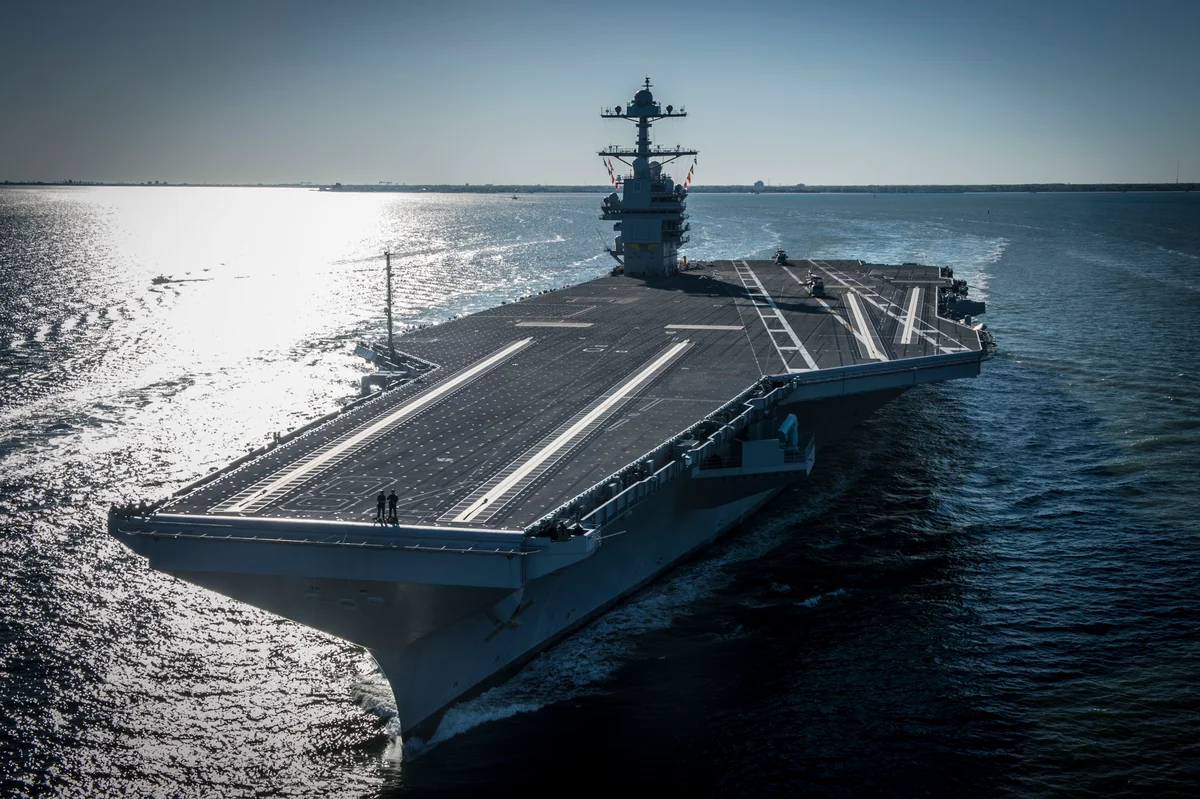
 Gerald R. Ford-class Aircraft Carrier
 Frequently asked questions
What is the main armament of the Babcock International Group Queen Elizabeth-class? +
The Babcock International Group Queen Elizabeth-class's primary weapon is the 3× Phalanx CIWS, 30 mm automated cannons.
What is the Babcock International Group Queen Elizabeth-class used for? +
The Babcock International Group Queen Elizabeth-class is a warship typically used for air superiority, isr.
How many countries operate the Babcock International Group Queen Elizabeth-class? +
The Babcock International Group Queen Elizabeth-class is operated by 1 countries.
How much does the Babcock International Group Queen Elizabeth-class cost? +
The Babcock International Group Queen Elizabeth-class has an approximate unit cost of 3,800,000,000 USD. Defense pricing varies by contract, offsets and configuration, treat this as directional.
Similar systems


Related coverage