Documents
 United Kingdom
 BAE Systems
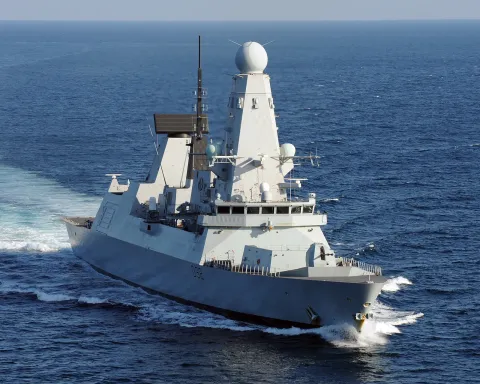
Type 23 Duke
Royal Navy general-purpose frigate originally designed for anti-submarine warfare in the North Atlantic, now serving as the fleet's multi-role workhorse armed with Sea Ceptor missiles. The class is being progressively replaced by the Type 26 and Type 31 as it reaches the end of its service life.
In service since 1990 · 1 operator countries
Compiled from public sources ·primary reference ↗ ·last verified 2026-07-02
4,900
t
28
kn
7,500
nmi
32
VLS
185
crew
Procurement snapshot
Availability & export
UK export-licensed
Subject to UK SPIRE licensing (ECJU); generally available to allied states.
Channel: Government-to-government or direct
Fielded & proven
Limited · 1 operator
In service since 1990. Status: active · ~16 built.
Lifecycle cost (est.)
No public unit price to model from. Why so few systems publish one →
Interoperability
Derived guidance from public data, export regime by country of origin, lifecycle from the GAO ~30% acquisition rule. Verify eligibility, pricing and offsets with the manufacturer and your acquisition authority.
Compatible munitions & weapons
Publicly reported weapons the Type 23 Duke can carry. Linked items have a full spec page.


Full specifications
Firepower
Armament, payload and guidance.
| Main armament Primary weapon: main gun, cannon or missile type. | 1× 4.5 in Mark 8 naval gun |
|---|---|
| VLS cells Vertical-launch missile cells on a warship, a proxy for magazine depth. Higher means more missiles before rearming. | 32 |
| Torpedo tubes Number of torpedo tubes (submarines and some surface ships). | 4 |
Physical
Dimensions, weight and crew.
| Length Overall length including gun/probe where applicable. | 133 m |
|---|
Sensors & avionics
Radar, sensor suite and datalinks.
| Radar Primary radar. AESA (active electronically scanned array) is the current state of the art. | Type 997 Artisan 3D radar |
|---|---|
| Sensors IRST, EO/IR turrets, laser designators, sniper pods, thermal sights. | Type 2087 towed-array sonar, Type 2050 hull sonar |
Program
Cost, production scale and operators.
| Units built Total production run. Higher means proven manufacturing, mature logistics and spares availability. | 16 |
|---|---|
| Operator countries Number of countries operating the system. More operators means broader support ecosystem. | 1 |
Specifications compiled from public BAE Systems and reference sources ↗. Published defense figures are approximations, treat comparisons as directional. Last verified 2026-07-02.
Compare with rivals
See how it stacks up
 Naval Group Amiral Ronarc'h-class Frigate (FDI)
  Navantia Alvaro de Bazan class (F100)
 Frequently asked questions
What is the main armament of the BAE Systems Type 23 Duke? +
The BAE Systems Type 23 Duke's primary weapon is the 1× 4.5 in Mark 8 naval gun.
What is the BAE Systems Type 23 Duke used for? +
The BAE Systems Type 23 Duke is a warship typically used for air defense, isr.
How many countries operate the BAE Systems Type 23 Duke? +
The BAE Systems Type 23 Duke is operated by 1 countries.