Product photos coming soon
 United States discontinued
 QinetiQ
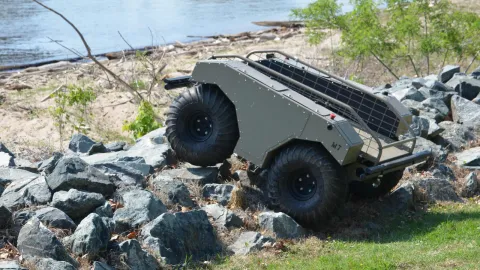
QinetiQ RCV-L
A tracked, diesel-electric hybrid unmanned ground vehicle developed by QinetiQ with Pratt Miller as a Robotic Combat Vehicle-Light contender; the US Army's RCV-L program was cancelled in May 2025.
Compiled from public sources ·primary reference ↗ ·last verified 2026-08-18
64
km/h
3,175
kg payload
Procurement snapshot
Availability & export
US ITAR-controlled
Export needs U.S. State Dept (DDTC) approval; end-use & re-transfer restrictions apply.
Channel: Foreign Military Sales (FMS) or Direct Commercial Sale
Fielded & proven
Operator data not public
Status: discontinued.
Lifecycle cost (est.)
No public unit price to model from. Why so few systems publish one →
Interoperability
No standardised NATO calibre / datalink detected in public specs.
Derived guidance from public data, export regime by country of origin, lifecycle from the GAO ~30% acquisition rule. Verify eligibility, pricing and offsets with the manufacturer and your acquisition authority.
Overview
The QinetiQ RCV-L was a tracked, diesel-electric hybrid unmanned ground vehicle developed by QinetiQ together with Pratt Miller as a contender for the US Army's Robotic Combat Vehicle-Light (RCV-L) program, with a published cargo payload capacity of about 3,175 kg and a top speed of roughly 64 km/h. Published combat weight figures for the vehicle conflict significantly and could not be reconciled: QinetiQ itself has described the vehicle as weighing just over 10 tons (roughly 10,000 kg), while Defense News separately cited a figure of under 8,500 lb (roughly 3,856 kg), a difference far too large to be a rounding or configuration discrepancy. Neither figure is populated as the platform's combat weight here; both are recorded in this description pending clarification. The US Army cancelled the RCV-L program in May 2025, and the RCV-L is treated as discontinued.
Full specifications
Performance
Speed, range, altitude and engagement capability.
| Max speed Maximum level speed. For aircraft this is at optimal altitude; for ground vehicles, top road speed. Higher means faster response and better kinematic performance. | 64 km/h |
|---|
Physical
Dimensions, weight and crew.
| Crew Personnel required to operate. Fewer reduces exposure; autoloaders trade a loader for mechanical complexity. | 0 |
|---|---|
| Cargo payload Maximum cargo the transport can carry. Higher means more lift per sortie. On an unmanned ground vehicle, this is the maximum mission payload the platform carries, including a weapon station. | 3,175 kg |
Propulsion
Engine, power and fuel.
| Propulsion type Turbofan, turboshaft, diesel, gas turbine, solid-fuel rocket, ramjet… | Diesel-electric hybrid |
|---|
Autonomy & control
How the platform moves, how much it does without an operator, and how far the control link reaches.
| Locomotion How the platform moves: tracked, wheeled or legged. Tracks suit soft ground and heavy payloads, wheels favor road speed and range, legs handle stairs and rubble. Not a ranking, a trade-off. | Tracked |
|---|---|
| Autonomy level How much the platform does without an operator, as the manufacturer describes it. Vendors do not use a common standard, so this is a coarse editorial bucket, not a certified rating. | Semi-autonomous |
Specifications compiled from public QinetiQ and reference sources ↗. Published defense figures are approximations, treat comparisons as directional. Last verified 2026-08-18.
Compare with rivals
See how it stacks up
 Roboneers Roboneers Ironclad
 Frequently asked questions
What is the top speed of the QinetiQ QinetiQ RCV-L? +
The QinetiQ QinetiQ RCV-L has a maximum speed of 64 km/h.
How many crew does the QinetiQ QinetiQ RCV-L require? +
The QinetiQ QinetiQ RCV-L requires a crew of 0.
Similar systems
Ghost Robotics
Ghost Robotics Vision 60
QinetiQ
QinetiQ MAARS
General Dynamics Land Systems
GDLS TRX
General Dynamics Land Systems