 Russia Legacy
 Kalashnikov Concern
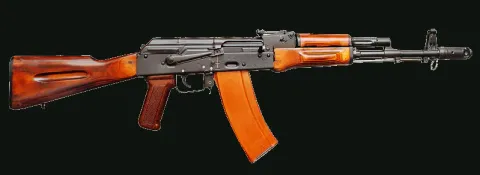
AK-74
The Soviet Army's shift to a small-caliber, high-velocity cartridge, replacing the 7.62x39mm AKM with the 5.45x39mm round to reduce recoil and increase magazine capacity per weight. It formed the basis for the later AK-74M and AK-100 series exported worldwide.
In service since 1974 · 20 operator countries
Compiled from public sources ·primary reference ↗ ·last verified 2026-07-02
400
m range
650
rpm
900
m/s
30
rds
Procurement snapshot
Availability & export
Russian state channel
Rosoboronexport monopoly; Western sanctions exposure and payment/logistics risk for many buyers.
Channel: Rosoboronexport (state)
Fielded & proven
Widely fielded · 20 operators
In service since 1974. Status: legacy · ~5,000,000 built.
Lifecycle cost (est.)
No public unit price to model from. Why so few systems publish one →
Interoperability
Derived guidance from public data, export regime by country of origin, lifecycle from the GAO ~30% acquisition rule. Verify eligibility, pricing and offsets with the manufacturer and your acquisition authority.
Full specifications
Performance
Speed, range, altitude and engagement capability.
| Effective range Distance at which the weapon reliably hits point targets. Higher extends engagement envelope. | 400 m |
|---|---|
| Rate of fire Rounds per minute (cyclic). Higher increases suppression and hit probability. | 650 rpm |
| Muzzle velocity Projectile speed leaving the barrel. Higher means flatter trajectory and better armor penetration. | 900 m/s |
Firepower
Armament, payload and guidance.
| Main armament Primary weapon: main gun, cannon or missile type. | 5.45×39 mm |
|---|---|
| Caliber Bore diameter of the main gun or rifle. Larger throws heavier projectiles; not simply better, ammunition commonality matters. | 5.5 mm |
| Ammunition Rounds carried (main gun) or standard magazine capacity. | 30 |
Physical
Dimensions, weight and crew.
| Length Overall length including gun/probe where applicable. | 0.93 m |
|---|---|
| Empty weight Weight without fuel, ammunition or crew. | 3 kg |
| Crew Personnel required to operate. Fewer reduces exposure; autoloaders trade a loader for mechanical complexity. | 1 |
| Barrel length Barrel length, longer improves muzzle velocity and accuracy, shorter improves handling. | 415 mm |
Program
Cost, production scale and operators.
| Units built Total production run. Higher means proven manufacturing, mature logistics and spares availability. | 5,000,000 |
|---|---|
| Operator countries Number of countries operating the system. More operators means broader support ecosystem. | 20 |
Specifications compiled from public Kalashnikov Concern and reference sources ↗. Published defense figures are approximations, treat comparisons as directional. Last verified 2026-07-02.
Compare with rivals
See how it stacks up
Frequently asked questions
How many crew does the Kalashnikov Concern AK-74 require? +
The Kalashnikov Concern AK-74 requires a crew of 1.
What is the main armament of the Kalashnikov Concern AK-74? +
The Kalashnikov Concern AK-74's primary weapon is the 5.45×39 mm.
What is the Kalashnikov Concern AK-74 used for? +
The Kalashnikov Concern AK-74 is a rifle & long arms typically used for infantry combat.
How many countries operate the Kalashnikov Concern AK-74? +
The Kalashnikov Concern AK-74 is operated by 20 countries.