Documents
 Israel
 Aeronautics Ltd.
Orbiter 1K
A combat-proven Israeli loitering munition derived from the Orbiter 2 mini-UAV airframe, replacing the EO/IR reconnaissance payload with an explosive charge at the nose. It is catapult-launched and controlled via a medium-range RF datalink for man-in-the-loop precision strikes.
Compiled from public sources ·primary reference ↗ ·last verified 2026-07-02
Pricing: Unit cost not publicly disclosed; Aeronautics won a reported $40 million order for the platform
Procurement snapshot
Availability & export
Israeli export-licensed
Israeli MoD (DECA/SIBAT) licensing; active export programme.
Channel: Direct commercial / G2G
Fielded & proven
Operator data not public
Status: active.
Lifecycle cost (est.)
No public unit price to model from. Why so few systems publish one →
Interoperability
No standardised NATO calibre / datalink detected in public specs.
Derived guidance from public data, export regime by country of origin, lifecycle from the GAO ~30% acquisition rule. Verify eligibility, pricing and offsets with the manufacturer and your acquisition authority.
Full specifications
Performance
Speed, range, altitude and engagement capability.
| Range Maximum distance: ferry range for aircraft, operational range for vehicles, maximum engagement distance for missiles. Higher means more standoff or persistence. | 100 km |
|---|---|
| Endurance Time on station. Critical for UAVs and patrol platforms, higher means longer persistent coverage. | 4 h |
Firepower
Armament, payload and guidance.
| Warhead Warhead mass. Heavier generally means larger effect radius, at the cost of range. | 2 kg |
|---|---|
| Warhead type Blast-fragmentation, shaped charge (HEAT), penetrator, thermobaric or nuclear-capable. | Fragmentation warhead |
Physical
Dimensions, weight and crew.
| Combat weight Fully loaded weight. Lighter eases transport and bridging limits; heavier often means more armor. | 13 kg |
|---|---|
| Crew Personnel required to operate. Fewer reduces exposure; autoloaders trade a loader for mechanical complexity. | 0 |
Propulsion
Engine, power and fuel.
| Propulsion type Turbofan, turboshaft, diesel, gas turbine, solid-fuel rocket, ramjet… | Electric motor, catapult-launched |
|---|
Sensors & avionics
Radar, sensor suite and datalinks.
| Sensors IRST, EO/IR turrets, laser designators, sniper pods, thermal sights. | Miniature EO/IR payload with video tracker |
|---|---|
| Datalink Network connectivity: Link 16, MADL, national datalinks. Enables cooperative engagement. | Medium-range RF datalink (analog/digital) |
Specifications compiled from public Aeronautics Ltd. and reference sources ↗. Published defense figures are approximations, treat comparisons as directional. Last verified 2026-07-02.
Compare with rivals
See how it stacks up
 Turkish Aerospace Industries ANKA-S
  General Atomics Aeronautical Systems MQ-9A Reaper
 Frequently asked questions
What is the range of the Aeronautics Ltd. Orbiter 1K? +
The Aeronautics Ltd. Orbiter 1K has a maximum range of 100 km.
How much does the Aeronautics Ltd. Orbiter 1K weigh? +
The Aeronautics Ltd. Orbiter 1K has a combat weight of 13 kg.
How many crew does the Aeronautics Ltd. Orbiter 1K require? +
The Aeronautics Ltd. Orbiter 1K requires a crew of 0.
What is the Aeronautics Ltd. Orbiter 1K used for? +
The Aeronautics Ltd. Orbiter 1K is a uav / drone typically used for deep strike.
How much does the Aeronautics Ltd. Orbiter 1K cost? +
Aeronautics Ltd. Orbiter 1K: Unit cost not publicly disclosed; Aeronautics won a reported $40 million order for the platform. Defense program costs are rarely fully public and vary by contract and configuration.
Similar systems
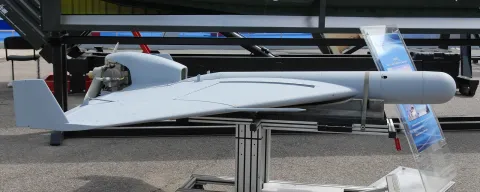
Israel Aerospace Industries
Harpy
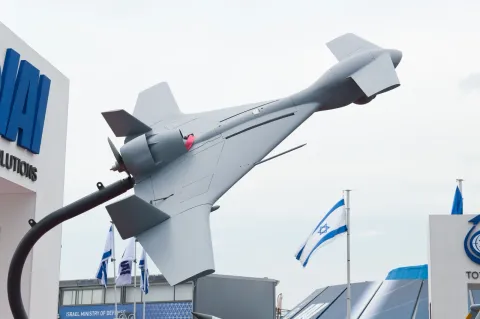
Israel Aerospace Industries
Harop
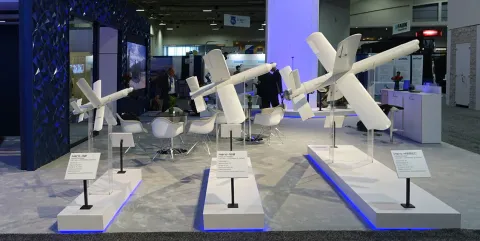
UVision Air
Hero-400EC
UVision Air