Lockheed's JR3 Training Rocket Clears a Second Flight Test at Yuma
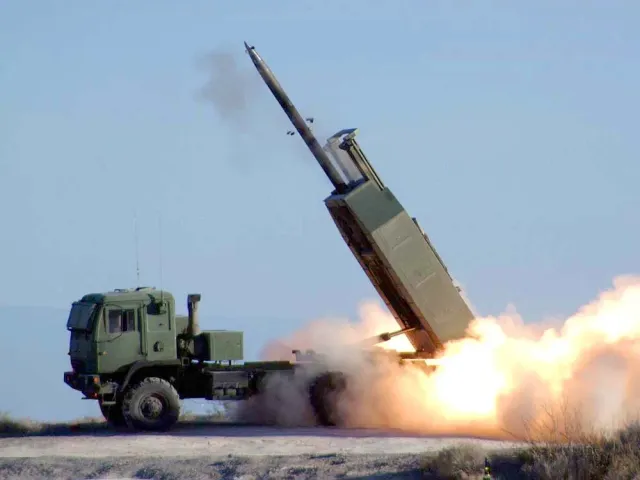
Lockheed Martin's reusable-pod JR3 training round fired multiple rounds from a HIMARS launcher on Aug. 28, 2026, aimed at a real Army stockpile problem: the current practice rocket's motor is no longer made.

U.S. Marine Corps photo by Cpl. Shayla Kuhn, DVIDS, public domain
Lockheed Martin fired multiple rounds of its new Joint Reduced Range Rocket, or JR3, from a HIMARS launcher at Yuma Proving Ground, Arizona, on Aug. 28, 2026, the training round’s second successful flight test in just over a year. The company’s own release describes the test as validating range, accuracy and marking-payload effects, the practical checkboxes a training rocket has to clear before an Army program office will consider replacing what troops already use on the range.
| Metric | Figure |
|---|---|
| JR3 reusable pod capacity | 24 rockets per pod |
| Launch platforms | HIMARS (M142) and M270 MLRS |
| Flight tests completed | 2 (Aug. 2025, White Sands; Aug. 28, 2026, Yuma) |
| Next flight test | Planned later in 2026 |
| Legacy M28A2 motor stockpile, Army estimate | Exhausted by fiscal year 2032 |
Why a training rocket needs a press release at all
Training rounds do not usually generate corporate news releases, and the reason this one does traces back to a supply problem rather than a performance one. The rocket the Army currently uses for live-fire training, the Reduced Range Practice Rocket, is built around M28A2 motors pulled from older, no-longer-produced 227mm artillery rockets that were withdrawn from combat service years ago. That stock is finite by definition, and defense trade outlet The War Zone, in reporting independently confirmed for this story, states plainly that the Army’s available M28A2 stockpile is expected to run out by fiscal year 2032. JR3 exists because a training rocket the Army fires by the thousands every year is running on a motor supply that has an expiration date.
What actually changed at Yuma
Lockheed’s release lays out the mechanics: JR3 pairs a new all-up round with a 24-rocket reusable launch pod, designed to fire from both the HIMARS and M270 MLRS launcher families already in Army and Marine Corps inventories. Reusability is the core design choice. Instead of a single-use round and disposable launch tube, crews reload fresh rockets into the same tube and pod, which Lockheed says supports higher-volume live fire on the same constrained ranges units already train on, day or night.
“Our new training round offers a scalable, very affordable solution built on mature rocket motor technology,” said Dave Griser, vice president, Lockheed Martin Precision Fires Rockets (Lockheed Martin, Aug. 28, 2026). “With a 24-round rocket launch pod, our JR3 system meets the Army’s demand for higher training volume and lower cost without sacrificing performance.”
The Aug. 28 test built directly on the program’s first flight, a White Sands Missile Range demonstration in August 2025 that proved out basic range, trajectory and tube-reload mechanics. This second test moved to a HIMARS launcher specifically and added marking-payload validation, the feature that lets range officers confirm where a training round actually landed. Lockheed says a third flight test is planned later in 2026 to further validate performance ahead of any Army decision to move the program past prototyping.
The launcher family JR3 depends on
JR3’s entire value proposition rests on compatibility with launchers the Army and its partners already operate at scale. Per WeaponSpecs’ own M142 HIMARS systems record, the M142 is a wheeled, 16,257-kilogram launcher fielded to 12 countries and built at Lockheed’s Camden, Arkansas Precision Fires Center of Excellence, the same facility that produces the GMLRS rockets and ATACMS missiles HIMARS fires in combat. A training round that works interchangeably across HIMARS and the older, tracked M270 MLRS means the Army does not need separate training pipelines for its two rocket artillery families, which is likely part of why Lockheed built JR3 as a dual-platform round from the outset rather than optimizing for one launcher first.
What to watch
The Army has not set a public timeline for a JR3 production decision, and Lockheed’s own release frames the next flight test, planned later in 2026, as another validation step rather than a program conclusion. The figures that matter most from here are the ones already in the table above: whether that third test happens on schedule, and how much runway is actually left on the M28A2 stockpile the Army is trying to replace before it runs out.
None of this changes what soldiers fire downrange tomorrow. JR3 is still a prototype two flight tests into a program that has not yet received a production decision, and the Army has not announced a timeline for when, or whether, it formally replaces the Reduced Range Practice Rocket fleet-wide. What the Aug. 28 test demonstrates is narrower but still concrete: a reusable, dual-launcher training round has now fired successfully from a HIMARS tube, which is the specific hardware validation step that has to happen before a sustainment-driven program like this one can move toward a production contract at all.
Sources
- Lockheed Martin Conducts Second Successful Test of New JR3 Rocket – A Low-Cost Path to Greater Army Readiness (Lockheed Martin, Aug 28, 2026)
- Lockheed Martin Tests New Training Rocket to Boost Army Readiness and Cut Costs (Lockheed Martin, Aug 25, 2025)
- Smaller Rockets To Provide Key Artillery Firepower Boost Sought By Army (The War Zone)
Systems mentioned
Every system named in this story, with its photo and, where available, a video. Tap a card to open the full spec sheet.
Artillery & MLRS
M142 HIMARSFrequently asked questions
What problem does JR3 actually solve? +
Per Lockheed's own release and independent reporting, the Army's current training rocket relies on M28A2 rocket motors pulled from stock that is no longer being produced, and the available stockpile is projected to run out by fiscal year 2032. JR3 is a reusable-pod replacement built on newer, sustainable rocket motor technology.
What launchers does JR3 fire from? +
HIMARS (M142) and the M270 MLRS, according to Lockheed Martin and confirmed against WeaponSpecs' own HIMARS systems record.
How many test flights has JR3 had? +
Two confirmed to date: the first at White Sands Missile Range in August 2025, and the second at Yuma Proving Ground on Aug. 28, 2026. Lockheed says a third flight test is planned later this year.
Is JR3 a combat weapon? +
No. It is a live-fire training and practice round used to qualify launcher crews, not a warhead-carrying munition.
More news


