 Poland
 Huta Stalowa Wola
PT-91 Twardy
A Polish-developed main battle tank derived from the Soviet T-72M1, upgraded with a domestic fire-control system, explosive reactive armor and a more powerful engine. It remained the backbone of Polish armored forces until being progressively replaced by the K2 and Abrams.
In service since 1995 · 2 operator countries
Compiled from public sources ·primary reference ↗ ·last verified 2026-07-02
60
km/h
650
km range
18.4
hp/t
125
mm gun
45,300
kg
Procurement snapshot
Availability & export
National export licensing
Subject to Poland export-control approval; verify eligibility with the manufacturer.
Channel: Direct commercial / G2G
Fielded & proven
Limited · 2 operators
In service since 1995. Status: active · ~233 built.
Lifecycle cost (est.)
No public unit price to model from. Why so few systems publish one →
Interoperability
No standardised NATO calibre / datalink detected in public specs.
Derived guidance from public data, export regime by country of origin, lifecycle from the GAO ~30% acquisition rule. Verify eligibility, pricing and offsets with the manufacturer and your acquisition authority.
Compatible munitions & weapons
Publicly reported weapons the PT-91 Twardy can carry. Linked items have a full spec page.


Full specifications
Performance
Speed, range, altitude and engagement capability.
| Max speed Maximum level speed. For aircraft this is at optimal altitude; for ground vehicles, top road speed. Higher means faster response and better kinematic performance. | 60 km/h |
|---|---|
| Range Maximum distance: ferry range for aircraft, operational range for vehicles, maximum engagement distance for missiles. Higher means more standoff or persistence. | 650 km |
| Power-to-weight Engine power per tonne of vehicle weight. Higher means better acceleration and cross-country mobility. | 18.4 hp/t |
Firepower
Armament, payload and guidance.
| Main armament Primary weapon: main gun, cannon or missile type. | 125 mm 2A46MS smoothbore with autoloader |
|---|---|
| Secondary armament Additional weapons: coaxial MG, remote weapon station, gun pods. | 7.62 mm coaxial + 12.7 mm AA machine gun |
| Caliber Bore diameter of the main gun or rifle. Larger throws heavier projectiles; not simply better, ammunition commonality matters. | 125 mm |
| Ammunition Rounds carried (main gun) or standard magazine capacity. | 42 |
Protection
Armor, countermeasures and survivability.
| Armor Armor technology: composite, modular, ERA-fitted, uranium-ceramic. Exact compositions are classified. | Composite armor with ERAWA explosive reactive armor |
|---|---|
| Reactive armor Explosive reactive armor (ERA) blocks that disrupt shaped-charge jets. | Yes |
| Countermeasures Self-protection: chaff, flares, DIRCM, towed decoys, smoke dischargers, jammers. | smoke grenade launchers |
| NBC protection Sealed crew compartment with overpressure filtration for nuclear/biological/chemical environments. | Yes |
Physical
Dimensions, weight and crew.
| Length Overall length including gun/probe where applicable. | 9.53 m |
|---|---|
| Width Overall width, matters for rail/road transport of vehicles. | 3.59 m |
| Height Overall height. Lower profile is harder to spot and hit for ground vehicles. | 2.19 m |
| Combat weight Fully loaded weight. Lighter eases transport and bridging limits; heavier often means more armor. | 45,300 kg |
| Crew Personnel required to operate. Fewer reduces exposure; autoloaders trade a loader for mechanical complexity. | 3 |
Propulsion
Engine, power and fuel.
| Engine Powerplant model and type. | S-12U diesel |
|---|---|
| Engine power Engine output power. Higher moves more weight faster. | 850 hp |
| Propulsion type Turbofan, turboshaft, diesel, gas turbine, solid-fuel rocket, ramjet… | Diesel |
Sensors & avionics
Radar, sensor suite and datalinks.
| Sensors IRST, EO/IR turrets, laser designators, sniper pods, thermal sights. | Drawa-T fire control system |
|---|---|
| Thermal imaging Thermal sights for night and obscured-visibility operations. | Yes |
Program
Cost, production scale and operators.
| Units built Total production run. Higher means proven manufacturing, mature logistics and spares availability. | 233 |
|---|---|
| Operator countries Number of countries operating the system. More operators means broader support ecosystem. | 2 |
Specifications compiled from public Huta Stalowa Wola and reference sources ↗. Published defense figures are approximations, treat comparisons as directional. Last verified 2026-07-02.
Compare with rivals
See how it stacks up
 Hyundai Rotem K2 Black Panther
  KNDS Leclerc XLR
  KNDS Leopard 2A7
 Frequently asked questions
What is the top speed of the Huta Stalowa Wola PT-91 Twardy? +
The Huta Stalowa Wola PT-91 Twardy has a maximum speed of 60 km/h.
What is the range of the Huta Stalowa Wola PT-91 Twardy? +
The Huta Stalowa Wola PT-91 Twardy has a maximum range of 650 km.
How much does the Huta Stalowa Wola PT-91 Twardy weigh? +
The Huta Stalowa Wola PT-91 Twardy has a combat weight of 45,300 kg.
How many crew does the Huta Stalowa Wola PT-91 Twardy require? +
The Huta Stalowa Wola PT-91 Twardy requires a crew of 3.
What is the main armament of the Huta Stalowa Wola PT-91 Twardy? +
The Huta Stalowa Wola PT-91 Twardy's primary weapon is the 125 mm 2A46MS smoothbore with autoloader.
What engine does the Huta Stalowa Wola PT-91 Twardy use? +
The Huta Stalowa Wola PT-91 Twardy is powered by the S-12U diesel.
What is the Huta Stalowa Wola PT-91 Twardy used for? +
The Huta Stalowa Wola PT-91 Twardy is a main battle tank typically used for anti armor.
How many countries operate the Huta Stalowa Wola PT-91 Twardy? +
The Huta Stalowa Wola PT-91 Twardy is operated by 2 countries.
Similar systems
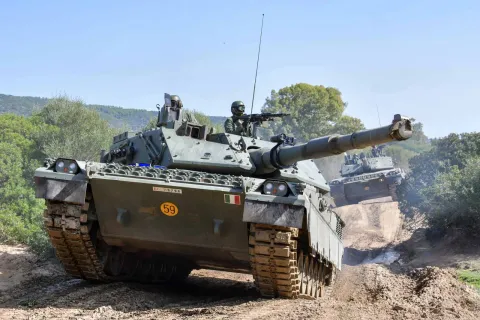
Leonardo
C1 Ariete
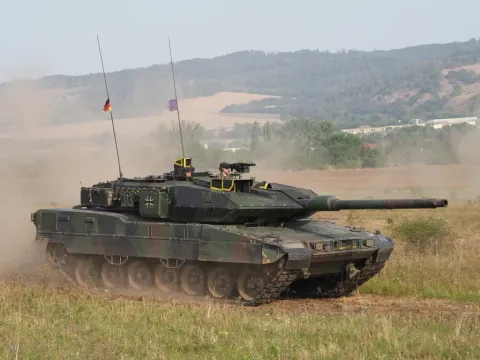
KNDS
Leopard 2A5
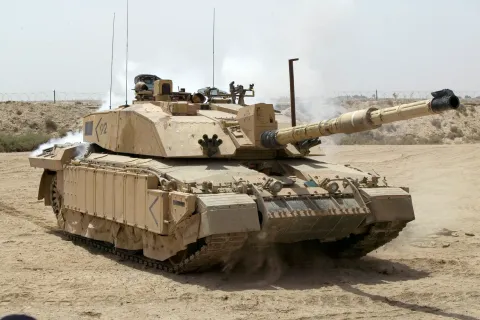
Rheinmetall BAE Systems Land (RBSL)
Challenger 2
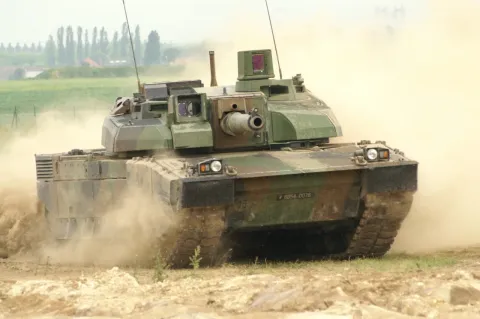
KNDS