Documents
 Italy
Italy Beretta
92FS
A double-action/single-action semi-automatic pistol adopted by the U.S. Armed Forces as the M9 in 1985, replacing the M1911A1, and serving as the standard U.S. sidearm for over three decades. It remains in wide service with Italian and export military and police forces.
In service since 1975 · 30 operator countries
Compiled from public sources ·primary reference ↗ ·last verified 2026-07-02
50
m range
381
m/s
15
rds
💲 ≈ $600, Approximate military/retail unit price
Procurement snapshot
Availability & export
Italian export-licensed
UAMA authorisation; standard EU/Wassenaar controls.
Channel: Direct commercial / G2G
Fielded & proven
Widely fielded · 30 operators
In service since 1975. Status: active · ~5,000,000 built.
Lifecycle cost (est.)
Unit cost known; one-shot / small-arms class has no meaningful O&S tail to model.
Interoperability
Derived guidance from public data, export regime by country of origin, lifecycle from the GAO ~30% acquisition rule. Verify eligibility, pricing and offsets with the manufacturer and your acquisition authority.
Full specifications
Performance
Speed, range, altitude and engagement capability.
| Effective range Distance at which the weapon reliably hits point targets. Higher extends engagement envelope. | 50 m |
|---|---|
| Muzzle velocity Projectile speed leaving the barrel. Higher means flatter trajectory and better armor penetration. | 381 m/s |
Firepower
Armament, payload and guidance.
| Main armament Primary weapon: main gun, cannon or missile type. | 9×19 mm Parabellum |
|---|---|
| Caliber Bore diameter of the main gun or rifle. Larger throws heavier projectiles; not simply better, ammunition commonality matters. | 9 mm |
| Ammunition Rounds carried (main gun) or standard magazine capacity. | 15 |
Physical
Dimensions, weight and crew.
| Length Overall length including gun/probe where applicable. | 0.22 m |
|---|---|
| Empty weight Weight without fuel, ammunition or crew. | 1 kg |
| Crew Personnel required to operate. Fewer reduces exposure; autoloaders trade a loader for mechanical complexity. | 1 |
| Barrel length Barrel length, longer improves muzzle velocity and accuracy, shorter improves handling. | 125 mm |
Program
Cost, production scale and operators.
| Unit cost Approximate flyaway/unit cost where public. Defense pricing varies hugely by contract, offsets and configuration. Lower is cheaper. | $600 |
|---|---|
| Units built Total production run. Higher means proven manufacturing, mature logistics and spares availability. | 5,000,000 |
| Operator countries Number of countries operating the system. More operators means broader support ecosystem. | 30 |
Specifications compiled from public Beretta and reference sources ↗. Published defense figures are approximations, treat comparisons as directional. Last verified 2026-07-02.
Compare with rivals
See how it stacks up
 FN Herstal Browning Hi-Power
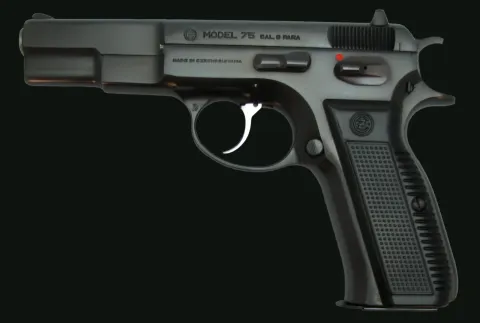
  Ceska zbrojovka (CZ) CZ 75
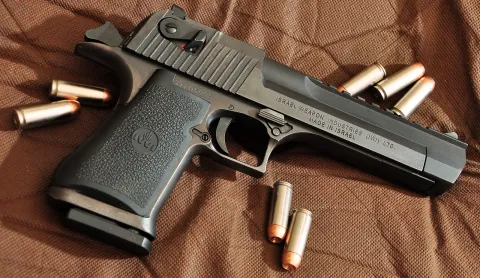
  IWI Desert Eagle
 Head-to-head comparisons
92FS vs
 P320-M17
 Frequently asked questions
How many crew does the Beretta 92FS require? +
The Beretta 92FS requires a crew of 1.
What is the main armament of the Beretta 92FS? +
The Beretta 92FS's primary weapon is the 9×19 mm Parabellum.
What is the Beretta 92FS used for? +
The Beretta 92FS is a pistol & sidearm typically used for infantry combat.
How many countries operate the Beretta 92FS? +
The Beretta 92FS is operated by 30 countries.
How much does the Beretta 92FS cost? +
The Beretta 92FS has an approximate unit cost of 600 USD. Defense pricing varies by contract, offsets and configuration, treat this as directional.