May 2026 in review: Ukraine's deadliest month, Oreshnik doubts
Ukraine logged its worst civilian toll in four years as Russia's Oreshnik hypersonic missile misfired, while Washington tripled Patriot output, cleared AI firms for classified work, and Sweden sealed a Gripen deal.

Wikimedia Commons, "2026 05 24 Russian attack on Kyiv 1.jpg", author listed as unknown, licensed CC BY 4.0 (Creative Commons Attribution 4.0 International); original source rbc.ua
By the numbers

Infographic: WeaponSpecs News Desk
May 2026 was the month Ukraine’s air war got measurably worse for civilians even as Russia’s newest hypersonic missile showed real cracks in the field, while in Washington the Pentagon moved to rebuild missile-defense stockpiles it has been drawing down for four years, cleared eight AI companies for classified-network work, and Sweden and Ukraine locked in a fighter deal years in the making. This digest ranks the six developments that mattered most across the month, weighing scale of impact and strategic significance over recency, each with a link back to primary sourcing.
Ukraine’s civilian toll hits its highest point in four years
The month’s dominant story is a casualty spike, not a battlefield line. At least 274 Ukrainian civilians were killed and 1,763 injured in May 2026, the highest monthly toll recorded since April 2022 and a 93 percent increase over May 2025, according to UN News reporting on the UN’s monitoring mission. Long-range missile and drone strikes on urban centers, chiefly Kyiv and Dnipro, accounted for 45 percent of the month’s casualties, while short-range FPV attack drones near the front line caused 64 deaths and 539 injuries, the highest toll attributed to that weapon type since February 2022, when Russia’s full-scale invasion began.
Two mass attacks defined the month. Overnight May 13 into May 14, Russia launched what independent tracking described as the war’s largest single aerial attack to date: 1,567 drones and 56 missiles in one coordinated barrage, per the Kyiv Independent’s running account of the month’s strikes. Ten days later, on May 24, Russia struck again with roughly 600 drones, 90 missiles, and, notably, two Oreshnik hypersonic missiles, a mix covered in detail below. The pairing of a record drone-and-missile count with a much smaller, high-profile hypersonic component in the same barrage is consistent with the same saturation logic WeaponSpecs has tracked in prior months: mixing slow, cheap mass with a handful of harder-to-intercept high-end weapons to strain a finite pool of interceptors across very different threat profiles at once.
The highest monthly toll since April 2022, up 93 percent versus May 2025. Long-range strikes accounted for 45 percent of casualties, but cheap front-line FPV drones, not the long-range missile mix that usually dominates the headlines, killed 64 and injured 539, nearly a quarter of May's civilian deaths and the worst monthly toll from that weapon type since the war's opening month.
Oreshnik’s reliability comes into question
Russia’s Oreshnik intermediate-range ballistic missile, first used operationally in late 2024 and touted by Moscow as an unstoppable Mach 10 hypersonic weapon, took center stage May 24 when two were fired at Kyiv alongside the barrage described above, according to NPR. The performance was not what Russian messaging has claimed. One of the two missiles reportedly fell short and landed in Russian-held territory rather than reaching its intended target, according to The National’s reporting on the incident. Independent analysis cited in that same reporting puts Oreshnik’s failure rate at roughly 25 percent across four total launches to date, a small sample but a striking one for a weapon Moscow has marketed as a strategic showpiece.
It is worth being precise about what is claim and what is observation here. Oreshnik’s stated performance figures, the Mach 10 speed, any suggestion of nuclear capability, and Russia’s framing of the missile as unstoppable, are Russian state and manufacturer claims, not independently verified. The 25 percent failure rate is different in kind: it is an outside, Western assessment of observable launch outcomes (missiles reaching or failing to reach their targets), not a figure Moscow has published or endorsed. The Oreshnik carries some design lineage from Russia’s shorter-range ballistic systems, similar in concept to the 9K720 Iskander-M that has been Russia’s primary precision-strike system against Ukrainian cities since 2022, but scaled up to intermediate range. A quarter of test-and-combat launches falling short of target, if the estimate holds up over more data points, would meaningfully undercut the missile’s value as the intimidation tool Russia has presented it as, regardless of whatever nominal top speed it can reach in a successful flight.
Washington moves to rebuild a missile-defense stockpile it has been drawing down
While Ukraine’s air war intensified, the Pentagon moved to address the interceptor shortage that years of sustained Ukraine support and rising Indo-Pacific posture requirements have created. Lockheed Martin secured a $4.7 billion contract to roughly triple production of the PAC-3 MSE interceptor, the primary round fired by Patriot batteries, from about 600 units a year to approximately 2,000, under a seven-year framework, according to Military Times. A planned second order would add 2,798 more missiles worth $12.2 billion on top of that, according to Defence Industry Europe, which also reports that THAAD interceptor production is being quadrupled and PrSM/GMLRS munitions output roughly 4x’d across the same planning window.
The scale of the ramp is the real story, not any single contract line. Tripling one interceptor line and quadrupling another simultaneously signals the Pentagon assesses current stockpiles as insufficient for a two-front posture: sustained air-defense support to Ukraine and Israel on one side, deterrence requirements against a more capable Indo-Pacific missile threat on the other. Production ramps at this scale take years to reach full rate regardless of contract value, so May’s announcements are a down payment on a multi-year fix, and the gap between contracted capacity and delivered interceptors will remain the more important number to track through 2026.

The Pentagon opens classified networks to eight AI companies, but not Anthropic
In technology policy, the Pentagon cleared eight companies, Amazon Web Services, Google, Microsoft, NVIDIA, OpenAI, Reflection, Oracle, and SpaceX, to deploy generative AI systems on classified networks up to Impact Level 6 and 7 via a new “GenAI.mil” platform, according to Al Jazeera and Breaking Defense. The notable absence from that list is Anthropic, which was excluded following a February dispute over unrestricted data access and the use of its models in autonomous-weapons applications, terms Anthropic reportedly declined to accept. The clearance is one of the broadest formal openings of classified US military infrastructure to commercial AI vendors to date, spanning cloud providers, chipmakers, model developers, and a space-systems company, and it sets a live test case for how the Pentagon balances frontier AI’s operational appeal against the access and use-case conditions individual vendors will accept.

Iran-US tensions in the Strait of Hormuz stay unresolved
The Strait of Hormuz remained a flashpoint through May. US “Project Freedom” naval operations aimed at keeping shipping lanes open destroyed several small Iranian boats in what US forces described as self-defense actions, according to CNN’s live coverage. A brief pause in operations was announced May 6, citing progress toward a ceasefire, but that calm did not hold: renewed self-defense strikes on Iranian missile sites and boats followed on May 25 and 26, per CNN’s later reporting. The pattern, a stated pause followed by renewed strikes within three weeks, mirrors the on-again, off-again trajectory this standoff has followed since it began, and it leaves the strait’s shipping-security question open heading into June rather than resolved in either direction.
Sweden and Ukraine finalize a Gripen fighter deal
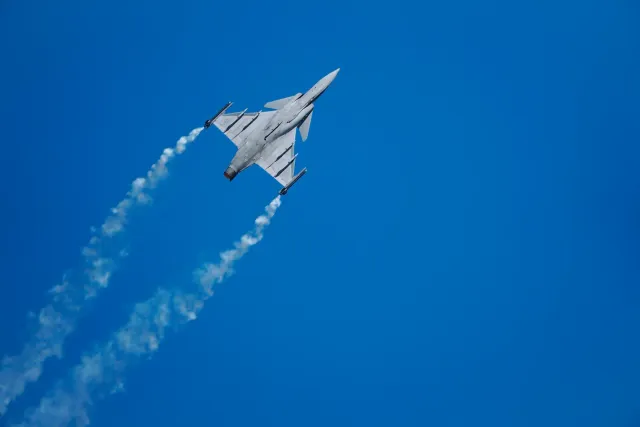
On the procurement side, Sweden and Ukraine advanced a fighter deal combining new-build and donated aircraft: up to 20 Swedish-built Gripen E/F jets for purchase, plus up to 16 Gripen C/D aircraft donated from Sweden’s existing fleet, according to The Aviationist, which reported the contract’s finalization building on the deal’s May groundwork. The Gripen adds a third distinct fighter type to Ukraine’s growing multi-type air force, joining the F-16C Block 70 already in service and a planned Rafale fleet. Operating three separate Western fighter families simultaneously is a genuine logistics and training burden, distinct engine types, weapons integrations, and maintenance pipelines, but it also diversifies Ukraine’s air combat capability across airframes with different strengths, and the Gripen’s short/rough-field operating profile in particular suits the dispersed, hardened-shelter basing posture Ukraine has adopted to survive Russian strikes.
For the day-by-day record behind these numbers, browse WeaponSpecs’ news desk, or run a side-by-side of the systems named here in the compare tool.
Sources
- Ukraine: civilian casualties hit four-year high, UN rights office reports — UN News, Jun 1, 2026
- Russia launches largest aerial attack of the war on Kyiv, May 24 — Kyiv Independent, May 24, 2026
- Russia uses hypersonic Oreshnik missile in mass attack on Kyiv — NPR, May 24, 2026
- Russia's $400m missile blitz misfires as hypersonic Oreshnik falls short — The National, May 27, 2026
- Pentagon, Lockheed Martin agree to $4.7 billion PAC-3 interceptor deal — Military Times, Apr 10, 2026
- Pentagon plans major THAAD and Patriot PAC-3 MSE interceptor purchases to strengthen Indo-Pacific missile defence — Defence Industry Europe, May 15, 2026
- Pentagon announces deal with seven AI companies for classified systems — Al Jazeera, May 1, 2026
- Pentagon clears 7 tech firms to deploy their AI on its classified networks — Breaking Defense, May 1, 2026
- Iran war live updates: Strait of Hormuz tensions, Project Freedom — CNN, May 4, 2026
- Iran war live updates: renewed self-defense strikes — CNN, May 25, 2026
- Ukraine's Gripen E contract finalized — The Aviationist, Jul 1, 2026
Systems mentioned
Every system named in this story, with its photo and, where available, a video. Tap a card to open the full spec sheet.
Compare these side by side →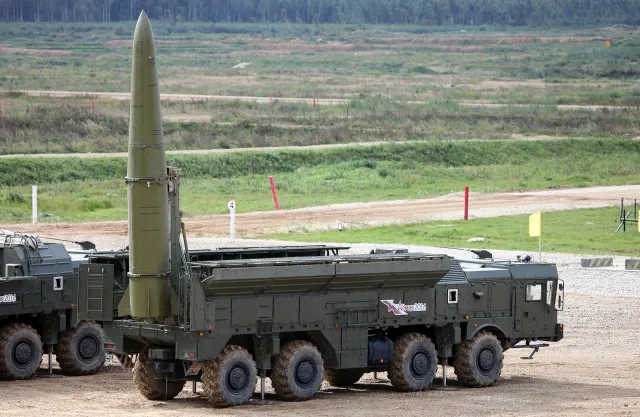
Missile
9K720 Iskander-M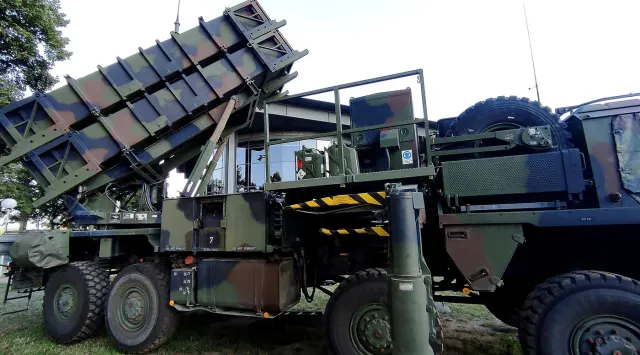
Air defense system
Patriot PAC-3
Fighter aircraft
JAS 39E Gripen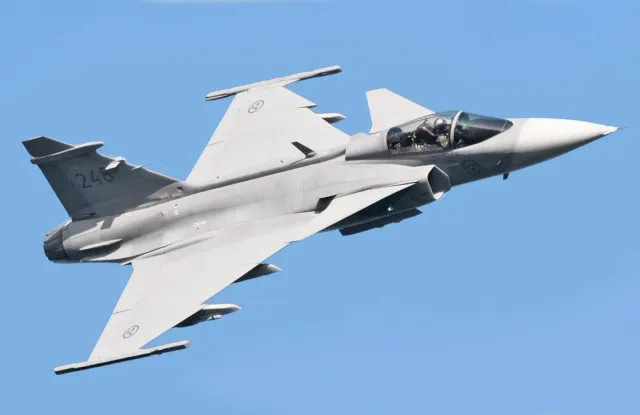
Fighter aircraft
JAS 39C Gripen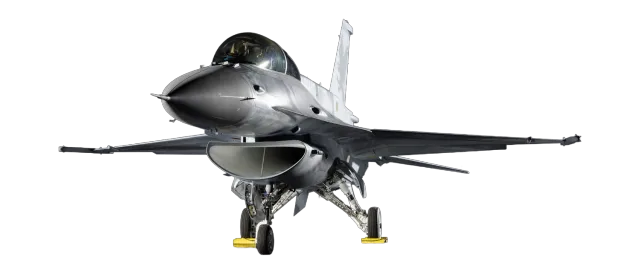
Fighter aircraft
F-16C Block 70/72 Fighting FalconFrequently asked questions
What was the single biggest story of May 2026? +
Ukraine's civilian casualty toll: at least 274 killed and 1,763 injured in May, the highest monthly figure in four years and a 93 percent increase over May 2025, according to UN reporting. It is the biggest story by human cost and by what it signals about the trajectory of Russia's long-range strike campaign.
Is Russia's Oreshnik missile really a Mach 10 hypersonic weapon? +
Those figures, including the Mach 10 speed claim and any nuclear-capability claim, are Russian state assertions and are not independently verified. What is independently observable is performance: of two Oreshnik missiles fired May 24, one reportedly fell short into Russian-held territory, and across four total launches to date, outside analysis suggests roughly a 25 percent failure rate.
Why is the Pentagon tripling Patriot interceptor production? +
Sustained Ukraine support and rising Indo-Pacific posture requirements have drawn down US interceptor stockpiles faster than production could replace them. The $4.7 billion Lockheed Martin contract aims to take PAC-3 MSE output from roughly 600 to about 2,000 interceptors a year over a seven-year framework, with THAAD production quadrupling on a similar logic.
What should I watch heading into June? +
Whether Ukraine's May casualty spike proves a peak or the new normal for Russian long-range strikes, whether further Oreshnik launches confirm or contradict the 25 percent failure estimate, and how quickly the Gripen and expanded Patriot/THAAD production lines convert from contracts into delivered hardware.
More news


