January 2026 in defense: Taiwan drills, M1E3, new US strategy
China ran its largest Taiwan blockade rehearsal yet, the US Army unrolled a next-generation tank five years early, and a new National Defense Strategy said Europe can no longer assume US conventional primacy.

Via Wikipedia, Arleigh Burke-class destroyer (shown for identification)
By the numbers

Infographic: WeaponSpecs News Desk
January 2026 opened with China’s largest Taiwan blockade rehearsal to date and closed with Washington rewriting its own strategic priorities in ways that put Europe on notice. In between, the US Army fielded a next-generation tank five years ahead of schedule, Japan approved a record defense budget aimed squarely at deterring China, and the Pentagon put real money behind autonomous drone swarms. This is WeaponSpecs’ first monthly highlights reel, a backfilled look at the month that set the tone for 2026.
China’s Taiwan drills cross a new line
China’s People’s Liberation Army ran “Justice Mission 2025,” a multi-day exercise around Taiwan spanning late December into early January, involving roughly 130 aircraft and 14 ships according to The Diplomat. The drills included live rocket fire into Taiwan’s contiguous zone, a step regional analysts read as a deliberate test run for an actual blockade rather than a routine show of force. The scale and the live-fire component distinguish this drill from prior PLA exercises around the island, which have typically been large but have stopped short of firing munitions this close to Taiwan’s own claimed waters.
The US State Department issued a formal condemnation on January 1, calling the exercise destabilizing and inconsistent with maintaining peace and stability across the Taiwan Strait. China’s own framing of the drills, including its stated objectives and the specific units and readiness levels involved, is a state claim from Beijing and its state media, not independently verified detail; what outside observers can confirm is the aircraft and ship count, the timing, and the rocket fire into the contiguous zone, which multiple governments and independent trackers logged in real time.
For naval context, the exercise underscores why US Navy surface combatants like the Arleigh Burke-class destroyer remain the backbone of American presence in the Indo-Pacific: they are the platforms most likely to be forward-deployed near any actual Taiwan contingency, and their numbers and readiness are a recurring subject of Pentagon budget testimony precisely because of scenarios like this one.
The M1E3 Abrams arrives five years early
On January 14-15 in Detroit, the US Army unveiled the M1E3, its next-generation Abrams variant, five years ahead of the original schedule, according to Defense One. The Army backed the acceleration with $474 million in funding aimed at getting prototypes into soldiers’ hands this summer, well ahead of a planned 2028 production decision, per Army Recognition and Breaking Defense.

The M1E3 keeps the Abrams lineage’s heavy armor concept but changes the machine underneath it: a hybrid diesel-electric powertrain replaces the current gas-turbine engine, and the design moves to an unmanned turret, pulling the crew fully into the hull. Breaking Defense reported the tank also includes a low-signature “silent stalking mode,” letting it operate on electric power alone for a period, cutting the acoustic and thermal signature that makes today’s tanks easy targets for cheap loitering munitions and drone-mounted sensors. That signature problem is the real driver here: Ukraine’s war has shown that a multi-million-dollar tank can be killed by a few-hundred-dollar drone if it can be seen and heard from kilometers away, and the M1E3’s design choices read as a direct answer to that lesson.
The M1E3 is the direct successor to the Army’s current fleet of M1A1 Abrams, M1A2 SEP v2, and M1A2 SEP v3 tanks, all of which trace their hull and gun back to the original 1980s Abrams design even after successive electronics and armor upgrades. The M1E3 is the first Abrams-family redesign to touch the powertrain and turret crewing at this scale rather than just bolting on new sensors and armor packages, which is why the Army is treating it as a new variant rather than another SEP block upgrade.
Placed on the same axis, the M1E3's $474 million and the drone-swarm prize's $100 million nearly vanish next to Japan's $58 billion budget, a reminder that a splashy US program announcement and a national budget aren't the same order of magnitude.
The chart above intentionally leaves out the $1.5 trillion FY2027 budget figure floated later in January, since that is a whole-of-government planning number on a completely different scale from these individual program announcements and would flatten the comparison. Note that Japan’s stand-off strike carve-out is itself one narrow slice of the country’s much larger total defense budget, covered in more detail below.
A new National Defense Strategy resets US priorities
Defense Secretary Pete Hegseth’s Pentagon released the 2026 National Defense Strategy on January 23, and it reorders longstanding US defense priorities: homeland defense now comes first, with China deterrence second, according to The Washington Post. The strategy leans harder into burden-sharing, and it explicitly states that European allies can no longer assume the US will guarantee conventional military primacy on the continent, a marked departure from decades of US strategic documents that treated a strong American conventional presence in Europe as a given.
CSIS framed the document as a mix of radical changes and real continuity: the homeland-first reordering and the Europe language are genuine departures, but China remains the pacing threat in the document’s own numbers, and much of the force-structure logic from prior strategies carries over. A $1.5 trillion FY2027 budget plan was floated alongside the strategy’s release, though that figure is a planning marker rather than an enacted appropriation, and it will move through a separate congressional budget process before it is final.
Japan approves a record defense budget
Japan’s Cabinet approved a record ¥9.04 trillion (about $58 billion) defense budget for FY2026, according to the Indo-Pacific Defense Forum. Of that total, ¥973 billion (about $6.2 billion) is earmarked for stand-off strike missiles, funding upgrades to the Type 12 surface-to-ship missile that extend its range toward 1,000 kilometers, a significant jump from the weapon’s original coastal-defense role.
That single line item matters more than its dollar figure suggests: a 1,000-kilometer-range Type 12 gives Japan a genuine long-range strike option against targets well beyond its own coastline for the first time, a capability shift tied directly to the same regional deterrence logic driving China’s Taiwan drills above. Japan has framed the increase explicitly around deterring China, making this budget a direct policy response to the security environment the PLA’s own exercises are shaping.
Shorter items: FREMM EVO, the drone-swarm prize, and the Warfighter order
Italy’s FREMM EVO frigate program passed its Critical Design Review on January 8, clearing the way for two units to join the Italian Navy by 2029-2030, according to Naval News. A Critical Design Review is the gate that confirms a warship’s design is mature enough to move into actual construction, so this milestone effectively locks in the frigate’s configuration ahead of steel-cutting.
The Pentagon launched a $100 million competition for an AI-driven drone-swarm “orchestrator,” a system meant to let a human operator direct multi-domain drone formations with voice commands rather than individually piloting each vehicle, per Defense One. SpaceX, xAI, and OpenAI were named among the competitors, putting major commercial AI labs directly inside a defense procurement competition for the first time at this scale.
President Trump signed a “Warfighter” executive order on January 7 aimed at defense-contractor accountability, according to the White House. The order ties executive compensation to production output rather than financial metrics and bans stock buybacks at contractors during periods of program underperformance, a direct response to years of criticism that major primes were rewarding shareholders while flagship programs slipped on schedule and cost.
What to watch
The M1E3’s prototype delivery to soldiers this summer is the most concrete near-term marker to track from this month’s stories: it will be the first real signal of whether the Army’s accelerated timeline holds. Japan’s Type 12 range extension and stand-off strike investment will keep drawing attention as regional tension around Taiwan continues, especially if China runs further exercises building on “Justice Mission 2025.” The Pentagon’s drone-swarm competition is still in its opening phase, and which of SpaceX, xAI, or OpenAI (or another entrant) actually delivers a working orchestrator system will be worth a dedicated follow-up once results emerge. And the 2026 National Defense Strategy’s language on Europe is likely to keep generating debate among allies through the rest of the year, particularly as the floated $1.5 trillion FY2027 budget plan works its way through Congress.
Sources
- China's Taiwan Drills Are Crossing a New Line — The Diplomat, Jan 5, 2026
- Response to China's Military Exercise Near Taiwan — US Department of State, Jan 1, 2026
- Army to push M1E3 prototypes to soldiers this summer, five years ahead of schedule — Breaking Defense, Jan 15, 2026
- U.S. Army Accelerates M1E3 Abrams Tank With $474M Funding Ahead of 2028 Production — Army Recognition, Jan 15, 2026
- Army unveils new tank, five years early — Defense One, Jan 14, 2026
- The 2026 National Defense Strategy in Numbers: Radical Changes, Moderate Changes, and Some Continuity — CSIS, Jan 25, 2026
- Pentagon leans into drone swarms with $100M challenge — Defense One, Jan 20, 2026
- Italian FREMM EVO program achieves Critical Design Review milestone — Naval News, Jan 8, 2026
- Japan's Cabinet OKs record defense spending — Indo-Pacific Defense Forum, Jan 10, 2026
- Prioritizing the Warfighter in Defense Contracting — The White House, Jan 7, 2026
Systems mentioned
Every system named in this story, with its photo and, where available, a video. Tap a card to open the full spec sheet.
Compare these side by side →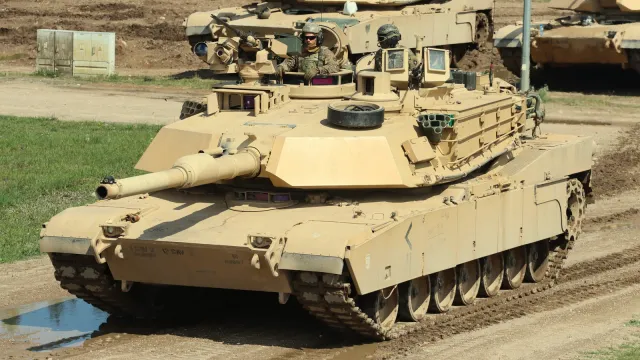
Main battle tank
M1A1 Abrams Main battle tank
M1A2 SEP v2 Abrams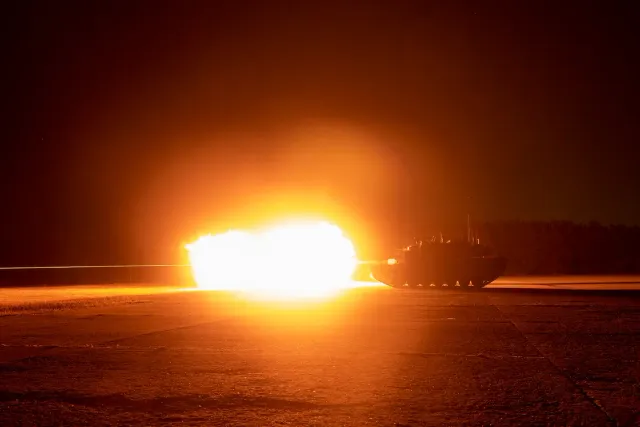
Main battle tank
M1A2 SEP v3 Abrams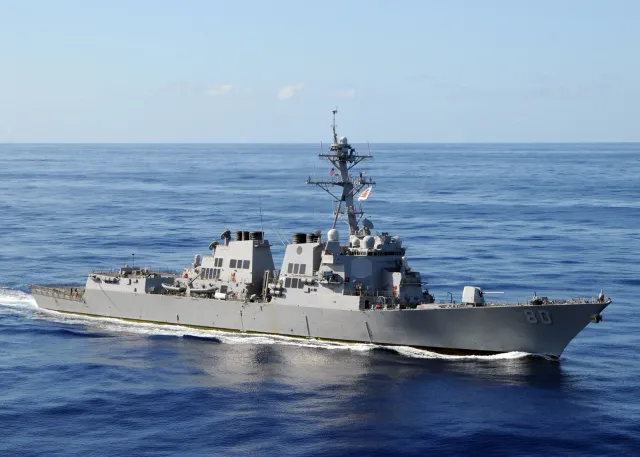
Warship
Arleigh Burke-class DestroyerFrequently asked questions
What was the single biggest story of January 2026? +
China's 'Justice Mission 2025' drills around Taiwan, which ran from late December into early January and involved roughly 130 aircraft and 14 ships, including live rocket fire into Taiwan's contiguous zone. The US State Department condemned the exercise on January 1, and analysts described it as a rehearsal for a blockade rather than a routine drill.
What is the M1E3 and why does it matter? +
The M1E3 is the US Army's next-generation Abrams tank, unveiled January 14-15 in Detroit five years ahead of its original schedule. It pairs a hybrid diesel-electric powertrain and an unmanned turret with a low-signature 'silent stalking mode' built for a battlefield where cheap drones can spot and kill armor that used to be safe from anything but another tank.
What changed in US defense strategy this month? +
The 2026 National Defense Strategy, released January 23, reordered US priorities to put homeland defense first and China deterrence second, and it explicitly said European allies could no longer assume the US would guarantee conventional military primacy on the continent, a marked shift toward burden-sharing.
What is still developing from January's stories? +
The Pentagon's $100 million AI drone-swarm 'orchestrator' competition was still in its early stage as of January's launch, with SpaceX, xAI, and OpenAI named as competitors; results and any fielded system are still to come. The M1E3's summer prototype delivery to soldiers is also a milestone still ahead.
More news


