March 2026 in defense: Iran war escalates, NATO hits 2% for all 32
Iran's largest missile-drone barrage of the war, a $20B Anduril counter-drone vehicle, Golden Dome's $185B baseline, and NATO's full-alliance 2% milestone define a month of escalation and spending.

Vyacheslav Argenberg, CC BY 4.0, via Wikipedia (shown for identification)
By the numbers

Infographic: WeaponSpecs News Desk
March 2026 was the month the Iran war stopped looking like a contained exchange and started looking like a regional war with no natural ceiling, while defense budgets on three continents moved in the same direction: up. Iran’s four-day missile-and-drone barrage against Israel and Gulf states opened the month, the Pentagon added $10 billion to its space-based missile-defense plan, the US Army handed Anduril its first task order under a new $20 billion contract vehicle, and NATO closed the month by confirming that, for the first time in the alliance’s history, all 32 members hit the 2 percent of GDP defense-spending floor. Beneath all of it, Sudan’s civil war quietly crossed into its fourth year with the largest displacement crisis on the planet and almost no international attention.
Iran’s Operation True Promise IV: the war’s largest barrage yet
The month’s dominant story was Iran’s retaliation for the strikes Israel and the United States carried out on February 28. Operation True Promise IV ran from March 1 to March 4, with Iranian and Iranian-aligned sources describing a coordinated wave of roughly 500 ballistic missiles and more than 2,000 drones aimed at Tel Aviv, Haifa, and a wider set of targets across Bahrain, Kuwait, the UAE, Saudi Arabia, and Iraq’s Erbil.12 That figure is Iranian-associated reporting on the scale of the launch, not an independently confirmed count from Israeli, American, or neutral defense sources, and it should be read with that caveat attached every time it’s cited.
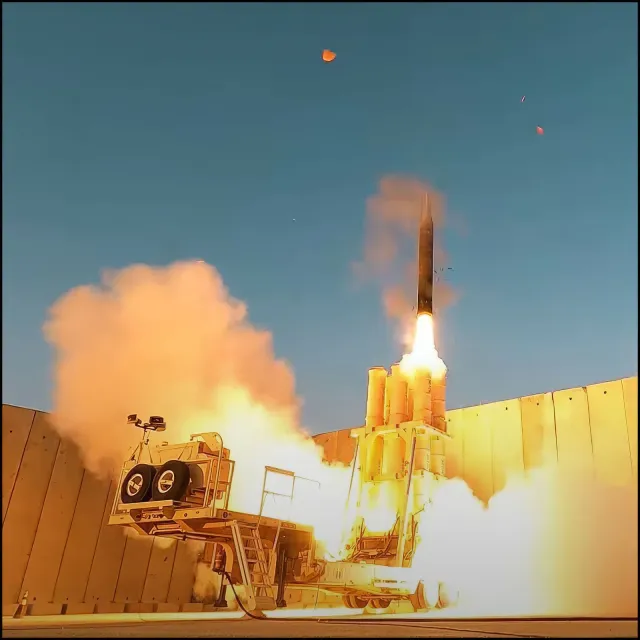
What is better established is the human cost. At least 10 people were killed in Israel during the opening days of the barrage, and a single strike on a residential building in Beit Shemesh on March 1 killed nine people, per the same sourcing. The war’s already-documented pattern of civilian-area strikes continued through the month: cluster munitions were used near Tel Aviv on March 18, killing two more people. Multi-front saturation of this kind, striking Israel and five separate Gulf states more or less simultaneously, is a materially different scale of operation than the single-target strikes that opened the conflict, and it stretches the region’s layered air-defense architecture (the Iron Dome, Arrow 2, and Arrow 4 systems Israel has leaned on throughout the war) across far more simultaneous engagement zones than any prior month.
The strategic read for March is that True Promise IV functioned as Iran’s answer to being struck first at the end of February, and the open question for April is whether this represents a ceiling on the scale of exchange the war will produce, or a floor that both sides now treat as the new baseline.
The Pentagon adds $10 billion to Golden Dome
On March 17, Space Force Gen. Michael Guetlein confirmed the Pentagon had increased funding for its Golden Dome space-based missile-defense architecture by $10 billion, raising the program’s baseline to $185 billion, according to Breaking Defense.5 The increase is earmarked to accelerate space-based capabilities specifically: AMTI (airborne moving target indicator-class) satellite constellations for tracking, and hypersonic-tracking sensor layers meant to detect and follow maneuvering hypersonic threats through their flight path, a detection problem traditional ground-based radar struggles with because of the short warning window hypersonic glide vehicles leave.
The timing is not incidental. A $10 billion acceleration to space-based tracking and hypersonic sensors lands in the same month Iran demonstrated a large-scale, multi-front ballistic and drone barrage, and the two data points read as connected even though the Pentagon’s announcement did not explicitly cite the Iran war as its trigger.

Anduril’s first task order under a new $20 billion Army contract vehicle
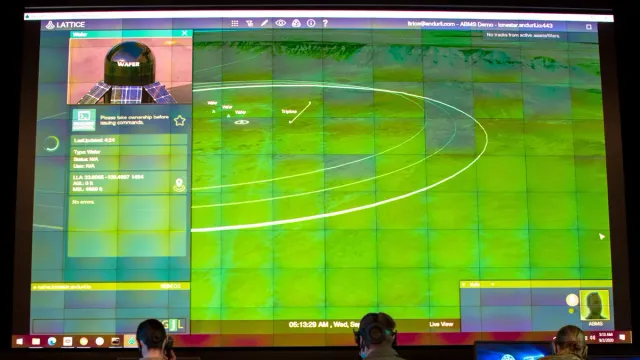
On the procurement side, the US Army awarded Anduril an $87 million counter-drone contract on March 1, the first task order issued under a newly created $20 billion, ten-year “enterprise” contract vehicle, according to Breaking Defense3 and Defense One.4 The vehicle consolidates more than 120 previously separate Army-Anduril contracts into a single structure built around Anduril’s Lattice command-and-control platform, which the Army will use as the common software backbone for counter-unmanned-aircraft-systems (C-UAS) operations across the service.
The consolidation matters more than the $87 million figure itself. Rolling 120-plus contracts into one ten-year vehicle is a structural bet that a single vendor’s software layer, rather than a patchwork of point solutions, is the right architecture for counter-drone defense going forward, a bet that lands the same month drone saturation defined Iran’s tactics overseas.
NATO: all 32 members hit 2% for the first time
NATO’s Secretary General released the alliance’s annual report on March 26, confirming that every one of NATO’s 32 member states met or exceeded the 2 percent of GDP defense-spending benchmark for 2025, the first time the full alliance has cleared that bar since the target was adopted, according to NATO’s own release6 and FlightGlobal’s reporting.7 European and Canadian defense spending rose 20 percent year over year to $574 billion, pushing alliance-wide spending past $1.4 trillion for the first time. Poland led individual member spending at 4.3 percent of GDP, with Lithuania at 4.0 percent and Latvia at 3.74 percent, well above the new floor. Alongside the milestone, NATO members agreed to a more ambitious 5 percent-by-2035 target, meaning the 2 percent bar that took over a decade to achieve alliance-wide is already being treated as outdated.
All three overachievers border Russia or its ally Belarus directly, while the 2 percent floor the other 29 members just reached was already being called outdated, replaced within the same report by a 5 percent target for 2035.
India approves a $25.1 billion procurement package, including its first S-400 for the Air Force
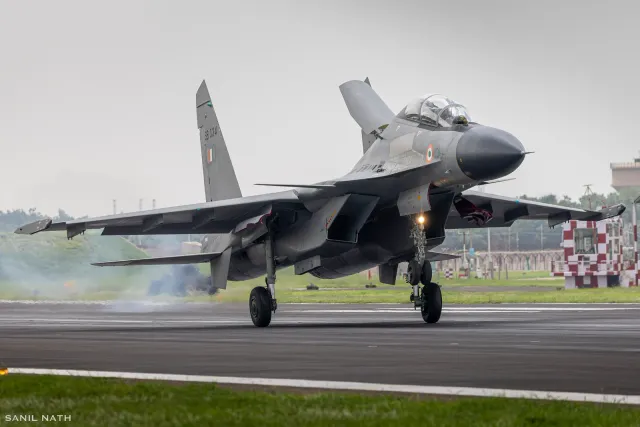
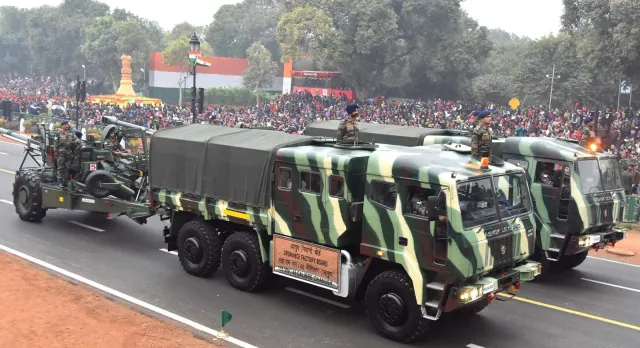
India’s Defence Acquisition Council approved a roughly $25.1 billion procurement package on March 27, spanning the Army, Air Force, and Coast Guard, according to Army Technology.8 The package’s headline item is India’s first official S-400 Triumf acquisition specifically for its Air Force, a Russian-made long-range air-defense system already in Indian service with other branches but newly formalized as an Air Force procurement this month. The S-400’s own published intercept-range and simultaneous-target figures are Russian manufacturer and state claims, standard practice for the system regardless of which country is buying it, and should be read as claims pending independent verification rather than confirmed performance. The broader package also touched Army artillery modernization (systems like the Dhanush howitzer program) and Air Force fighter-fleet support, including continued Su-30SM-family sustainment.

Sudan’s civil war enters its fourth year at 12 million displaced
Away from the month’s procurement and escalation headlines, Sudan’s civil war passed a grim threshold in March: entering its fourth year with an estimated 12 million people displaced, up from roughly 6 million in 2024 and 2 million in 2023, according to the Timeline of the Sudanese civil war9 and Health Policy Watch.10 Death toll estimates for the conflict range widely, from roughly 40,000 to 150,000, depending heavily on methodology and what counts as a direct versus indirect war death, a spread wide enough that any single figure should be treated as one estimate among several rather than a settled count. No major new offensive defined March specifically; the milestone was the calendar itself; the war’s fourth anniversary landing with no resolution in sight and the world’s largest displacement crisis still growing.
Sources
- 2026 Iran war — Wikipedia, Mar 31, 2026
- Timeline of the 2026 Iran war — Wikipedia, Mar 31, 2026
- Army awards Anduril counter-drone task order as first in new $20B contract vehicle — Breaking Defense, Mar 1, 2026
- Anduril secures $87M contract for Common Counter-Unmanned C2 program — Defense One, Mar 1, 2026
- To accelerate space capabilities, Pentagon ups Golden Dome spending plan by $10 billion — Breaking Defense, Mar 17, 2026
- NATO Secretary General's annual report shows significant increase in defence investment from Europe and Canada — NATO, Mar 26, 2026
- NATO spending tops $1.4 trillion, with non-US contributions soaring by 20% — FlightGlobal, Mar 26, 2026
- India's Defence Acquisition Council approves major military procurement package — Army Technology, Mar 27, 2026
- Timeline of the Sudanese civil war (2026) — Wikipedia, Mar 31, 2026
- Sudan's catastrophic civil war enters fourth year — Health Policy Watch, Mar 25, 2026
Systems mentioned
Every system named in this story, with its photo and, where available, a video. Tap a card to open the full spec sheet.
Compare these side by side →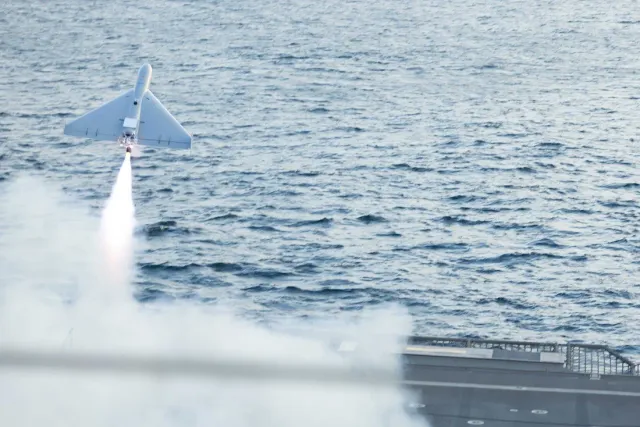
UAV / drone
Shahed-136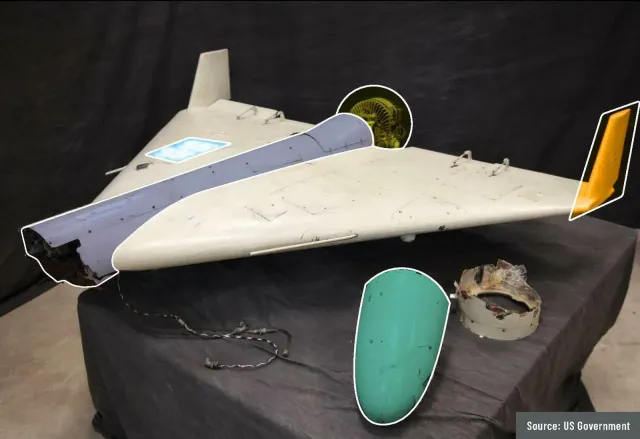
UAV / drone
Shahed-131
Air defense system
S-400 Triumf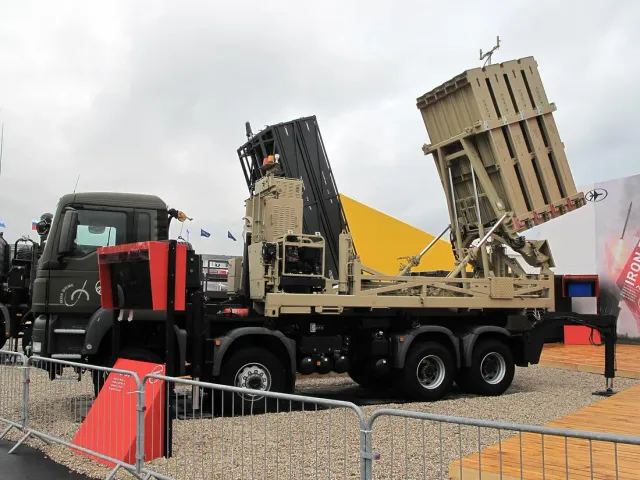
Frequently asked questions
What was the single biggest story of March 2026? +
Iran's Operation True Promise IV, a four-day barrage against Israel and Gulf states from March 1 to 4 that Iranian sources describe as roughly 500 ballistic missiles and more than 2,000 drones, the largest single wave of the 2026 Iran war to that point, killing at least 10 people in Israel including nine in a single strike on a Beit Shemesh apartment building.
Is the Iranian missile and drone count independently confirmed? +
No. The roughly 500-missile, 2,000-drone figure traces to Iranian and Iranian-aligned reporting on the operation and should be treated as a state-linked claim, not an independently verified count, pending confirmation from Israeli, US, or neutral military sources.
What changed in NATO spending this month? +
NATO's Secretary General's annual report, released March 26, confirmed that all 32 member states hit the 2 percent of GDP defense-spending target for the first time, with European and Canadian spending up 20 percent year over year to $574 billion and alliance-wide spending crossing $1.4 trillion, alongside a new 5 percent-by-2035 target.
What is still unresolved heading into April? +
The Iran conflict's trajectory, whether True Promise IV represents a ceiling or a floor for further exchanges, remains the open question, alongside how quickly the Pentagon's expanded Golden Dome budget and India's new S-400 acquisition translate into deployed capability.
More news


