Electronic Warfare Systems Compared: Jamming Range 2026
Russia's Murmansk-BN claims a strategic jamming range of 5,000 km, far beyond the tactical 20-35 km range of the other EW systems in our database.

Russian Ministry of Defence, via Wikimedia Commons, CC BY 4.0 (shown for identification)
Russia’s Murmansk-BN carries a claimed jamming range of 5,000 km. The other three systems in this comparison, Repellent-1, R-330Zh Zhitel, and Bukovel-AD, claim 35 km, 30 km, and 20 km respectively. That is not a rounding difference or a generational leap, it is two different categories of equipment doing two different jobs, and treating them as points on the same scale is the single most common mistake in casual EW comparisons.
Key takeaways:
- Murmansk-BN claims a 5,000 km strategic HF jamming range, more than 140 times the next-largest claim in this comparison.
- Repellent-1 claims a 35 km tactical jamming range, the largest of the three front-line systems compared here.
- R-330Zh Zhitel claims a 30 km tactical jamming range, aimed at drone control links and battlefield radios.
- Bukovel-AD, Ukraine’s entry in this comparison, claims a 20 km tactical jamming range.
- All four figures come from Russian or Ukrainian defense-industry disclosures, none independently verified by a neutral third party.
What does “jamming range” actually mean here?
It depends entirely on which kind of system you’re looking at. Murmansk-BN is a strategic high-frequency (HF) radio-jamming and signals-intelligence platform. Its stated 5,000 km figure describes a theater-spanning, or beyond-theater, capability to intercept and disrupt long-range military and diplomatic communications, using HF skywave propagation, where a signal bounces off the ionosphere and back down to earth hundreds or thousands of kilometers from where it was transmitted. Repellent-1, R-330Zh Zhitel, and Bukovel-AD are tactical systems. Their claimed ranges of 35 km, 30 km, and 20 km describe local, line-of-sight-ish jamming of drone control links, GPS signals, and battlefield radios near the front line. Same word, “range,” describing two physically different phenomena.
This is worth pausing on, because spec-sheet comparisons tend to flatten exactly this kind of distinction. A reader skimming a rankings list sees four numbers under one column header and assumes they’re fungible, that a system claiming 5,000 km is simply “better” at the same job as one claiming 20 km. It isn’t. A strategic HF jammer parked on a ship or at a fixed station is not competing with a truck-mounted tactical jammer for the same mission, and neither one could realistically substitute for the other. Murmansk-BN was never designed to sit near a front line jamming a quadcopter’s control link, and a system like Bukovel-AD was never designed to reach across an ocean.
How do the four claimed ranges compare?
| System | Country | Claimed range |
|---|---|---|
| Murmansk-BN | Russia | 5,000 km |
| Repellent-1 | Russia | 35 km |
| R-330Zh Zhitel | Russia | 30 km |
| Bukovel-AD | Ukraine | 20 km |
Murmansk-BN isn't 140 times more capable than Bukovel-AD, it's a strategic HF skywave jammer competing in a different category than three tactical front-line systems entirely. At this scale, the three tactical systems are barely visible bars, that's the point, not a rendering error.
The three tactical bars are effectively invisible slivers next to Murmansk-BN’s. That’s not a charting error, it’s the honest picture. A linear scale that could actually show 35 km, 30 km, and 20 km as readable bars would need Murmansk-BN’s bar to run off the page and around the block. Any chart that tries to fit all four on one clean axis is quietly lying to you about the shape of the comparison.
Why is Murmansk-BN’s figure a different kind of claim?
Murmansk-BN’s mission is to reach into the HF spectrum used for long-distance military and diplomatic traffic and jam or intercept it from a fixed or shipborne station, potentially thousands of kilometers from the transmitter it’s targeting. That relies on skywave propagation, which is a function of ionospheric conditions, time of day, solar activity, and frequency selection, not simply “how strong is the transmitter.” Repellent-1, R-330Zh Zhitel, and Bukovel-AD instead work in the frequency bands drones, GPS receivers, and local radios actually use, at ranges measured in tens of kilometers, using more conventional local RF jamming. Their mission is denying a small, specific patch of electromagnetic spectrum near the front line, not reaching across a continent. Putting a 5,000 km strategic system and three tactical systems on the same axis obscures that these are different tools built for different fights, not four points on a single capability ladder.
How reliable are these four numbers?
“Experts have long touted Russia as having some of the most experienced and best-equipped EW units in the world,” wrote Bryan Clark, Senior Fellow and Director of the Center for Defense Concepts and Technology at the Hudson Institute, in IEEE Spectrum, July 2022.
All four figures here are Russian or Ukrainian defense-industry disclosures. None of them come with independent test telemetry, third-party measurement, or a neutral verification process, and neither government has a strong incentive to publish a number that undersells its own equipment. Electronic warfare performance is unusually hard to verify from the outside even when a party wants to be transparent about it, because how well a jammer performs depends on the target receiver’s design, the terrain in between, and atmospheric or ionospheric conditions on a given day. A single published “range” figure compresses variables that can each move the real-world outcome by an order of magnitude. Treat every number in this table, Murmansk-BN’s 5,000 km included, as an unverified claim from the party that built and fields the system, not a measured fact.
This is a general problem with EW claims, not one specific to these four systems or these two countries. Jamming is inherently a contest between a transmitter and a receiver, and the receiver side of that contest, its antenna design, its signal-processing tricks, its shielding, is usually the part outsiders know the least about. A jammer that reliably defeats one drone model’s control link may do nothing against a different model built with frequency-hopping resistance, even though the jammer’s published range figure doesn’t change. Terrain matters too, HF skywave propagation depends on ionospheric layers that shift with the time of day and the point in the solar cycle, so a 5,000 km figure measured under favorable conditions may not hold on an average day. None of this means the four claims are wrong. It means a single number on a spec sheet is a starting point for questions, not a finished answer.
What should you actually take from this comparison?
Not “Murmansk-BN is 140 times better than Bukovel-AD.” That comparison doesn’t exist in any meaningful sense, because the two systems aren’t competing for the same job. The useful takeaway is narrower: strategic HF jamming and tactical local jamming are different categories with different physics, different missions, and different verification problems, and any single ranked list that puts all four systems on one number line is oversimplifying in a way that actively misleads. If you’re trying to understand where a specific EW system fits in the broader landscape, that requires looking at mission profile first and claimed range a distant second.
Our comparison tool lets you set two systems side by side on the full spec sheet rather than a single headline number, the electronic warfare systems category page covers the tactical and strategic entries in the database together, the systems advisor can help narrow down which category actually matches the question you’re asking, and WeaponSpecs articles has more of this kind of category-by-category breakdown for readers who want the caveats along with the numbers.
Sources
Systems in this comparison
Every system covered above, with its photo and, where available, a video. Tap a card to open the full spec sheet.
Compare these side by side →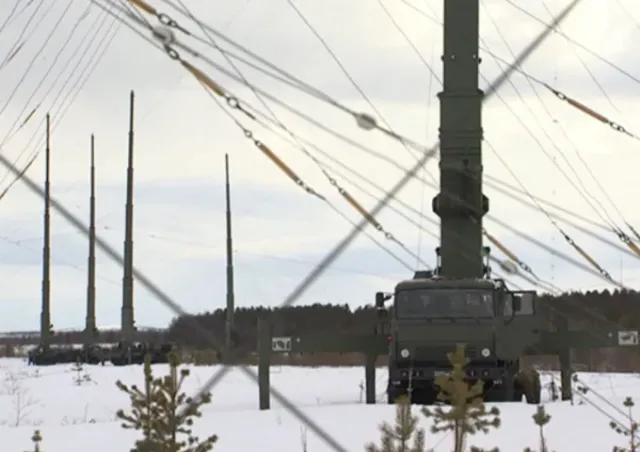
Electronic warfare
Murmansk-BNElectronic warfare
Repellent-1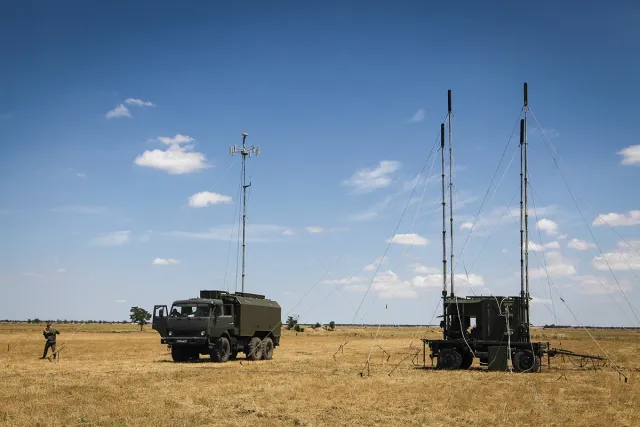
Electronic warfare
R-330Zh Zhitel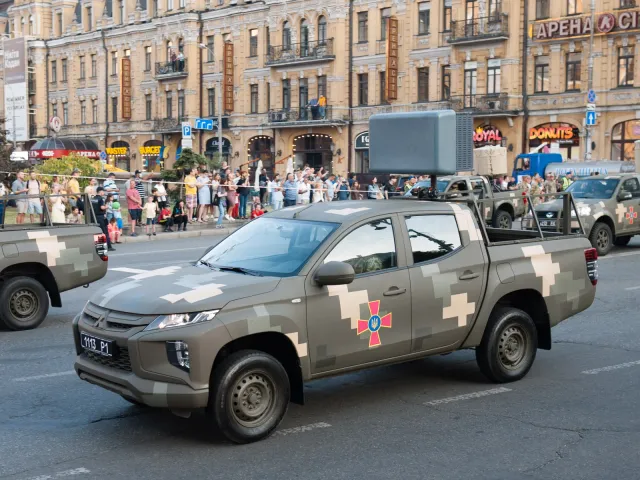
Electronic warfare
Bukovel-ADFrequently asked questions
Why is Murmansk-BN's claimed range so much larger than the other systems? +
Because it isn't doing the same job. Murmansk-BN is a strategic HF (high-frequency) radio-jamming and signals-intelligence system built to disrupt long-range military and diplomatic communications across an entire theater, using skywave propagation that bounces signals off the ionosphere. Repellent-1, R-330Zh Zhitel, and Bukovel-AD are tactical systems built to jam drone control links, GPS, and local battlefield radios within tens of kilometers of the front line. Comparing their ranges on one axis is comparing two different kinds of physics, not two grades of the same weapon.
What is the difference between strategic and tactical electronic warfare? +
Strategic EW aims at long-range, theater-wide or beyond-theater targets, think intercepting and jamming a rival navy's HF communications from a fixed or shipborne station thousands of kilometers away. Tactical EW operates at the front line, jamming the specific frequencies a drone operator or infantry unit is using to communicate or navigate, usually within a few tens of kilometers of the jammer itself. The two categories use different antennas, different frequency bands, and different propagation physics, so their range figures are not directly comparable.
Can Murmansk-BN's 5,000 km jamming range be independently verified? +
No, not by outside observers with public information alone. The 5,000 km figure comes from Russian defense-industry and state disclosures, and like most EW performance claims it has not been tested or confirmed by a neutral third party. Treat it as a manufacturer's claim, not a measured fact.
Are Russian and Ukrainian EW range claims reliable? +
Treat all four figures in this comparison, Russian and Ukrainian alike, as unverified claims from the parties that build and field the systems. Neither country's defense industry publishes independent test data, and neither has an incentive to publish a number that undersells its own equipment. That doesn't mean the figures are false, it means they haven't been confirmed by anyone without a stake in the outcome.
What do tactical EW systems like Repellent-1 and Bukovel-AD actually jam? +
Tactical systems in this class are generally built to disrupt drone control and video links, GPS/GNSS navigation signals, and short-range battlefield radio communications. Their claimed ranges, 35 km for Repellent-1, 30 km for R-330Zh Zhitel, 20 km for Bukovel-AD, describe how far from the jammer those effects are claimed to reach, not how far a radio signal can travel in open air.
Why can't a single 'range' number capture how well a jammer performs? +
Jamming effectiveness depends on the target receiver's design and shielding, the terrain between jammer and target, atmospheric and ionospheric conditions for HF systems, and how much power the jammer can put into the specific frequency the target is using. A single published range figure compresses all of that into one number, which is convenient for a spec sheet and not very informative about what happens in a specific engagement.
Related reading


