Loitering Munitions Explained: The Drones Rewriting War
Loitering munitions explained: how $50K kamikaze drones are rewriting the cost math of modern warfare.

Via Wikipedia, ZALA Lancet (shown for identification)
A loitering munition is a one-way-attack drone: it launches, flies to a patrol area, circles overhead while a sensor feed searches for a target, then dives onto whatever it finds and detonates on impact. It is not a reconnaissance drone that calls in someone else’s fire, and it is not a missile locked to a pre-planned flight path, it is both roles fused into a single expendable airframe, and that fusion is quietly rewriting the economics of who can afford to fight, and how. A system that costs tens of thousands of dollars can now credibly threaten a main battle tank worth millions, and that math is not a footnote in modern warfare, publicly available battlefield reporting from Ukraine suggests it may be the headline.
What actually makes it a “loitering” munition
The defining feature is time. A cruise missile commits to a target the moment it’s launched, following a route calculated in advance. A loitering munition instead flies to a general search box, then holds position, circling, hovering, or flying a search pattern, while a camera feed lets a human operator (or, increasingly, onboard image-processing software) confirm a target before committing to the terminal dive. That window, often minutes and sometimes much longer depending on the airframe’s endurance, is the whole point: it lets an operator hunt for a target that wasn’t visible at launch, wait out a false alarm, or abort a strike if the picture changes. Publicly, most fielded systems retain a human-confirm step before impact, though manufacturers increasingly advertise autonomous terminal tracking once a target is locked.
The three broad categories
Loitering munitions aren’t one thing, the category spans backpack-portable scout-killers to truck-launched tank hunters, and lumping them together obscures the real story.
- Man-portable tactical systems. The archetype is the Switchblade 300 from AeroVironment: a tube-launched, backpack-carried system weighing a few kilograms, built for squad-level use against personnel and light vehicles at ranges of roughly 10 kilometers. It’s cheap, fast to deploy, and disposable by design, a small unit’s organic precision-strike capability, not a division-level asset.
- Anti-armor/heavier tactical systems. Step up in size and warhead and you get systems like the Switchblade 600 and Russia’s Lancet family, built specifically to kill armored vehicles. The Switchblade 600 reportedly carries a tandem shaped-charge warhead, publicly described by AeroVironment as capable of defeating explosive reactive armor, with a longer loiter time and range than its 300 sibling. Lancet, widely documented in open-source footage from the Ukraine war, has become one of the most-reported anti-armor loitering munitions of the conflict.
- Longer-range/theater systems. Further up the scale sit systems like Iran-linked Shahed-136 derivatives and larger Western developmental programs (publicly, systems in the Altius family are pursued for extended range and modular payloads), designed less as a battlefield-organic weapon and more as a stand-off strike or saturation-attack tool against fixed infrastructure, air defenses, or logistics targets well behind the front.
The cost-asymmetry story, in one comparison
This is the part that has procurement officers on every side paying attention. A Switchblade 300 has been publicly estimated in the tens of thousands of dollars per round; larger anti-armor variants and Lancet-class systems run higher, but still typically in the low-to-mid five or six figures. A modern main battle tank, by contrast, costs several million dollars, and a top-tier anti-tank guided missile alone can run $2-4 million depending on variant and country. Publicly reported battlefield footage from Ukraine has repeatedly shown a single sub-$50,000 loitering munition disabling or destroying armor worth 50-100 times its own price. That ratio, not any single engagement, is the structural shift: for the first time at scale, the attacker’s per-shot cost can be a rounding error next to the defender’s per-unit cost, inverting a cost relationship that has favored armor and air defense for most of modern military history.
Ukraine: where the theory became a spreadsheet
Ukraine didn’t invent the loitering munition, but the war made the category impossible to ignore. Publicly available open-source tracking of destroyed and damaged vehicles has repeatedly flagged Lancet and comparable systems as recurring causes of Russian armor and artillery losses, and both sides have scaled domestic production of tactical loitering munitions in response to battlefield demand that outpaced existing inventories. The war has also normalized a tactic that barely existed as doctrine a decade ago: using cheap loitering munitions not to replace artillery or armor, but to attrit it persistently, forcing constant dispersal, camouflage discipline, and electronic-warfare investment that themselves carry a cost. Publicly, this dynamic is widely credited with accelerating global interest in both offensive loitering-munition production and the counter-drone systems built to defeat them, an arms race with a much lower barrier to entry than the tank-versus-missile race it’s partly displacing.
Autonomy: the trend everyone’s watching and few will confirm
The uncomfortable long-term question is how much of the targeting chain gets automated. Publicly, manufacturers describe increasingly capable onboard image recognition, terminal-guidance tracking, and target-reacquisition features, useful for hitting a moving vehicle after a human has already selected it. What’s far less publicly confirmed is autonomous target selection without a human in the loop at any stage, a step most Western manufacturers and militaries have publicly stated they intend to avoid or heavily restrict, at least in current doctrine. Given the pace of software iteration on cheap commercial hardware, this is a boundary worth watching rather than assuming, the sensors and compute needed for further autonomy are already commercially available, even where the doctrine hasn’t caught up.
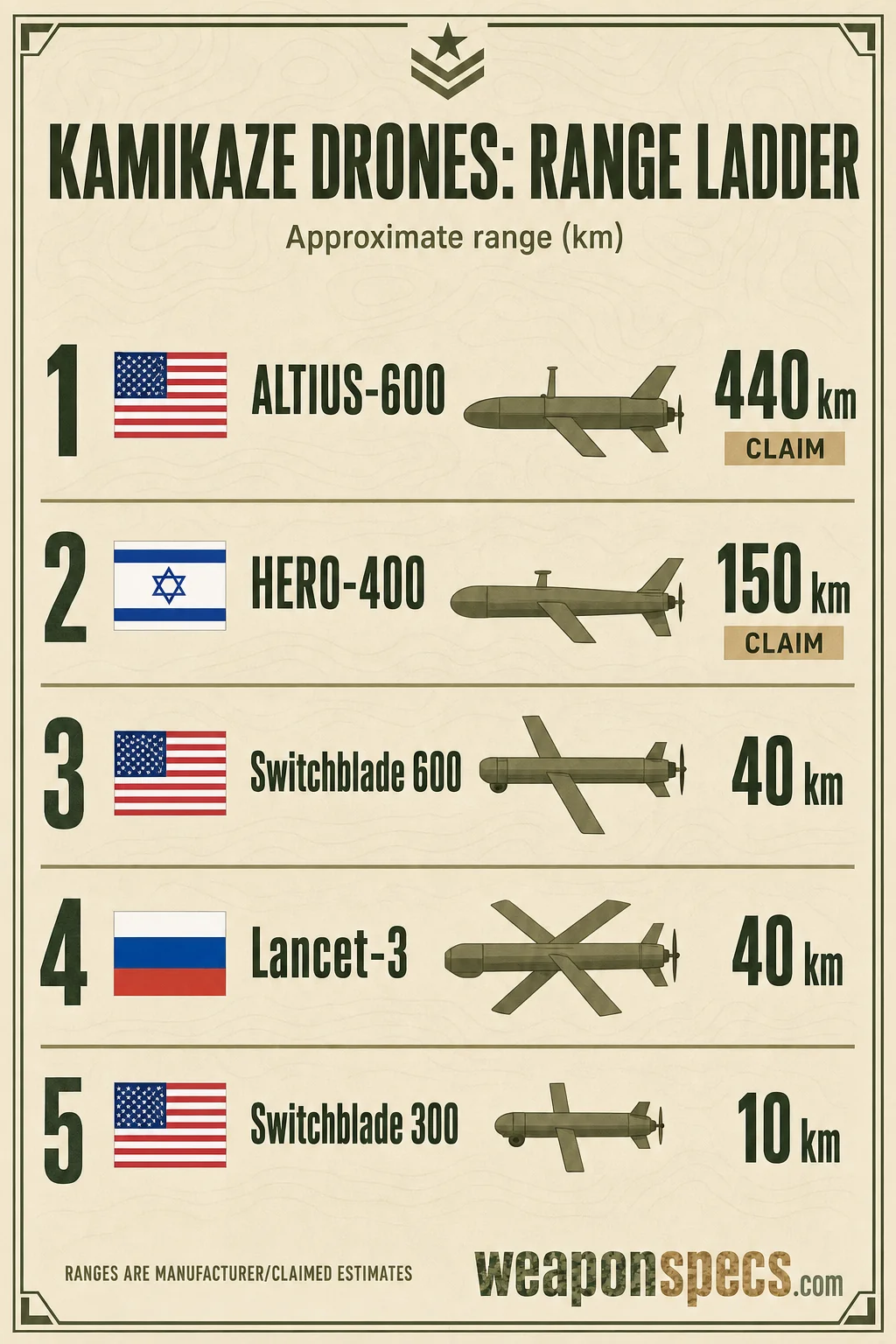
The numbers, side by side
| System | Class | Approx. range | Warhead/role | Origin |
|---|---|---|---|---|
| Switchblade 300 | Man-portable tactical | ~10 km | Anti-personnel/light vehicle, fragmentation | United States (AeroVironment) |
| Switchblade 600 | Anti-armor tactical | ~40+ km (manufacturer claim) | Tandem shaped-charge, anti-armor | United States (AeroVironment) |
| Lancet-3 | Anti-armor tactical | ~40 km (publicly reported) | Shaped-charge/fragmentation, anti-armor | Russia (ZALA Aero) |
| HERO-400 | Medium tactical/anti-armor | ~150 km (manufacturer claim) | Multi-purpose warhead | Israel (UVision) |
| ALTIUS-600 | Extended-range/modular | 440+ km (developmental, manufacturer claim) | Modular payload, ISR/strike | United States (Anduril/AV lineage) |
The 44x range spread from Switchblade 300 to Altius-600 isn't the disruptive number here: even the priciest tactical variant still costs a fraction of the multi-million-dollar armor and ATGMs it's shown able to kill.
Every figure above should be read as a publicly disclosed or manufacturer-claimed estimate rather than an audited spec, loitering-munition ranges and warhead performance are rarely independently verified, and combat conditions typically shrink the numbers on the brochure.
The bottom line
Loitering munitions didn’t just add a new weapon category, they broke a cost equation that has governed land warfare for decades, letting a $20,000-$100,000 system credibly threaten assets worth 50 to 100 times as much. Ukraine turned that from a procurement slide into a documented battlefield pattern, and the trend line, cheaper sensors, better terminal tracking, wider proliferation, points toward more of this, not less. The open question isn’t whether loitering munitions matter; it’s how far the autonomy dial gets turned, and who turns it first.
Compare tactical and anti-armor loitering systems side by side in the UAV class on WeaponSpecs, weigh them against traditional missile options, or run your own mission profile through the Advisor tool. For more breakdowns like this one, browse the WeaponSpecs articles.
Systems in this comparison
Every system covered above, with its photo and, where available, a video. Tap a card to open the full spec sheet.
Compare these side by side →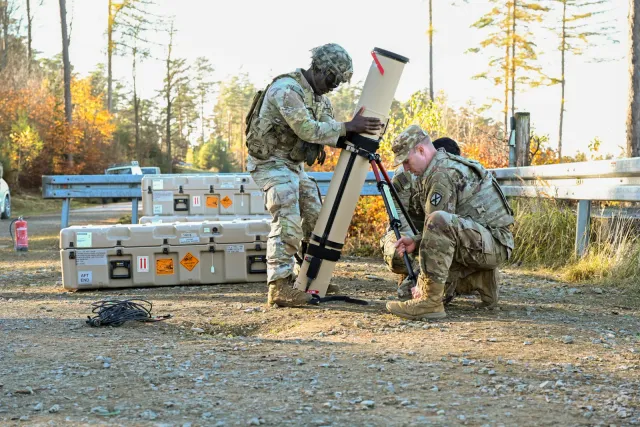
UAV / drone
Switchblade 600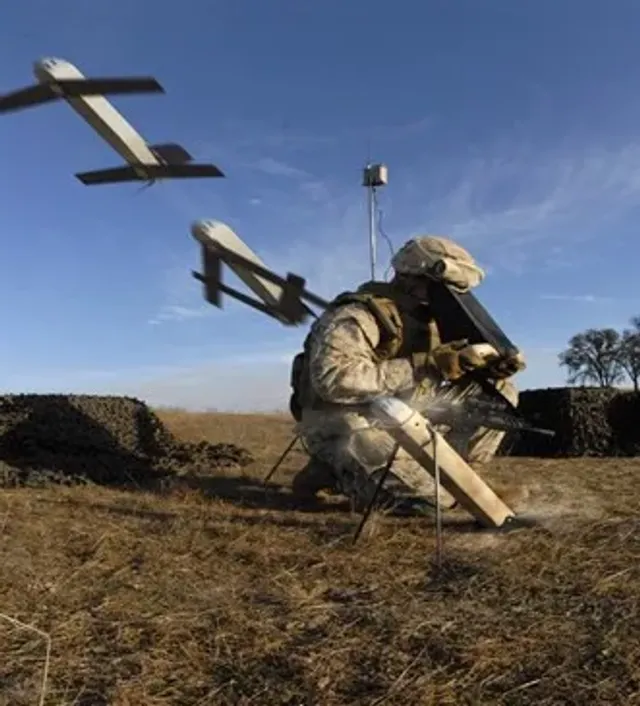
UAV / drone
Switchblade 300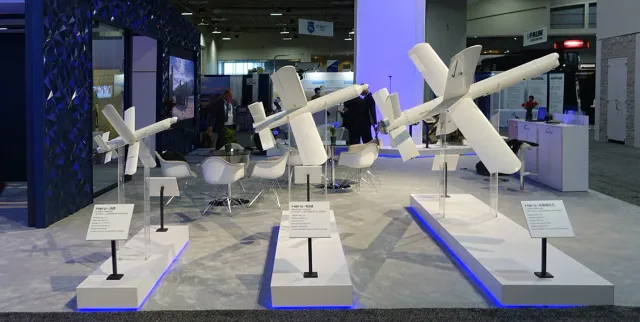
UAV / drone
Hero-400EC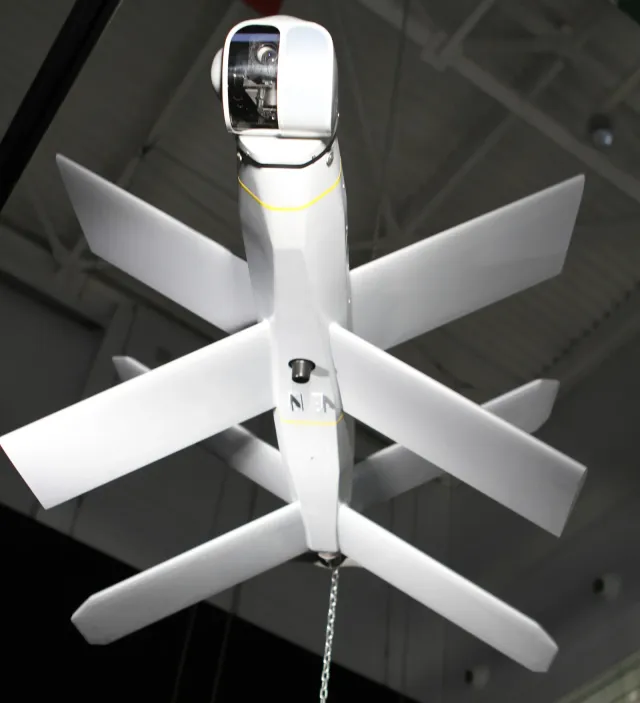
UAV / drone
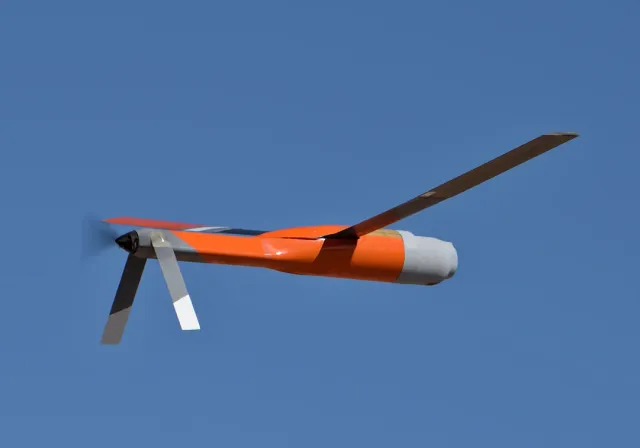
ALTIUS-600Frequently asked questions
What is a loitering munition? +
A loitering munition is an armed drone that flies to a search area, circles ('loiters') while a sensor and operator hunt for a target, then dives into it as a one-way strike, destroying itself along with whatever it hits. It's a drone and a warhead in one airframe.
How is a loitering munition different from a drone or a missile? +
A reconnaissance drone watches but doesn't strike; a missile strikes but flies a pre-set path with no time to search. A loitering munition does both, it hunts for minutes to hours before committing, giving an operator a late abort option missiles don't have.
How much does a loitering munition cost? +
Publicly disclosed figures vary widely by class and are rarely official, from roughly $35,000 for a Russian Lancet-3 to $50,000-$90,000 for man-portable tactical systems like Switchblade 300 and Switchblade 600, still far below a $2-4 million anti-tank guided missile or a multi-million-dollar armored vehicle.
What is the Switchblade drone? +
Switchblade, made by AeroVironment, is a family of U.S. loitering munitions. The Switchblade 300 is a backpack-portable anti-personnel system; the Switchblade 600 is a larger, longer-range anti-armor variant carrying a tandem shaped-charge warhead capable of defeating reactive armor.
Are loitering munitions autonomous? +
Most fielded systems today keep a human in the loop for the final strike decision, per public manufacturer and military statements. Terminal guidance, target tracking, and navigation are increasingly automated, but full autonomous target selection without human confirmation remains publicly unconfirmed at scale.
Related reading


