Ukraine opens arms exports to 27 nations via new Drone Deal framework
Ukraine approved a wartime arms-export mechanism on July 1, opening drones, missiles and other systems worth $335K+ to 27 vetted partner nations.

Neptune R-360 missile on display, Kyiv 2021. Photo by VoidWanderer via Wikimedia Commons (CC0).
By the numbers

Infographic: WeaponSpecs News Desk
Ukraine’s Cabinet of Ministers approved a new wartime arms-export mechanism on July 1, opening the door for 27 vetted partner nations to buy Ukrainian-made drones, missiles, and other systems directly from manufacturers, according to Janes. The framework, nicknamed the “Drone Deal” for its emphasis on loitering drones and unmanned systems, sets a minimum transaction threshold of $335,000 per order, per Kyiv Post.
At least 15 NATO members are among the 27 confirmed participating countries, according to RBC Ukraine, which reported a scramble among allied governments to move through the approval process as battlefield drone demand rises globally. Euronews had reported in April that Kyiv planned a selective rollout rather than opening exports to every country.
Why is Ukraine exporting weapons now?
The mechanism exists because Ukraine’s domestic defense-manufacturing capacity has expanded roughly 35 times over during the war, from about $1 billion in annual output before 2022 to approximately $35 billion in 2026, with industry projections pointing toward $55 billion by the end of the year, according to United24 Media. That growth has outpaced what Ukraine’s own military can absorb on the front line, leaving manufacturers with spare production capacity to sell abroad.
The scale of that shift is easy to understate. Ukraine’s pre-war defense-export business ran at roughly $400-500 million a year, mostly Soviet-legacy aircraft parts, engine maintenance, and component work handled by state-linked suppliers like Motor Sich and Ivchenko-Progress. Moving from there to a $35 billion run-rate is not incremental growth, it is closer to a 70-fold transformation, and it pulled in a different kind of manufacturer entirely: design bureaus like Luch (which builds the Neptune missile) shifting into direct wartime production, alongside new private and crowdfunded entrants that had no defense-export footprint before 2022.
The $55 billion bar is an industry projection, not confirmed output, and even the current $35 billion figure measures total production capacity, not exports, which ran a fraction of that size before the war.
Under the framework, licensed export sales must return 20 percent of the product’s value to Ukraine’s state budget, according to Kyiv Post, turning surplus production into a direct revenue stream for the war effort rather than relying solely on foreign aid.
Which countries can buy, and what systems are on offer?
The 27-country list is built around NATO and EU alignment, with vetting standards restricting the mechanism to trusted partners, per Euronews. Available systems include loitering munitions such as the Bober-class attack drone and anti-ship missiles such as the Neptune, alongside other domestically produced platforms, according to RBC Ukraine.
The Bober attack drone is a useful example of what buyers are actually getting: a crowdfunded program, roughly $500,000 raised from private donors before it reached serial production, that flew its first mission in 2023 and has since been flown on strikes reported as far as the Moscow area. It carries a KZ-6 warhead out to roughly 1,000 kilometers, entirely outside the price bracket and procurement pedigree of a typical NATO-standard loitering munition. The Neptune anti-ship missile has an even sharper resume: a roughly 300-kilometer-range, 150-kilogram-warhead missile built around an 870-kilogram airframe descended from the Soviet Kh-35, most famous for sinking the Russian Black Sea Fleet cruiser Moskva in April 2022.
Why buyers want non-NATO-standard systems
That combat record points to a paradox worth sitting with: several of the confirmed buyers, Poland, Romania, the Baltic states, Nordic countries, Australia, Japan, and Taiwan among them per open reporting, are NATO members or close US allies who already have access to NATO-standard anti-ship and strike systems. Neptune is not one of those. It is a Soviet-lineage, subsonic missile, cheaper to build and field than NATO’s own Harpoon, with no NATO type-certification behind it. Bober has no NATO equivalent whatsoever; it was designed and iterated entirely inside a live war.
What these buyers are actually purchasing is not interoperability, it is proof. Neptune has sunk a capital warship under real combat conditions against the exact kind of naval threat several of these buyers plan for. Bober has flown deep-strike missions and survived contact with Russian air defense in numbers real enough to be independently reported, something no NATO test range produces. Governments hedging against a range of adversaries are treating combat-proven Ukrainian hardware as a genuine second source, diversifying away from any single NATO-standard supply chain while directly funding the country doing the fighting.
The $335,000 threshold as a seriousness filter
The minimum order size is not an arbitrary number. Neptune itself costs roughly $250,000 to $300,000 to build, three to four months of material and skilled labor per unit, so a $335,000 floor bakes in a 10 to 15 percent margin plus the mandated state contribution while shutting out one-off “window shopping” purchases. A government clearing that bar is signaling it wants an ongoing supply relationship: training, spare parts, maintenance support, repeat orders, not a single evaluation unit. Turkey’s Bayraktar TB2 export program used a comparable minimum-order filter for the same reason, screening for buyers committed to a real program.
How is this different from a normal arms deal?
Traditional arms contracts typically run through multi-month, government-to-government negotiations. The Drone Deal framework instead sets a 30-day standard review window for manufacturer-to-partner approvals, according to Janes, a deliberate streamlining meant to let Ukrainian firms close export sales at wartime speed rather than peacetime bureaucratic pace.
The closest peacetime precedent is Israel’s arms-export model, which also pairs rigorous end-use vetting with a defense industry built to sell abroad, but whose approvals typically still take several months even for trusted partners. Ukraine is running the same basic idea, vet the buyer, then sell, at roughly a tenth of that timeline. South Korea offers the other half of the comparison: it has built itself into the world’s sixth-largest arms exporter, around $9 billion a year, by proving that rigorously vetted export programs can scale into serious volume without loosening standards. Ukraine is attempting a version of that outcome using production capacity built from a standing start, entirely during active wartime, with no real peacetime analogue.
Sources
- Ukraine Approves Export Mechanism for Drone Deal Partners — Kyiv Post, Jul 2, 2026
- Ukraine Built a $50B Defense Industry in Four Years. Here's Why Exports Matter — United24 Media
- Ukraine says it will open arms exports with 'Drone Deals,' but not to all countries — Euronews, Apr 28, 2026
- Ukraine approves mechanism for partner countries to procure Ukrainian weapons — Janes, Jul 1, 2026
- 20+ countries move toward Ukraine's Drone Deal amid rising battlefield drone demand — RBC Ukraine, Jul 3, 2026
Systems mentioned
Every system named in this story, with its photo and, where available, a video. Tap a card to open the full spec sheet.
Compare these side by side →UAV / drone
Bober (UJ-26)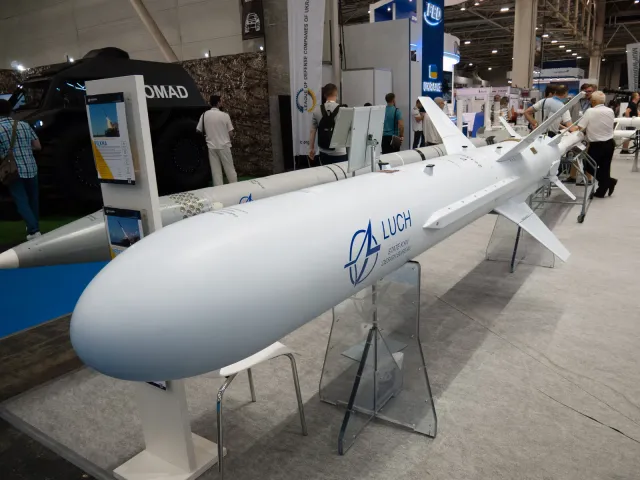
Missile
R-360 NeptuneFrequently asked questions
Why is Ukraine exporting weapons now? +
Domestic defense production capacity has grown far faster than battlefield demand, so manufacturers can now sell to allied nations while returning 20% of export value to Ukraine's state budget.
Which countries can buy? +
The framework lists 27 vetted partner nations, including at least 15 NATO members, with vetting built around NATO/EU alignment.
What systems are available? +
Loitering drones like the Bober-class, anti-ship missiles like Neptune, and other domestically built systems, at a minimum order value of $335,000.
How is this different from a normal arms deal? +
It's a streamlined 30-day manufacturer-to-partner approval process instead of the multi-month, government-to-government negotiations typical of traditional arms contracts.
More news


