Shahed-136 vs Switchblade 600 vs Lancet-3: Range & Role
Iran's Shahed-136 is built for 2,500 km strategic strikes, while the US Switchblade 600 and Russian Lancet-3 are short-range 40 km tactical weapons.

Sgt. Cody Nelson, U.S. Army, via Wikimedia Commons, Public Domain (U.S. federal government work)
Shahed-136, Switchblade 600, and Lancet-3 get compared constantly online, and the comparison is mostly wrong on its face. These are not three versions of the same weapon. Shahed-136 is a long-range strategic strike weapon, a one-way attack drone built to fly 2,500 km and hit fixed infrastructure targets far from the front line. Switchblade 600 and Lancet-3 are short-range tactical loitering munitions, built to fly 40 km at most and hit a moving vehicle or troop position that a drone operator can already see. The gap between them is not a matter of one being “better.” It is a matter of two different categories that happen to share a marketing label, and the size of that gap is itself the most useful thing this comparison shows.
Why does Shahed-136 have a 2,500 km range while the others top out at 40 km?
Range is a function of where the weapon is launched from, not just how far it can technically fly. Shahed-136 is designed to be launched from well behind a front line, sometimes from a different country’s territory entirely, against fixed targets like power infrastructure, storage sites, or industrial facilities. A weapon meant to do that needs enough range to cross a large amount of contested or unreachable airspace before it ever nears its target. Iran’s stated figures put that range at 2,500 km, a number that reflects the strategic mission, not a technical ceiling somebody decided to be impressive.
Switchblade 600 and Lancet-3 are built for the opposite problem. Both are tactical, front-line systems, launched close to the point of contact, often by a small unit or a battery that can already see or has a drone feed on the target it wants to hit. A 40 km range is not a limitation for that mission, it is roughly the outer edge of what a front-line unit needs to reach with a munition it is carrying or launching from a nearby position. Building either system for 2,500 km range would add weight, cost, and flight time for a capability the tactical mission never calls for.
Why is Shahed-136’s warhead ten times larger than Switchblade 600’s?
Warhead size follows target type. Shahed-136’s 40 kg warhead is scaled to damage fixed structures, buildings, parked equipment, infrastructure that does not move and often has some hardening. Hitting a stationary target well enough to put it out of action generally takes more blast mass than hitting a moving vehicle with precision.
Switchblade 600 and Lancet-3 take the opposite approach. Both carry warheads in the 3 to 4 kg range, small compared to Shahed-136, but both are designed around precision terminal guidance, a camera-guided approach that lets the operator select an aim point on a vehicle rather than simply pointing at a general area. A small, well-placed charge against the top armor or engine deck of a vehicle can disable it in a way that a much larger but less precisely aimed warhead might not improve on. The tradeoff is deliberate: strategic strike weapons buy destructive mass, tactical anti-armor weapons buy precision, and neither approach is simply “more” or “less” capable than the other, they are solving different problems.
What is Switchblade 300, and why include a fourth, smaller system?
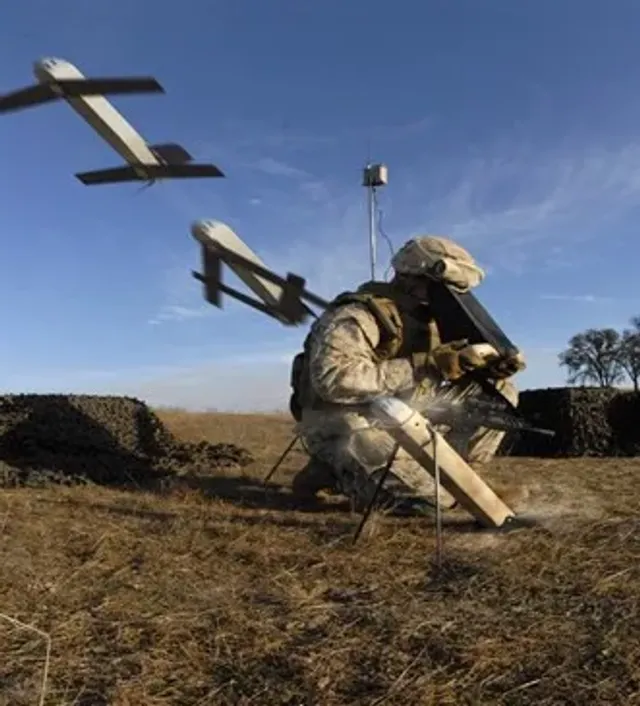
Switchblade 300 is worth including precisely because it breaks the comparison into three tiers instead of two. It is a man-portable loitering munition built for squad-level use, carried in a backpack and launched by a single soldier against personnel and light vehicles at short range. Its figures, a 10 km range and a 0.45 kg warhead, sit well below even Switchblade 600’s tactical numbers.
Putting all four systems in one table on purpose mixes weight classes that have almost nothing in common operationally. That is the point. “Loitering munition” has become an umbrella term covering everything from a backpack-carried anti-personnel drone weighing a few kilograms to a strategic strike weapon that, at 200-plus kilograms all-up, functions more like a slow cruise missile than anything a single soldier could carry. Reading this table as an apples-to-apples ranking misses what the numbers are actually showing: a single label now spans roughly three orders of magnitude in scale.
| System | Country | Max range | Warhead |
|---|---|---|---|
| Shahed-136 | Iran | 2,500 km | 40 kg |
| Switchblade 600 | United States | 40 km | 4 kg |
| Lancet-3 | Russia | 40 km | 3 kg |
| Switchblade 300 | United States | 10 km | 0.45 kg |
The 62-fold gap between Shahed-136 and the other three isn't a scaling error, it's three genuinely different weapon categories sharing one marketing label, not points on a single spectrum.
The chart is not a design flaw, it is the finding. Shahed-136 dwarfing three tactical systems on a linear scale is exactly what a strategic strike weapon next to battlefield munitions should look like. If the bars all looked similar, that would be the surprising result worth investigating.
What does the strategic-versus-tactical split actually mean for how these weapons get used?
Shahed-136 is fired in numbers from fixed or semi-fixed launch positions well removed from the fighting, aimed at targets that do not move and are chosen well in advance, typically infrastructure. It does not require a nearby operator watching a video feed to pick a final aim point, once launched, its flight profile and target are largely set. That makes it a weapon of attrition against fixed assets and, per manufacturer and state claims, a low-cost way to saturate air defenses through sheer volume, claims that deserve scrutiny rather than blanket acceptance, since neither cost nor effectiveness figures come from independent audits.
Switchblade 600 and Lancet-3 are used close to where the fighting already is, against targets an operator is actively tracking, usually vehicles or equipment spotted by reconnaissance drones. Both rely on a human in the loop for final targeting, which is precisely why their warheads can be smaller: precision substitutes for mass. Switchblade 300 pushes that same logic down to the level of a single infantry squad defending or clearing a small piece of ground. None of the three tactical or strategic roles is a lesser or greater achievement than the others, they are different tools built for different points on the battlefield, and conflating them because they share a “loitering munition” label obscures more than it explains.
Ready to see the rest of the spec picture?
Numbers in isolation only go so far. If you want to place Shahed-136, Switchblade 600, Lancet-3, and Switchblade 300 against the wider loitering munition and UAV field, run a side-by-side in the comparison tool, browse the full UAV and loitering munition category, or use the system advisor to filter by range, warhead class, or role. For more data-first breakdowns like this one, the articles archive has the rest of the series.
Systems in this comparison
Every system covered above, with its photo and, where available, a video. Tap a card to open the full spec sheet.
Compare these side by side →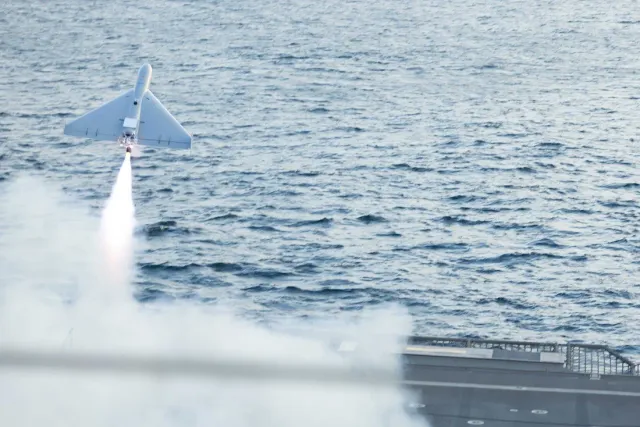
UAV / drone
Shahed-136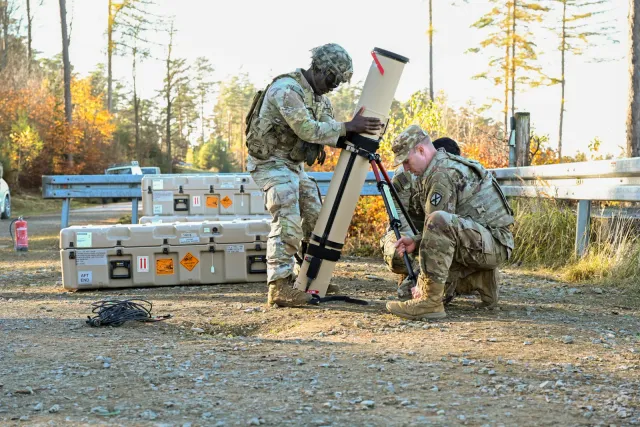
UAV / drone
Switchblade 600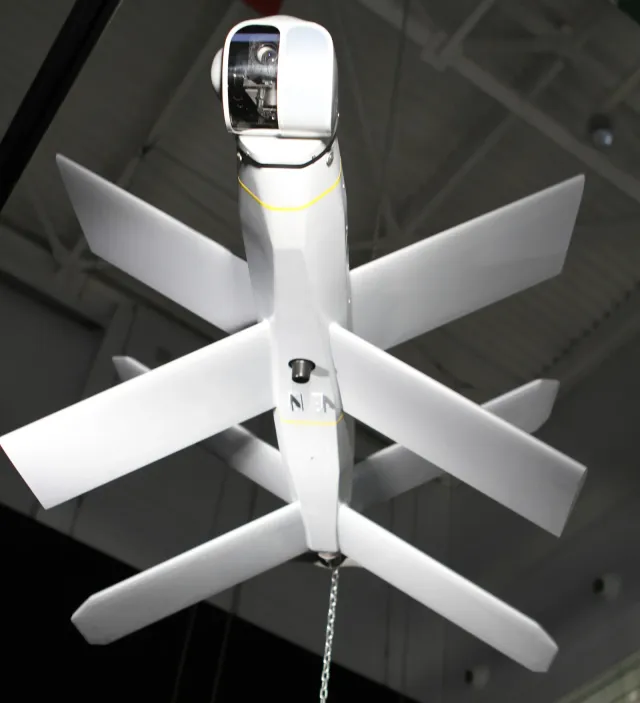
UAV / drone
Switchblade 300Frequently asked questions
Are the Shahed-136 and the Switchblade 600 direct competitors? +
No, and treating them as rivals misreads both. Shahed-136 is a long-range strategic strike weapon meant to hit fixed infrastructure from hundreds of kilometers behind the front. Switchblade 600 is a short-range tactical loitering munition meant to be launched near the battlefield against a moving vehicle. They share a marketing label, one-way attack or loitering munition, but they answer different targeting problems entirely.
Why does Shahed-136 carry a bigger warhead than Switchblade 600 or Lancet-3? +
Warhead size follows mission, not technology level. Shahed-136 is meant to damage fixed structures, power infrastructure, buildings, parked equipment, targets that need blast mass to put out of action. Switchblade 600 and Lancet-3 are aimed at armored vehicles at close range with precision optics doing the work a bigger warhead would otherwise have to do. A smaller, better-aimed charge against a vehicle's top armor can achieve what a much larger warhead achieves against a building.
Why is the range gap between these systems so large, 2,500 km versus 40 km? +
Because they are launched from different distances from the fight by design. Shahed-136 is fired from well behind the front line, sometimes from another country's territory, so it needs range to reach anything at all. Switchblade 600 and Lancet-3 are launched close to or on the front line, often within visual or drone-relay range of the target, so a 40 km envelope already covers their entire operating picture.
What is Switchblade 300 and how does it fit in? +
Switchblade 300 is a smaller, man-portable loitering munition built for squad-level use, roughly a 10 km range and a 0.45 kg warhead aimed at personnel and light vehicles rather than armor. It sits a full size class below Switchblade 600, which itself sits far below Shahed-136. The three-tier spread shows how wide the loitering munition category has become.
Do these systems cost roughly the same per unit? +
No, and cost tracks the same design logic as range and warhead. Publicly reported figures (which are manufacturer or program estimates, not verified transaction prices) put Shahed-136 in the tens of thousands of dollars per unit, reflecting a simple airframe built for mass production and one-way flight. Switchblade 600 and Lancet-3, with terminal guidance optics and precision strike electronics, are generally reported as costing more per unit despite flying a fraction of the distance. Switchblade 300, the smallest system, is reported as the cheapest of the four. Exact figures vary by source and contract, so treat any single number as a claim, not a fixed price.
Related reading


