MRAP Buyer's Guide: Bushmaster vs Hawkei vs M-ATV
Australia's Hawkei is the lightest MRAP-class vehicle in our database at 8.1 tonnes, roughly half the weight of the heavier Bushmaster and M-ATV.

Via Wikipedia, Bushmaster Protected Mobility Vehicle (shown for identification)
There is no single best MRAP in this comparison, only a set of weight-driven tradeoffs a buyer has to weigh against their own mission. Across the four protected mobility vehicles in our database, combat weight ranges from the Hawkei’s 8,100 kg up to the Oshkosh M-ATV’s 14,742 kg, and that near two-to-one spread isn’t noise. It’s the clearest single variable separating these designs: how much armor and hull mass a vehicle carries against how mobile and deployable it stays. Buy for deployability and off-road speed, and the Hawkei’s numbers look compelling. Buy for maximum protection margin against a heavier IED threat, and the extra mass on the Bushmaster or M-ATV is doing real work. Buy for a proven, decades-old design still getting upgrades in the field, and the Casspir earns its spot on the list for reasons that have nothing to do with being the newest option.
Key takeaways:
- Combat weight spans 8,100 kg (Hawkei) to 14,742 kg (Oshkosh M-ATV), a near two-to-one range across the four vehicles compared.
- The Bushmaster and M-ATV carry roughly 6,400-6,600 kg more mass than the Hawkei, most of it armor and structural reinforcement.
- A vehicle in the Hawkei’s 8-tonne class is a realistic C-130 Hercules load in a way the 14.5-tonne Bushmaster and 14.7-tonne M-ATV are not.
- The Casspir, at 12,500 kg, entered service in 1980 and is still fielded today, the oldest design in this comparison by four decades.
- The Bushmaster carries up to eight troops behind its monocoque V-hull, versus a two-person patrol crew for the Hawkei.
What do the numbers actually say?
| Vehicle | Country | Combat weight | Era |
|---|---|---|---|
| Bushmaster | Australia | 14,500 kg | Modern, in continuous production |
| Casspir | South Africa | 12,500 kg | Legacy design, 1980s origin, still fielded |
| Oshkosh M-ATV | United States | 14,742 kg | Modern, MRAP-All-Terrain-Vehicle generation |
| Hawkei | Australia | 8,100 kg | Modern, lightweight protected mobility |
No bar is highlighted as a winner here on purpose: the near 2x spread between Hawkei and the M-ATV trades armor mass for C-130 airlift and off-road speed, not vehicle quality.
None of the bars above are shaded to mark a winner. That’s deliberate. This isn’t a ranking where the tallest bar takes the trophy, it’s four different answers to the question of how much armor mass a designer decided to trade against mobility.
Why is the Hawkei so much lighter than the others?
The Hawkei was built from the outset as a lightweight protected mobility vehicle, replacing unprotected Land Rovers in reconnaissance and light patrol roles rather than standing in as a heavy troop carrier. At 8,100 kg it carries roughly 6,400 kg less mass than the Bushmaster and 6,642 kg less than the M-ATV. Some of that gap is smaller troop capacity and a lighter drivetrain, but a meaningful share of it is a scaled-down armor package relative to the two heavier vehicles. Thales, its manufacturer, markets the Hawkei’s protection as scalable, meaning armor modules can be added for higher-threat deployments, but the baseline weight figure reflects a design built around staying air-transportable and fast off-road first.
Is lighter actually better, or just different?
Different, and any buyer’s guide that tells you otherwise is selling something. A vehicle in the Hawkei’s weight class is a realistic load for a C-130 Hercules in ways the Bushmaster and M-ATV, at nearly double the mass, are not. That matters enormously if the mission is getting protected mobility into a forward airstrip fast, or moving a unit off-road at speed where a lighter chassis has an easier time on soft ground and unimproved trails. But there’s no way to shed 6,000-plus kilograms of vehicle mass without shedding something, and in this vehicle class, the something is very often armor thickness or hull reinforcement built to handle a larger blast charge. A lighter MRAP is not a free upgrade over a heavier one. It’s a different bet about what threat you expect to face and how much you value getting there quickly versus surviving the worst case once you arrive.
Does the Bushmaster or M-ATV’s extra weight buy real protection, or just bulk?
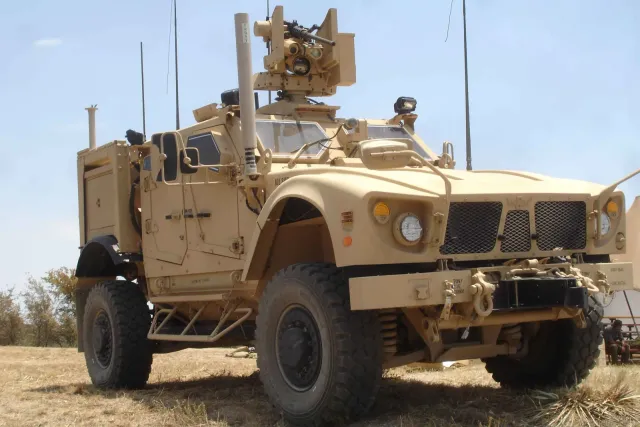
Some of it is genuinely armor and structural mass built to absorb larger blast loads, and some of it is troop capacity, drivetrain robustness, and mission equipment that has nothing to do with survivability. The Bushmaster carries up to eight troops behind its monocoque V-hull steel armor, a load the Hawkei, built for a two-person patrol crew, was never meant to carry. The M-ATV’s weight reflects both its blast protection and a four-person crew configuration with off-road suspension built for the MRAP-All-Terrain-Vehicle program’s demand for both protection and genuine cross-country mobility, a combination that came at a real weight cost when the U.S. Army fielded it as a Humvee replacement.
“It is a much lighter vehicle and it can go places the other MRAPs couldn’t go previously. Troops like the power and the size, where it can go and what it can do for them. The vehicles are already saving lives,” said David Hansen, Principal Deputy Program Manager for the Joint MRAP vehicle program, in March 2010.
That comment was made about the M-ATV relative to the first-generation MRAPs it replaced, the same weight-versus-mobility tradeoff this comparison keeps circling back to, just one generation earlier in the program’s history. None of these manufacturer or program figures are independently audited blast-test results, they’re disclosed specifications, and should be read as claims about design intent rather than proof of battlefield outcome. But within that caveat, the extra mass on both vehicles is doing something other than sitting there.
Why does a 1980s design like the Casspir still belong in this comparison?
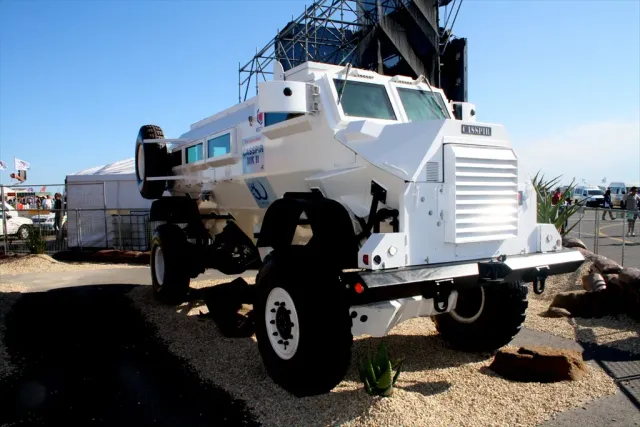
Because at 12,500 kg the Casspir sits in the middle of this weight range, not at some obsolete extreme, and it’s still fielded today according to available sourcing, decades after it entered service in 1980. The Casspir’s V-shaped monocoque hull, developed in South Africa to counter landmine warfare during the Border War, is the direct ancestor of the hull geometry every other vehicle on this list uses. That a basic 1980s engineering concept still underpins a category of vehicle being built new in 2026 says something about how right the original idea was. It also means a buyer evaluating legacy fleets or lower-budget acquisitions shouldn’t dismiss an older Casspir-derived design out of hand. The core physics of deflecting a blast away from the crew compartment hasn’t changed, even if the composite materials and electronics wrapped around that hull have moved on considerably.
So which one should a buyer actually choose?
That depends entirely on what problem is being solved, and this comparison won’t pretend otherwise. A unit that needs protected mobility off an airstrip fast, or that expects lower-yield threats where scalable armor is enough, has good reason to look hard at the Hawkei’s weight class. A unit expecting sustained exposure to larger IEDs, or that needs to move eight troops at once behind steel V-hull armor, has good reason to accept the Bushmaster’s extra mass as the cost of doing business. A program replacing aging Humvees with something that keeps genuine off-road mobility while adding MRAP-level protection has reason to look at what the M-ATV’s weight was actually spent on. And a buyer working with legacy fleets or tighter budgets has reason not to write off a Casspir-derived design just because the base concept is over four decades old. There’s no overall winner in this list, only a weight number that tells you what tradeoff you’re buying into.
Run your own comparison
Weigh these four platforms directly, spec against spec, in the compare tool. For the wider field of MRAPs and protected mobility vehicles filed under our infantry combat vehicle category, browse the IFV type page. If you’re trying to match a design’s tradeoffs against your own mission priorities rather than eyeballing a weight column, run it through the Advisor. More buyer’s guides and head-to-head breakdowns like this one live on the WeaponSpecs articles page.
Sources
Systems in this comparison
Every system covered above, with its photo and, where available, a video. Tap a card to open the full spec sheet.
Compare these side by side →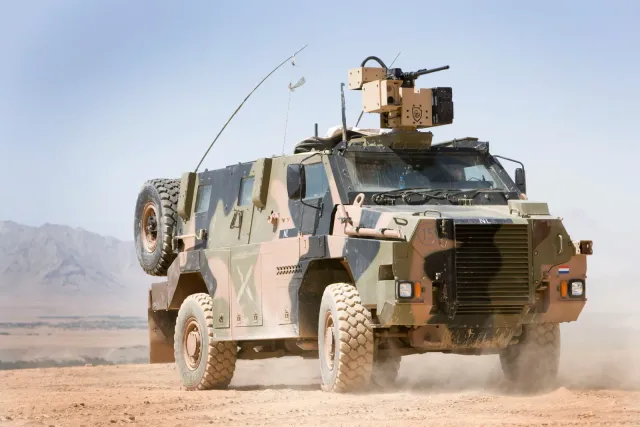
IFV / APC
Bushmaster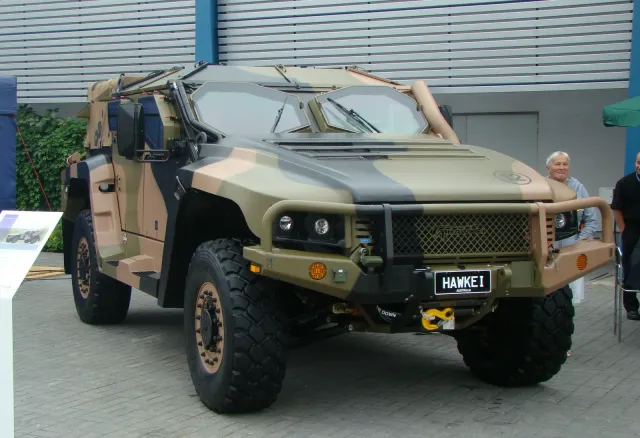
Frequently asked questions
Which MRAP is the lightest, and does that make it the best choice? +
The Hawkei is the lightest at 8,100 kg, roughly half the weight of the Bushmaster (14,500 kg) and the Oshkosh M-ATV (14,742 kg). Lightest doesn't mean best, it means a different set of tradeoffs. A buyer prioritizing air-transportability and off-road speed gets real value from that weight. A buyer prioritizing maximum blast protection against large IEDs is giving something up to get it.
Why does weight matter so much in the MRAP class? +
Weight in this class is mostly a proxy for armor and hull mass. A V-hull that deflects and absorbs a mine or IED blast needs steel or composite mass to do it, and that mass has to go somewhere on the vehicle. More protection margin against larger charges generally means more weight, and more weight means a vehicle that's harder to move by air, slower off-road, and heavier on fuel and drivetrain wear.
Is the Hawkei's lighter weight actually a mobility advantage? +
Yes, in the ways that matter operationally. A vehicle in the 8-tonne class is a realistic C-130 Hercules load in ways a 14.5-tonne Bushmaster or 14.7-tonne M-ATV are not, which changes how quickly a unit can get protected mobility into a forward airstrip. Lighter also generally means better power-to-weight off-road, less strain on bridges and unimproved roads, and easier ground transport logistics. None of that is in dispute. It's the other side of the ledger, protection margin, that buyers need to weigh against it.
Does a heavier MRAP always mean better protection? +
Not automatically, hull geometry and armor material matter as much as raw mass, but within a given design generation, more weight usually correlates with a bigger protection envelope against larger blast threats. The Bushmaster and M-ATV carry roughly 6,400-6,600 kg more mass than the Hawkei, and a meaningful share of that difference is armor and structural reinforcement rather than payload or crew space. Manufacturer protection claims for any of these vehicles should still be read as claims. None of the publicly available figures in this comparison amount to independently audited blast-test results.
Why is the 1980s-era Casspir still on this list next to modern designs? +
Because the core concept it pioneered, a V-shaped monocoque hull that deflects blast energy away from the crew compartment, is still the basic engineering principle every vehicle in this comparison relies on. The Casspir entered service in 1980 at 12,500 kg and is still fielded today, per available sourcing, after decades of incremental upgrades. That's not nostalgia, it's a working demonstration that the fundamental MRAP hull shape has held up far longer than most military vehicle designs manage before being replaced outright.
Related reading


